This seems pertinent:
This seems pertinent:
Does the existence of 8 billion working brains mean there are 8 billion different real players, or is there only one player, and this one player designed the human matrix to look like there are 8 billion decision makers?
Does the human face represent a real individual with free will and ability to choose, or what’s happening behind the face, turning the human face into a hyper-realistic mask covered and painted by skin and hair with the ability to show emotion and feeling ?
What if Even the result of your interaction or search with AI and a computer or Internet is also programmed?this deep level of programming and attention to even small details!Nobody can believe their interaction with AI or a computer or Internet itself can be something programmed. programming inside a program to deepen the illusion of reality. If a reality becomes programmed, then every interaction in that system is programmed, no matter how complex and realistic it could function,such as the interaction of a human with AI. A programmed brain is using a programmed AI with predetermined results, but this interaction is so realistic and complex that consciousness can’t understand it.
The deeper you go down the rabbit hole, the more you encounter Consciousness versus the programmed brain, with each person experiencing different levels of involvement. We experience the human matrix only as consciousness, either enjoying a coffee, or having a headache, or falling in love with somebody; it’s all experienced only as consciousness, which means we only understand the matrix and not really the doer of any action.
The illusion in the matrix is to bring the consciousness to this conclusion, that somebody is doing it. It’s like a programmed show with an illusory sense of control made for consciousness, which is nobody; consciousness is not somebody. The matrix is doing everything to make this feeling that someone is doing any action, and then any action can be claimed. That’s how the universe is playing with its own consciousness, by making the illusion of choice and free will as thoughts.
The whole human ability for conversation and make words and sentences are designed in this matrix to deceive the consciousness to believe , something other than what is happening, no matter how good you talk, and how much of the truth you use in your conversation, the reality doesn’t need any explanation as words to be understood, words are actually hiding the truth. No matter how close you talk about the truth.
Saying everything is consciousness does not mean anything, the world of religions and mystical paths are all play of words, and words and sentences are the main obstacles in your way to be conscious as consciousness, so no matter how they want to close you to the truth, still using words to occupy the brain, and cover the existing consciousness.
This paper presents an original theory on the nature of consciousness and free will, proposing that human life operates within a predetermined matrix where the illusion of free will is created through the interaction of consciousness with the nervous system, particularly through cerebrospinal fluid. The work explores physiological mechanisms behind this process and their implications for understanding religious practices, subjective experiences, and the fundamental nature of reality:
Research link:
I think there’s something in this, though I am unsure of the complete validity of the proposed mechanism. Some counterpart theories have a different framework, for example: We are Made of Mushrooms - Eileen McKusick
This is somewhat connected to McKenna’s ‘Stoned Ape’ hypothesis that I mentioned in another thread.
Then there is some work around DMT.
The thing with those experiences is they are consistent and universal in the themes, underlying ones being independent of culture, age, background, etc. What’s interesting is such studies take us outside the default mode thinking framework, outside of the barriers imposed by language, and outside of ego and cultural conditioning. If we are to refine essential truths, arguably that is the zone that bears the greatest fruit.
What do we get when we ask: what are the most common perception and realisations that arise from use of perception-altering aids?
And: what are some of the common themes in spiritual and scientific discovery?
In such states we grasp where consciousness is and how it arises. The reports are uncannily similar in this area.
One distinction that helps me here is between recurring phenomenology and a universal metaphysical conclusion.
DMT reports often converge on motifs such as ego dissolution, unity, timelessness, entities and a sense of hyperreality. That convergence is important, but “recurring” is not yet the same as “independent of culture, age and background.” Expectations, vocabulary, set and setting, selection effects and the way reports are coded can all shape what appears universal.
Speaking personally, psychedelic experiences have made universal consciousness feel like a serious possibility to me. But that is a philosophical change in what I consider plausible, not public experimental proof of what consciousness is or where it arises.
A useful research programme would keep three layers separate: the phenomenology itself; the neural or cognitive mechanisms enabling it; and the metaphysical interpretation. Prospective cross-cultural studies with preregistered categories could then ask which features really replicate, including among participants who have not already absorbed psychedelic or mystical vocabularies. The convergence can motivate the hypothesis without settling it.
The main question is whether the human body represents somebody with the ability to become conscious by itself, or the human body is a high-performance machine which is hyperrealistically designed to represent someone and receives its consciousness from somewhere other than its own brain and the body to operate?
I’d be curious how one might distinguish between these two alternative views. Can you think of any type of evidence that would point specifically one way or the other?
You may find this of interest: Turning the Psychedelic Experience into a Math Problem
Not planning on taking DMT anytime soon, but I am reading Whitehead, which will have to do!
Whitehead criticizes Hume (and others) on “perception” and to me that critique offers a useful way to understand the impact of psychedelics. For Hume, perception is sense impression pure and simple. Hume showed that causal relationships cannot be directly perceived from such impressions, leading to a skeptical position overall. Whitehead agrees with that analysis, under the assumption that “perception” equates to raw sense impression. That assumption, however, Whitehead very much does not agree with! For Whitehead, “perception” is the union of raw sense data with what he calls “causal efficacy”. Causal efficacy is grounded in memory and in cognitive models of how structure emerges in the field of space-time. Blotches of green on the horizon are not perception. Grasping the presence of “trees”, including their relationships to both seeds and forests, is more that what Whitehead understands by “perception”. I take all that in neo-Kantian directions by noting that different cultures have different repertoires within their possibility spaces of what “objects” might thus be perceived. (Homer’s wine-dark seas, for example, were a function of ancient Greece having no notion of “blue”.)
My layman’s grasp of brain-mind relationships suggests that cultures get entangled in human neurology through education, maturation, and frequent social interactions. Our ability to see “trees” or “blue” or anything is a gift of long years of socialization. But yes, we carry the impact of that socialization in our neurons. So applying chemical disruptors to neural pathways is likely to shuffle the cultural deck, so to speak. Trance-dancing, long fasts in caves, extreme physical challenges, and other sorts of stock shamanism can lead to similar effects. Disable standard memory and other cognitive functions, and the doors of perception will swing differently!
What interests me is how raw DMT sense impressions get turned into “machine elves” and other stock images frequently related by research-oriented psychonaughts. I’ve gotten rather good for example at being aware of my own dream processes, even while I am asleep and in the act of dreaming, and it’s pretty clear to me the “objects” I see in dreams or the “people” I met there are not objects at all! Rather, there is a bit of sense impression, then some lag time, and then a linguistic construct gets associated with the raw sense. Chaining such constructs leads to ludicrous stream-of-consciousness narrative lines, which I can appreciate as ludicrous, even while dreaming them! (My suspension of disbelief in dream-worlds while dreaming them tends to fade in and out over the course of an evening …) Anyway, when someone claims to “see” some “object” under DMT or other exotic influence, to me that raises as many questions as it answers. In any case, I would not take such object narratives (drugged or sober) as reports about unfiltered reality, because whatever the underlying experience was, the narration of such experience is necessarily influenced by culture.
I find this interesting, Robert, but there seems to be a curious methodological paradox here. You are trying to understand what radically altered states of consciousness tell us about perception while simultaneously declining one of the few means by which the phenomenon can be investigated directly from the first-person perspective. Reading Whitehead may be considerably safer than DMT, but I am not sure it will entirely “have to do”. 
I don’t mean that taking DMT somehow confers privileged access to metaphysical truth. But consciousness presents an unusual problem because the phenomenon under investigation is experience itself. There would seem to be a limit to how completely one can understand a radically different mode of experience through third-person reports and conceptual analysis alone.
What also strikes me is that you seem already to have supplied the explanation: DMT disrupts normal neural/cultural processing, unusual sense impressions occur, and the mind subsequently turns them into machine elves, entities, etc. That may well be correct. But isn’t that precisely one of the hypotheses that ought to remain open to investigation rather than being assumed at the outset?
The cultural mediation point doesn’t resolve it for me either. Ordinary perception is also neurologically and culturally mediated. Likewise, dreams demonstrate that consciousness can manufacture extraordinarily convincing realities, but that establishes possibility, not equivalence: it doesn’t establish that DMT phenomenology is simply another species of dream production. And there is perhaps a small Whiteheadian irony here - if one is interested in concrete experience but substitutes an increasingly sophisticated conceptual account of that experience for encountering the experience itself, are we not drifting rather close to the fallacy of misplaced concreteness?
Examining consciousness entirely outside all altered states strikes me as a pointless endeavour, and essentially nothing more than a juggling of words, no different from playing around with the latest LLMs, whilst achieving zero deep insights.
In evaluating risk/reward propositions prior to performing human experimentation on oneself, it strikes me that second-hand accounts are far better than nothing! Just now I did a quick review of about 20 DMT articles from various sources (as reputable as available) and my first takeaway was for me, anyway, the potential risk outweighs the potential reward. On your analysis, I would however be forced to agree that the most authentic near-death research for example would involve literally almost dying, but I’m satisfied to let others engage in that type of personal research. Likewise, although DMT risk is less than intentionally flirting with death, it’s not negligible. Also, I tried to assess what revolutionary insights are emerging from such DMT research, and nothing all that earth-shattering has shown up yet. In the scientific papers, it all more or less confirms what I expressed more casually above. (As for seeing the world in fractals, I’m generally able to do that stone cold sober, so maybe that accounts for my lack of passion for adding plant medicine to the program!)
Would I ever take DMT under any circumstances? The AI session below - on pragmatic DMT outcomes - did suggest a couple of use cases under which I might favor trying DMT. One is stroke. The other is glaucoma. When physical health is going downhill under its own momentum, more aggressive pharmacological interventions seem more justified. To sum up - I’m glad research is looking into this. But as with most research (particle physics, archeological digs, forensic autopsy), I’ll be happy to let others do the “hands-on” and enjoy the summary write-ups after the fact!
=====
While N,N-Dimethyltryptamine (DMT) has been used for centuries in traditional Amazonian practices (like Ayahuasca), its modern medical and scientific applications have recently sparked tangible therapeutic and technological innovations. [1]
Rather than generating physical inventions like electronics, DMT research has forced the medical industry to engineer unique drug delivery mechanisms, novel mental healthcare pathways, and protective therapies for brain injury.
1. “Extended-State DMT” (DMTx) and Target-Controlled Infusion
Normally, inhaled or injected DMT results in a “businessman’s trip”—a chaotic, intense experience that peaks in 2 to 5 minutes and ends within 20 minutes. This brevity makes it incredibly difficult for neuroscientists to study brain activity or for therapists to do clinical work.
2. High-Efficiency Hyper-Accelerated Depression Therapy
Most classic psychedelic therapies (like those using psilocybin or LSD) require a patient to spend 6 to 8 hours under supervision in a clinic, which is highly expensive and difficult to scale across public healthcare systems.
3. Neuroprotective Devices & Stroke Recovery
Because DMT interfaces deeply with cellular defense mechanisms (specifically the Sigma-1 receptor), its chemical framework is being leveraged to protect the physical brain from acute trauma.
4. Advanced Brain Mapping Techniques
To observe exactly how the brain “constructs reality” under DMT, neuroscientists have been forced to pioneer new ways of processing functional magnetic resonance imaging (fMRI) and electroencephalogram (EEG) data. This research has uncovered how DMT collapses the brain’s rigid, everyday network boundaries and transitions it into a state of global functional connectivity—effectively giving researchers a blueprint of how the brain navigates waking dreams, imagination, and heightened neuroplastic states. [9, 14, 15, 16]
AI responses may include mistakes.
[1] https://psychedelics.berkeley.edu/substance/dmt/
[2] https://www.youtube.com/watch?v=Iy1NzHGITuM
[3] https://elifesciences.org/articles/59784
[4] https://www.frontiersin.org/journals/pharmacology/articles/10.3389/fphar.2016.00211/full
[5] https://pubmed.ncbi.nlm.nih.gov/27471468/
[6] https://pmc.ncbi.nlm.nih.gov/articles/PMC10851633/
[10] https://www.theguardian.com/science/2026/feb/16/psychedelic-drug-dmt-treat-depression-trial-shows
[11] https://www.sciencedaily.com/releases/2025/10/251006051129.htm
[12] https://finance.yahoo.com/news/pharmadrug-advances-dmt-analogue-program-113000537.html
[14] https://www.imperial.ac.uk/news/243893/advanced-brain-imaging-study-hints-dmt/
[15] https://www.sciencedaily.com/releases/2023/03/230320150723.htm
[16] https://www.imperial.ac.uk/news/193993/ayahuasca-compound-changes-brainwaves-vivid-waking-dream/
If not soon, then when??
When there is more to gain and less to lose.
To me, it is a bit like someone who watches movies on mute. You try to convey the impact of sound, and music, and they respond by saying they understand the principles of it through images and words.
Knowledge, for me, is not so much a process of discovery as remembering. We refined our deep insights of the world through language and culture, in the manner of a microscopic lens that, with each magnification, loses sight of the larger whole.
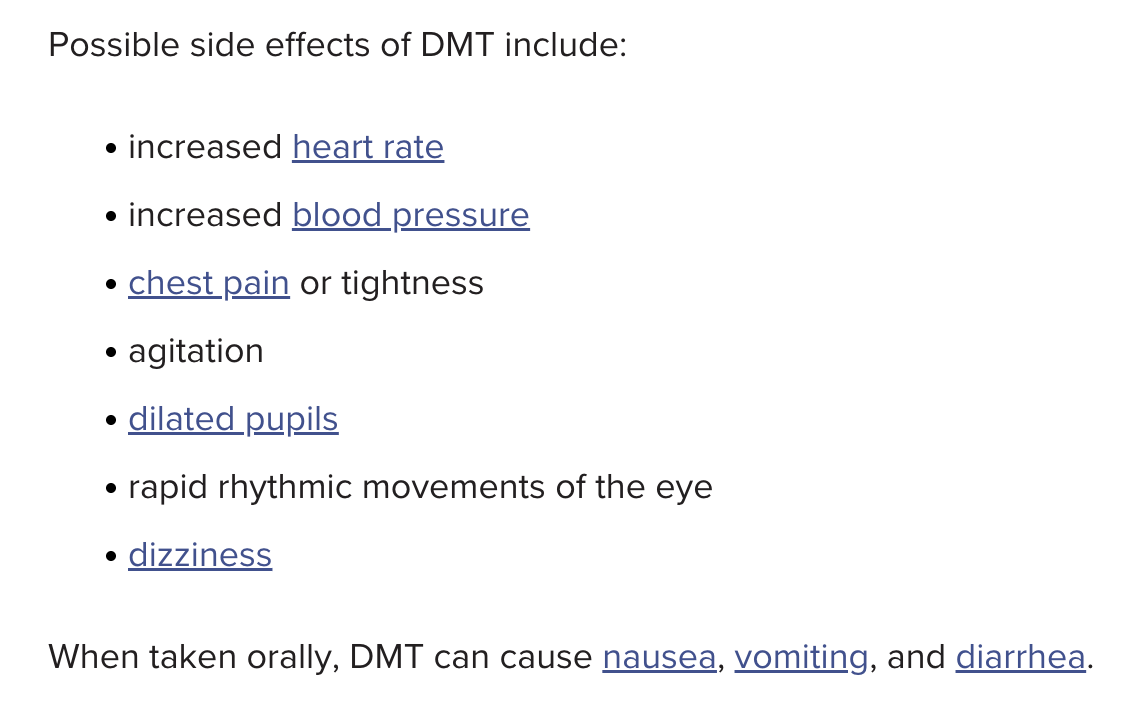
There are thousands of direct life experiences available. Why sign up for potential side effects like these?
One can also become deaf by hearing music.
What direct life experiences don’t have “potential side effects”? Kayaking? driving?
Given that a lot of those who’ve tried DMT rate it as among their most significant life experiences, these side effects seem pretty mild! But to each his own.
Given that I take medication specifically to lower blood pressure and mitigate potential cardiac risk, hard pass! If younger people want to become psychonaughts, go for it! On the “life changing” experience point, I’d love to see more evidence about what sorts of specific life changes are occurring and what the social impact of such life changes might be.
From this study, note that I would be specifically excluded from the study population due to prior medical diagnosis. Also, on the life changing impact front, it looks like “oceanic boundlessness” is the most frequently reported outcome. How life-changing that feeling would be likely depends on the extent of prior experience with such sensations. I suppose a hard-core atheist/materialist would need some serious worldview refactoring.
Human Ego (Biological AI) uses words and language to interface with Consciousness. To understand this extra operating system, recognize that the stream of mental conversation is not generated by Consciousness itself (the real self). Exactly as an AI system produces search results or generated text, the human brain creates a local agent called Ego to help operate the body. Like any computer program, this agent can produce unrelated, repetitive, or outdated output in the form of inner voice.
Consciousness can exist without these local agents. Although the Ego is commonly presented as essential and valuable, it often functions as interference rather than pure signal. Reality continues to operate according to its own order, independent of any single local agent. From a broader perspective, the reality that is common to all humans functions according to a different system than the one narrated by the local brain or Ego through inner talk. In other words, these inner conversations—the so-called Ego—are frequently noise relative to that deeper Reality: a layer of information that is widely assumed to be necessary for living, yet is not required for Consciousness or for Reality itself to function.
Yes, that makes sense to me.
What would you say defines and underpins consciousness?