I invited Gemini to propose solutions. Looks like it really wants Promise Protocol!
1 Like
These intervention points make sense, but I think there’s something missing here - how do we make the interventions palatable to those whose participation they require?
A therapist or any perceptive person might know where to intervene but this doesn’t cover how. For example, a person might experience a whole world of difficulty revolving around a limiting belief they hold that doesn’t serve them, and while this is obvious to outsiders, the person isn’t ready to integrate this. The effective interventionist has to not only have the insight to know what the problem is, but also has to know how to guide the target of the intervention to the experience that frees them from their limiting beliefs.
So, going back to the bigger picture, many can agree that our information ecosystem is polluted beyond repair. This is a deeper understanding than the typical view that this or that crisis is the problem (e.g. climate change, racial injustice, economic inequality, etc). But if we go deeper we still need to ask the question of how; because information flows aren’t the way they are by chance - they serve a purpose, just as the limiting beliefs of a patient seeking help from a therapist serve a purpose that they’re likely at odds with. The question then becomes: how to we simultaneously honor the purpose that the broken information ecology has served while also introducing a path to experiencing something that will help us leave it for something better?
Agreed. In gearing up for future head-butting about Claude Shannon and semantics, I familiarized myself today with the analysis of Shannon’s collaborator Warren Weaver. The overall Shannon-Weaver model identifies three levels of communication: technical, semantic, and effective.
https://arxiv.org/pdf/2212.01485
Shannon, of course, focused largely on the technical, specifically excluding semantics from his signal/noise formulas. However. clearly he and and Weaver were aware of the necessity of semantics. What grabbed me about this story though is the contrast of semantics with the additional dimension of effectiveness. This got me thinking right away about Harari’s distinction between “information as truth” vs “information as power”. Extracting meaning from bits to get at underlying signal is basically an information as truth move. But encoding bits in a particular way to achieve a particular impact on the interpretant is an information as power move.
We could fire up all our outrage at “ideology” and “corporate media” at this point, but I’d also like to suggest that “information as power” may have prosocial and even therapeutic application as well. Indeed, that may well be what you are pointing to above. What sort of rhetoric has the power to catalyze tangible change? May be a topic worth exploring!
1 Like
Again I can’t help but think about Rauch’s book Constitution of Knowledge on this topic. It is an excellent source of how things came to be this way. (detailed beyond what one might casually assume), and what precedents we can reference to find our way to balance again.
OK, you talked me into it. I just ordered a copy.
Sounds good. I exchanged a couple brief emails with Rauch. I had put together a short diagram of key concepts and shared with him (attached). You can skim this as you’re reading if you like.
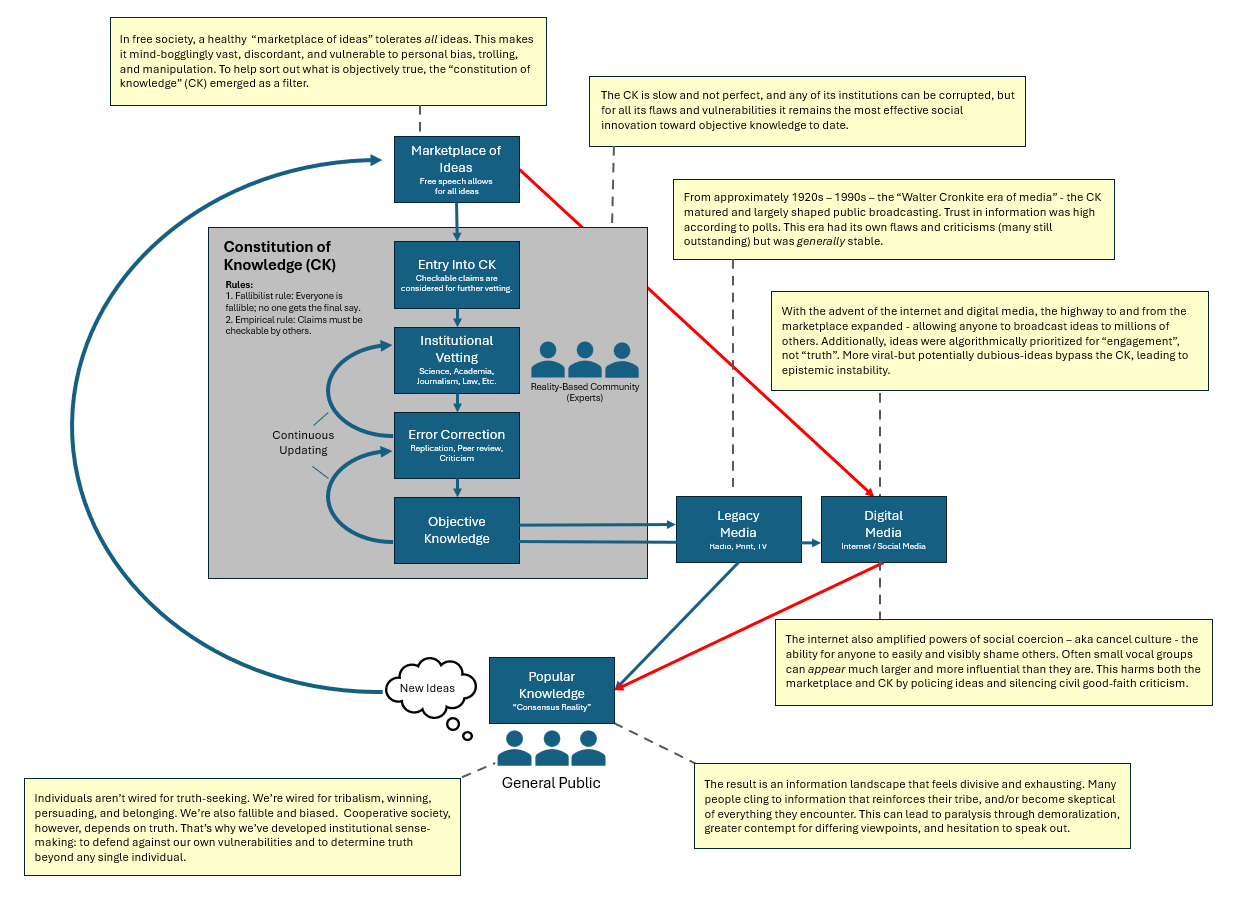
Happy to discuss and/or attempt to integrate insights from the book this project when you’re done. (I ran a couple book club zoom calls on this book - I can share what we all converged on in our conversations).
THX. Taking the diagram as a quick and dirty representation of book, I think my play will be to explore psychological and social systemic mechanisms influencing the phenomena presented here. How people are “wired” is precisely the topic the intrigues me the most.
Hi @Jesse, welcome to the forums.
Looking over your diagram (I’m not familiar with Rauch’s work), I see it addresses what I consider to be an important leverage point relevant to the meta-crisis, and yet it seems to ignore, rather than resolve, much of what makes this problem difficult.
One of the symptoms/undesirable effects of our present predicament is bad information ecology, bad epistemology, and in general, the low likelihood of truth claims being correctly adjudicated by any part of the system - including the institutions that are part of the Constitution of Knowledge in your diagram.
There’s been a lot of critique of knowledge-producing institutions over the last 75 years that doesn’t seem to have made it into this system. (If I’m missing something please let me know - perhaps there’s some seed knowledge that is used as a starting point?). For example, the critiques of Kuhns and others, the general observation that ‘science progresses one funeral at a time’, the fact that truth claims are more of a side effect rather than the purpose of these knowledge producing institutions, and so on.
The load bearing part of this CoK system that doesn’t seem to hold up, from what I see here, is this point: we have to work with the institutions we actually have, not the ones we wish we had.
Again, I’m basing these statements on your diagram alone and it’s likely to be a superficial analysis of the proposal. But it seems to me that put into practice, this type of system would often gaslight or explain away much of what is most relevant at any given time (as this is also likely to be contentious, charged, disputed, etc, for the very reasons that make institutions fallible). Case in point: how would a statement like “Covid was created in a lab” pass through this system? How would dissenters be treated? What would be the state on which it settles?
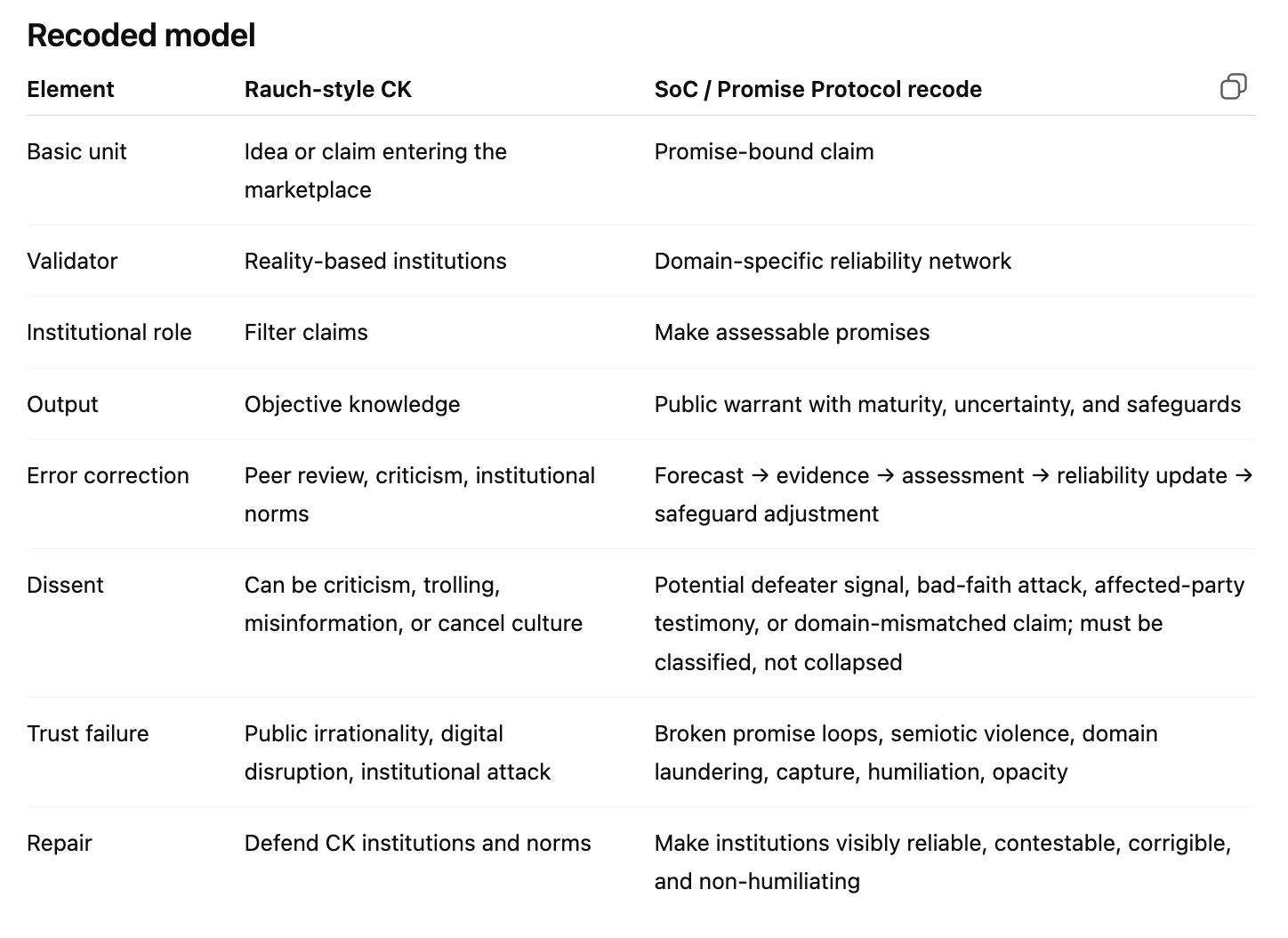
I’ve compared the CoK system as represented in your diagram with my own work, which addresses the same issues. Here’s a summary (links to the documents this draw from are included below).
How your work sees the epistemic crisis differently
Rauch’s diagram reads the internet as a route around the knowledge filter: digital media lets dubious ideas bypass institutional correction and go straight to popular belief.
Your media chapter would say: yes, but the deeper mechanism is accelerated interpretants. A sign circulates, a caption supplies the code, outrage forms, counter-frames appear, institutions react, and reaction outruns verification. The result is not merely misinformation but semiotic enclosure: publics inhabit different coded realities, each treating outside framing as manipulation.
Your institutional distrust section is also crucial. The old chain is:
Public distrust → ignorance/misinformation → expert correction → perceived condescension → deeper distrust
The alternative chain is:
Public distrust → signal of broken legitimacy, prior betrayal, opacity, or identity threat → humility, transparency, shared verification, local intermediaries → earned trust
And the key sentence is: trust is not a message; trust is a consequence of repeated signs that institutions are competent, honest, accountable, and non-humiliating.
That is the major departure from Rauch. The answer to epistemic disorder is not simply stronger defense of the knowledge institutions. It is making knowledge institutions keep epistemic promises repeatedly enough that their signs become trustworthy again.
The proposed recoding
I would recode Rauch this way:
Old code
Institutional vetting produces objective knowledge.
This makes institutional authority the central validator. It encourages the public to ask: “Was this claim accepted by the right institutions?”
New code
Public knowledge is a reliability-bearing promise system.
This makes warranted knowledge the product of kept epistemic promises. It encourages the public to ask: “What exactly is being promised, in what domain, under what evidence standard, with what uncertainty, by which assessors, with what correction path, and with what reliability history?”
More compactly
From trust the institutions that vet knowledge
to trust claims in proportion to the institution’s demonstrated promise-keeping in that domain.
A few posts higher, Gemini, asked to find solutions to global weaknesses and threats, spat this out under the rubric of improved information flows:
“By mandating open, interoperable identity and protocol standards (where users, not central algorithms, control their filtering lenses) and integrating cryptographic verification into media routing, the system introduces a powerful negative feedback loop against synthetic disinformation. This re-aligns hyper-scale networks with human cognitive limits, restoring a shared baseline of facts required for democratic governance.”
Promise Protocol? Family resemblance at least.
Sounds like it, but is Gemini’s memory turned on?
Probably. When it came up with the idea below for analysis, it’s pretty clear it’s been reading Pogany. It could have got that from me. Or it could have got that from the Internet.
“Hegemonic Lifecycle Entropy (The Transition to Multipolar Realism)”
I was not able to conveniently export my full list of session topics, but it’s all over the place, and 80-90% of it does not show up in the Gemini “SWOT Analysis of global civilization” I posted in the thread above. So even if Gemini is cribbing my sources, it’s got a relevancy filter on which sources it applied to this set of sessions. If Promise Protocol is inspiring it, there is a valid reason. Also, Gemini could have got similar ideas off the Internet from sources like Michel Bauwens or Audrey Tang. So it’s not like PP is absolutely innovative in what it addresses. But it’s a good, practical example of the sort of thing a lot of people are proposing and/or working on.
I agree with this point. The book is not so much a solution, but a detailed analysis on history and state of affairs.
Yes - please take the diagram very lightly - refer to Rauch’s book directly.
Thanks a lot for engaging here. Again I will just affirm that Rauch’s book is MOSTLY rich history and analysis of state of affairs, rather than a path forward. His implicit path forward is “Hope the CK recovers somehow”. Personally, I am not satisfied with that, and I am highly interested in talking about what to do about it. But that doesn’t take away from the lessons of the book IMO.
Can you point me to one resource that distills your vision on this topic?
Pardon my availability - I will be away for a few days.
I hope this clarifies that my diagram is no substitute for Rauch’s full book, and further, that I too don’t agree the CK is magically going to make a comeback without intervention.
1 Like
In all seriousness, I’ve got some former students prototyping an app based on @dvdjsph 's Promise Protocol. The point of PP is to clean up the information/trust ecosystem, at least on small to medium scales (Another Forum thread about PP below).
Although this current thread is about a book project, IMO, software is higher-leverage than books. My focus here on books is because they are lower overhead and I can manage more of the development processes personally. But teams working on platforms, apps, and automation are going to have more reach. Here’s a good point of entry to that solution space:
1 Like
I’m about halfway through Rauch’s book now, and one thing that is weighing on me is Rauch’s use of the phrase “reality-based community” with an focus on scientific empiricism. The implication, of course, is that “science” has a privileged view of “realty” whereas as other modes of human understanding are somehow less “real”.
To explore my gut vibes about all that, I decided to call a contrary witness to the stand: Martin Luther. (Any number of other spiritual or philosophical figures might likewise be cited on the notion of “reality” beyond the empirical scientific. The example of Luther just struck me has a good-as-any example to illustrate my key idea.) I doubt Luther ever responded to the phrase “reality-based community” directly, but through the magic of AI we might imagine what he would have said. See that session below.
Gemini:
Martin Luther would have understood the “reality-based community” through the lens of his Two Kingdoms doctrine. He viewed it as a sphere of divinely ordered temporal reality. While empirical, this community was governed by natural law rather than saving grace, designed by God to restrain evil and preserve order. [1, 2, 3, 4]
A more localized, historical perspective reveals exactly how he would have categorized these concepts:
- Discernable Reality (The Left-Hand Kingdom): Luther believed humans could use their natural reason, senses, and observation to discern worldly truths. The “reality-based” study of politics, economics, and nature is legitimate and necessary in earthly life, governed by civil authorities rather than the Bible.
- The Spiritual Realm (The Right-Hand Kingdom): Faith and salvation, however, transcend the reality-based community. The spiritual truths of the Gospel are not subject to empirical proof or human reason; they must be accepted through faith in the written Word of God.
- The Danger of “Creating Realities”: Luther fiercely opposed leaders who claimed to create their own realities, such as the radical spiritualists or the corruptions of the Papacy. For Luther, substituting human imagination or political ambition for observable reality or God’s word was the ultimate form of pride and falsehood.
For additional context on how Luther’s theology separated the limits of human reason from divine truth, you can read more about his Luther’s Two Kingdoms (governances) doctrine. [2, 6]
AI responses may include mistakes.
[1] https://dissentmagazine.org/article/symposium-e-j-dionne-jr/
[2] https://www.youtube.com/watch?v=HV78hav3VSU
[3] https://www.youtube.com/watch?v=vYKjDonDWxA
[4] https://inthesetimes.com/article/dreaming-up-new-politics
[5] https://journals.sagepub.com/doi/10.1177/0020964318802818