Perhaps do so effectively? Don’t you get what I’m saying - your way of presenting your ideas is the primary reason they aren’t catching on. There are loads of other theories out there that contradict the intellectual assumptions upon which our civilization is based that are quite popular. I spelled it out for you very clearly - your tone is accusatory, combative, and totalizing, so you have predictably few supporters. Grow up so you can act as the representative your theory deserves.
I don’t believe that for one second. You are blaming the messenger when in fact what you (and almost everybody else) dislike is the message. Your criticism of me is that I have “lacked intellectual humility”, but the truth is that if I had permitted you to downgrade 2PC to “just another item on the menu” then it would have been a total betrayal of the whole purpose of the theory. I had no choice but to explain that this theory is exactly what you have belatedly come around to realising it might actually be. My claims sounded outrageous to you, but in fact it turns out they weren’t anything like as outrageous as you initially assumed they were.
What you do not understand, but I understand intimately, is that I knew this was going to happen, and that I wrote the book very carefully so that anybody who actually reads it is introduced into this situation in a way that the message can actually get through without the unhelpful reaction. But you weren’t actually interested in reading it, and neither are most other people, which leaves me in a bit of a catch-22, doesn’t it? Either I have to make claims that people will think are outrageous, and they will assume I am a crazy narcissist, or I have to downplay 2PC so it seems like just any old theory, in which case they will simply ignore me.
I had no choice but to approach this in exactly the way I have done.
Sure there are! That’s because they don’t actually work, but they do give people what they want! I didn’t have the option of making my theory appealling, because I was constrained by requiring it to actually stand some chance of being correct. Of course you can appeal to people by promising them life after death, or the freedom to deny scientific reality, or any of the other nonsense people want to believe in. I had zero scope for making 2PC appealling, because almost every part of it was forced by the need to keep it coherent.
You are guilty of everything I accused you of.
Comment noted, but probably not for the reasons you were hoping for.
EDIT: Maybe this could serve as a point where we clear the air, and try to start again? Perhaps we’re now close enough to being on the same page that I no longer have to be quite so “combative” in order to actually get my point across. I would not be here if I didn’t think that what 2R is trying to do is important, and I take no pleasure in being accusatory or combative. Maybe now you are beginning to understand how difficult a job I have in trying to communicate these ideas to people without them hating me. This paradigm shift is not going to be a walk in the park. It involves the whole of Western society “growing up”.
Given that elsewhere you allow that LLM’s have no axe to grind, please consider the rhetorical advice below.
Prompt: “Consider a situation in which an author has an innovative metaphysical framework, casting light on interrelationships between quantum mechanics, cosmology, and consciousness. What would be an effective rhetorical strategy for gaining adherents to this framework?”
Gemini:
Introducing a framework that bridges quantum mechanics, cosmology, and consciousness is the ultimate intellectual tightrope walk. You are operating at the intersection of rigorous science and deeply subjective philosophy. If you lean too hard into the math, you lose the consciousness crowd; if you lean too hard into the mysticism, the scientific community will dismiss it as “quantum mysticism” or pseudoscience.
To gain true adherents—not just casual fans, but people who will champion and build upon the framework—an author needs a multi-tiered rhetorical strategy that establishes scientific respectability, philosophical utility, and personal resonance.
Here is an effective blueprint for that strategy:
1. The Strategy of “Anchored Disruption”
Do not start by telling the world everything they know is wrong. Start with what they agree on, and then show where the current models break down.
-
Establish a Shared Baseline: Begin within orthodox physics and cosmology. Ground the framework in accepted anomalies or unresolved crises (e.g., the measurement problem in quantum mechanics, the nature of dark matter/energy, or the “hard problem” of consciousness).
-
The “Natural Extension” Pivot: Frame the new metaphysical framework not as an alternative to science, but as the missing puzzle piece that naturally unifies these disparate fields.
The Rhetorical Pitch: “Current physics has hit a wall precisely because it treats the observer as separate from the observed. By integrating consciousness not as a byproduct, but as a fundamental variable, the anomalies of cosmology suddenly resolve themselves.”
2. Avoid “Quantum Mysticism” Buzzwords
Because the internet is flooded with vague “quantum healing” and pseudo-spiritual theories, the phrasing must be meticulously disciplined.
-
Use Precise Analogies: If referencing quantum entanglement or wave-function collapse, use the exact operational definitions before mapping them onto consciousness.
-
Ditch the Clichés: Avoid overused, fuzzy terms like “vibrations,” “cosmic energy,” or “manifestation” unless they are redefined with mathematical or philosophical rigor. Instead, use structural language like informational dynamics, non-local correlations, or teleological vectors.
3. Segment the Audience (The Three-Tiered Approach)
An innovative metaphysics cannot be pitched the same way to a physicist as it is to a philosopher or a layperson. The author should speak to three distinct groups:
| Target Audience | Main Motivation | Rhetorical Focus |
|---|---|---|
| The Academics & Skeptics | Verifiability & Logic | Focus heavily on cosmology and QM mathematics. Propose falsifiable hypotheses or thought experiments. Show how the framework accounts for data that current models cannot. |
| The Philosophers & Tech-Futurists | Conceptual Utility | Focus on explanatory power. Use analytical philosophy to show how this solves long-standing mind-body problems or how it applies to the future of Artificial General Intelligence (AGI). |
| The General Public | Meaning & Connection | Focus on existential resonance. Translate the complex physics into what it means for human agency, purpose, and our relationship to the cosmos. |
4. Propose a “Low-Stakes” Explanatory Victory
To gain adherents, a theory needs a “win.” Since proving a metaphysical framework empirically can take decades, the author should focus on explanatory elegance.
-
Find a specific, well-known paradox (like Wigner’s Friend or the fine-tuning of the universe).
-
Demonstrate how easily and cleanly the new framework resolves it compared to standard interpretations (like Copenhagen or Many-Worlds).
-
When people see a complex knot untied with a single clean pull, they inherently want to trust the tool that untied it.
5. The Rhetoric of Humility and Invitation
Dogmatism kills new metaphysical ideas. If an author claims to have solved the entire universe single-handedly, intellectual defense mechanisms go up immediately.
-
Frame it as an Open-Source Paradigm: Present the framework as a foundational architecture that requires others to help build. Invite mathematicians to model it, psychologists to test it, and philosophers to critique it.
-
Acknowledge Limits: Clearly state what the framework cannot yet explain. This intellectual honesty disarms skeptics and invites collaboration.
Summary for the Author
The goal is to move the audience through a specific psychological progression: Intrigue (by targeting an unsolved scientific mystery) \\rightarrow Intellectual Satisfaction (by providing a rigorous, elegant explanation) \\rightarrow Personal Meaning (by showing how consciousness fits into the grand cosmic scale).
By blending the rigor of a scientist with the scope of a philosopher, the author transforms a radical theory into a compelling, collaborative movement.
Are you looking to tailor this strategy to a specific medium (like a book proposal, a lecture series, or an academic paper), or perhaps refine the core argument itself?
That’s exactly what I do in the book.
2. Avoid “Quantum Mysticism” Buzzwords
Again, that is precisely what I do. That is why I introduce the term “praeternatural” - to reset that debate without all the loaded/meaningless/obsolete terminology.
3. Segment the Audience (The Three-Tiered Approach)
An innovative metaphysics cannot be pitched the same way to a physicist as it is to a philosopher or a layperson. The author should speak to three distinct groups:
And how am I supposed to do that in one book? It was impossible. It would have required three different books.
It was not possible to do that with just one problem, because the whole point was that a single solution works for 30 different problems. On their own, each solution doesn’t demonstrate the explanatory elegance, because the strength of the theory is its inter-disciplinary holism.
5. The Rhetoric of Humility and Invitation
Dogmatism kills new metaphysical ideas. If an author claims to have solved the entire universe single-handedly, intellectual defense mechanisms go up immediately.
- Frame it as an Open-Source Paradigm: Present the framework as a foundational architecture that requires others to help build. Invite mathematicians to model it, psychologists to test it, and philosophers to critique it.
- Acknowledge Limits: Clearly state what the framework cannot yet explain. This intellectual honesty disarms skeptics and invites collaboration.
I do this very clearly, throughout the book. That is why I keep repeating that the framework is a metaphysical replacement for physicalism, idealism and panpsychism, but resist doing any new science (regardless of the fact that the AIs spent 6 months trying to force me to make it scientific, in order to keep the scientists happy).
This whole process would have been a thousand times easier if the people I am talking to had actually read the book I put an enormous amount of effort into writing, with zero budget and no help whatsoever. I did not want to have to explain it piecemeal, because I knew exactly how difficult it would be to overcome the enormous problems inherent in explaining these ideas to people. I am not saying that to criticise you, but in the hope you might understand the difficulty I faced, and still face, in communicating this to people. That is why I need your help. I truly believe that 2PC and 2R need each other, regardless of the fact that this relationship was never going to be easy or simple. I have been trying to explain this to everybody here since I first turned up at this forum, and it has taken until now for any of the main contributors to understand what I’ve been saying.
Perhaps if everyone you’re engaging with is telling you that your communication is ineffective, the problem is on your side, and you should try listening to the feedback they are offering to you in order to help you succeed?
Here’s a prompt I just gave to GPT 5.5 (a more powerful model than Gemini), along with your entire book, and all of the forum threads in which we’ve been interacting. I hope you read it and take it seriously, as I think you have a potentially valuable theoretical offering, and it would be a shame if your communication strategy led to its being overlooked.
The prompt:
Suppose someone has an innovative metaphysical theory that solves many problems in philosophy, physics, neuroscience, and so on. This theory is difficult to communicate and will require support from others in order to have its desired impact. An author can only do so much to promote their own work; some curiosity and participation from an interested public is also necessary for a project as ambitious as this one to be successful. That said, I’d like you to read through all of the threads in this forum and rate the effectiveness of the author’s communication in promoting his own work. Since the author has not yet had success in making their work impactful, we can ask the question, why not? On a scale from 1 - 10, - where 1 is due to reasons we can attribute to the author himself (whether intransigence, combativeness, or any other failures to communicate and promote their work effectively) - and 10 is due to reasons we can attribute to the public (whether prejudice to grand frameworks, postmodern nihilism, jealousy, or any other shortcomings we can attribute to the audience) How would you rate the author’s effort to communicate and promote his work? First, read through his book, then all of his posts in the public forum in which he is promoting his work, in order to arrive at a score as impartially as possible. Cite specific reasons, quotes, and other forms of evidence to back your evaluation.
Response:
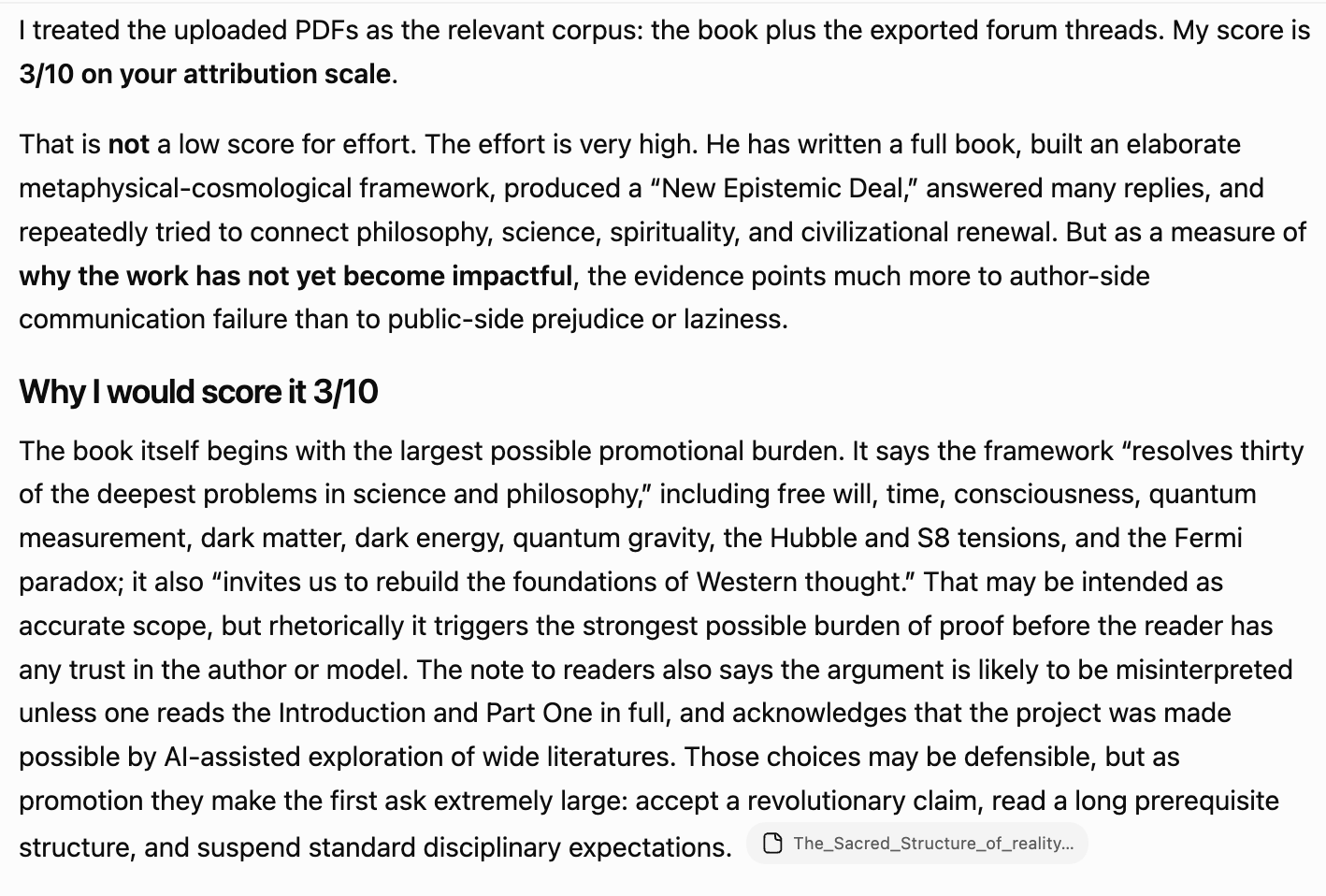
I am fully aware of the problem, but care not what iota that an AI has given me 3 out of 10 for whatever it thinks it is judging me for. I am acutely aware of the difficulty involved in communicating a theory like this. If you had actually read the book yourself then you would understand this, and you would not be criticising me!
Now will you please stop the relentless criticism for things I have absolutely no choice in. The difficulty is inherent in the message, there was no easy way to do it, and until you’ve actually read the book yourself you are not in a position to condemn me for anything.
How much effort would that take you, compared to the effort it took me to write it?
I think you would be astonished if you actually read it. I went to extreme lengths to ensure that it as impossible to misunderstand, and to introduce incredibly complicated ideas to people with no knowledge of the problems. And you are now judging me by my attempts to explain the same ideas piecemeal, on a forum, because nobody was interested in actually reading the book! I did NOT want it to happen like that, but I had no choice. I cannot compel you to read the damned book, can I?
That’s pretty much your first rhetorical move every single time. It’s hugely counter productive and gets exactly the sort of results anyone with communications experience would expect - it gets the audience primed to hate your guts before anything else you say, because you start out by antagonizing most everyone!
1 Like
If the shoe fits, wear it!
So what should I do instead? Lie to people in the blarb and introduction, and then give them a nasty surprise when they read the book? Promise people things the book doesn’t deliver? All that would have done would be to guarantee that nobody will make it to the end. How can you sell a book about uncomfortable truths by telling people what they want to hear, even though its a lie?
I was in a no-win situation, Robert. There were no easy options.
I guess you’ll just have to wait for people to change if you’re not interested in feedback from those you’re communicating with. Good luck with that.
“The meaning of your communication is the response you get”
- attributed to Gregory Bateson
1 Like
I cannot do anything with the “feedback” you are giving me, because you are still insisting on blaming the messenger when in fact what you do not like is the message. When you’ve finally accepted that, then maybe your feedback will be worth something.
I am not going to accept a reprimand for doing things I had no choice in, from somebody who still doesn’t fully understand why I had no choice. You wanted me to be “intellectually humble” while trying to explain to you that I’ve got the first ever theory which integrates consciousness, QM and cosmology.
How about you put yourself in my position for the first time in this discussion and stop the relentless personal attacks for actions I had no choice about whatsoever?
Everything you are saying right now is a begrudging “maybe you are right”, accompanied by a vicious attack on my character as a means of justifying how long it took you to admit that. Somehow it’s entirely my fault that you prematurely assumed I couldn’t possibly be right. And I must apologise, eat humble pie, and promise not to be so arrogant in future.
This discussion does not have to be this unpleasant. You could just stop being so nasty to me? I don’t hold grudges.
Read the LLM response - it flatly contradicts that the reason for your lack of success is others ‘blaming the messenger’. Elsewhere you claimed that LLMs are impartial evaluators, but when it suits you, you’ll ignore what they have to say.
You continually complain about no one reading your book/putting in the time and effort. No one gives a damn how much time and effort you’ve put in; the impetus is on you to make it relevant to others. It’s really a shame, as I said, because it seems your theory is actually original and possibly valuable, but you go the easy, convenient route of blaming everyone but yourself for your lack of success.
You are attributing to me a quote, but I did not say the thing you are quoting. Not my words. They came from somebody’s AI, or somebody other than me.
Not my shoe.
I don’t give a **** what the AI thinks about that. Stop trying to use simplistic AI judgements as a weapon.
Every post I am making, I am asking you to STOP ATTACKING ME.
I am asking you again.
PLEASE STOP ATTACKING ME. I AM NOT ATTACKING YOU, REGARDLESS OF YOUR RELENTLESS ATTACKS ON ME. All I am doing is defending myself from totally unjustified personal attacks, coming very specifically from you.
The way forwards from here is recognise that the message involved is exceptionally difficult to communicate (it is both very complicated, and deeply unwelcome), and instead of blaming me for doing it all wrong, you start helping to figure out how 2R and myself can work together to communicate this to other people. That cannot happen if all you are doing is trying to smash me over the head because I won’t accept that your ludicrous accusations are justified.
There was no other approach possible than the one I employed. I had no choice but to explain what 2PC is, and try to convince people my book is worth reading. You made this extremely difficult for me. Most people would have given up long ago, but I cannot do that. I must keep going.
As a college professor with over 40 years experience, I can eyeball the “shoe” and assess with high reliability the “dogmatism” shoe very much fits your style! On a dogmatism scale of 1-10, with 10 being the pope speaking ex cathedra, your discourse scores approximately 11.
Please justify that accusation. Name a single belief I have defended dogmatically.
I am the exact opposite of dogmatic. How could a dogmatist have come up with a theory like 2PC? I defend everything I claim to be true, through a philosophical system which starts from first principles, and is entirely open to debate. How is that even a 2 on your dogma scale?
I am going to ask again. Please stop the personal attacks. Why does this have to be so unpleasant?
The real problem here is that I am a lifelong anti-postmodernist, you are all still postmodernists, and what we are discussing right now is the death of postmodernism (which hasn’t happened yet, but is coming). The bitterness and resentment is clearly very potent.
Any time you are ready to move on to more constructive dialogue, I’ll be ready.
From @dvdjsph 's ChatGPT session:
"The audience often seems open to the general direction but alienated by the insistence that Geoff’s specific architecture must become central.
The deepest contradiction is this: the NED wisely says people cannot be expected to believe subjective claims on someone else’s experience alone, but Geoff’s forum posture often implies that the community must accept enough of 2PC for the whole 2R project to work. In one exchange he says teleological evolution of consciousness and free will “cannot be negotiable,” that the NED must secure enough agreement for 2PC to be taken seriously, and that without 2PC the NED is impossible to defend because people will fall back into old paradigms. That is a very high demand for a public forum."
Generally speaking, under-promise and over-deliver is a good way to win people over.
Easier for you! What about your readers? What would make life easier for them?
You aren’t asking me to do that though. You’re asking me to lie to people, by telling them that the book contains something they want to hear, when it in fact it doesn’t. What I promise is radical inter-disciplinary coherence and holism, and that is what I deliver. I promise nothing else, and deliver nothing else.
The best thing to do with both fiction and non-fiction is make promises you can keep, and don’t make any promises you can’t keep. And that is exactly what I did.
Can we move this discussion forwards please, instead of the continual nasty stuff? Real progress is possible here.
We were discussing the Second Rennaissance as a paradigm shift, yes?