# What is the intellectual history of the 4Ps ways of knowing: propositional, procedural, participative and perspectival?
**URL:** https://forum.secondrenaissance.net/t/what-is-the-intellectual-history-of-the-4ps-ways-of-knowing-propositional-procedural-participative-and-perspectival/311
**Category:** Research and Sense-Making
**Created:** [April 22, 2025, 6:52pm UTC](https://forum.secondrenaissance.net/t/what-is-the-intellectual-history-of-the-4ps-ways-of-knowing-propositional-procedural-participative-and-perspectival/311 "2025-04-22T18:52:05Z")
**Posts on this page:** 11
**Page:** 1
### Author:  [@rufuspollock](https://forum.secondrenaissance.net/u/rufuspollock)
#### Post date: [April 22, 2025, 6:52pm UTC](https://forum.secondrenaissance.net/t/what-is-the-intellectual-history-of-the-4ps-ways-of-knowing-propositional-procedural-participative-and-perspectival/311/1 "2025-04-22T18:52:05Z")
Vervaeke refers to this a lot and i was wondering what people thought the sources were?
My sense is that several of these "P"s are standard ideas in epistemology and Vervaeke is just presenting them in a conveniently memorable form – but perhaps it is more than that.
My question is therefore about the source of these ideas – do they come from elsewhere in epistemology or is this specific to Vervaeke and his work?
## Example: Stanford Encyclopaedia of Philosophy on Knowledge How
Or e.g. this standard reference article from Stanford Encyclopaedia of Philosophy [Knowledge How (Stanford Encyclopedia of Philosophy)](https://plato.stanford.edu/entries/knowledge-how/) which starts with the standard distinction of:
- acquaintance (participatory?)
- “that” (proposotional)
- “how” (procedural)
> In introductory classes to epistemology, we are taught to distinguish between three different kinds of knowledge. The first kind is _acquaintance knowledge_ : we know our mothers, our friends, our pets, etc., by being acquainted with them. The second kind is knowledge of facts, propositional knowledge, or _knowledge-that_ : this is the sort of knowledge we acquire when we learn that, say, Ithaca is in New York State or that Turin is located in Italy. It is customary to add to the list a _third_ kind of knowledge that is supposed to be distinct both from acquaintance knowledge and from propositional knowledge. One possesses this knowledge when one can be truly described as _knowing how_ to do something: play the piano, make a pie, walk, speak, create, build, and so on.
## Example: Russell on knowledge by acquaintance
For example, Bertrand Russell discussed knowledge by acquaintance vs knowledge by description:
> **[Knowledge by acquaintance](https://en.wikipedia.org/wiki/Knowledge_by_acquaintance)**
>
> Bertrand Russell makes a distinction between two different kinds of knowledge: knowledge by acquaintance and knowledge by description. Whereas knowledge by description is something like ordinary propositional knowledge (e.g. "I know that snow is white"), knowledge by acquaintance is familiarity with a person, place, or thing, typically obtained through perceptual experience (e.g. "I know Sam", "I know the city of Bogotá", or "I know Russell's Problems of Philosophy"). According to Bertrand R In...
> Whereas knowledge by description is something like ordinary [propositional knowledge](https://en.wikipedia.org/wiki/Propositional_knowledge) (e.g. “I know that snow is white”), knowledge by acquaintance is familiarity with a person, place, or thing, typically obtained through perceptual experience (e.g. “I know Sam”, “I know the city of Bogotá”, or "I know Russell’s _Problems of Philosophy_ ").
---
### Author:  [@RobertBunge](https://forum.secondrenaissance.net/u/RobertBunge)
#### Post date: [April 22, 2025, 11:47pm UTC](https://forum.secondrenaissance.net/t/what-is-the-intellectual-history-of-the-4ps-ways-of-knowing-propositional-procedural-participative-and-perspectival/311/2 "2025-04-22T23:47:05Z")
I was not able to locate a really definitive book or article for the 4Ps model. But the references below may provide a jumping off point.
> **[John Vervaeke’s Brilliant 4P/3R Metatheory of Cognition](https://www.psychologytoday.com/us/blog/theory-knowledge/202101/john-vervaeke-s-brilliant-4p3r-metatheory-cognition)**
>
> Professor John Vervaeke has developed a "4P/3R" model of cognition that explains it both in terms of "knowing" and in terms of "information processing." This is a huge deal.
> **[From propositions to who I am: propositional knowing](https://balazskegl.substack.com/p/from-propositions-to-who-i-am-propositional)**
>
> John Vervaeke's four Ps of knowing
> **[Notes on John Vervaeke's "AI: the coming thresholds and the path we must take"](https://balazskegl.substack.com/p/notes-on-john-vervaekes-ai-the-coming)**
>
> How to make AGI rational
---
### Author:  [@rufuspollock](https://forum.secondrenaissance.net/u/rufuspollock)
#### Post date: [April 23, 2025, 9:13am UTC](https://forum.secondrenaissance.net/t/what-is-the-intellectual-history-of-the-4ps-ways-of-knowing-propositional-procedural-participative-and-perspectival/311/3 "2025-04-23T09:13:20Z")
🙏 This is useful.
* * *
My sense is that several of these "P"s are standard ideas in epistemology and Vervaeke is just presenting them in a conveniently memorable form.
My question is more about the source of these ideas in epistemology.
For example, Bertrand Russell discussed knowledge by acquaintance vs knowledge by description:
> **[Knowledge by acquaintance](https://en.wikipedia.org/wiki/Knowledge_by_acquaintance)**
>
> Bertrand Russell makes a distinction between two different kinds of knowledge: knowledge by acquaintance and knowledge by description. Whereas knowledge by description is something like ordinary propositional knowledge (e.g. "I know that snow is white"), knowledge by acquaintance is familiarity with a person, place, or thing, typically obtained through perceptual experience (e.g. "I know Sam", "I know the city of Bogotá", or "I know Russell's Problems of Philosophy"). According to Bertrand R In...
> Whereas knowledge by description is something like ordinary [propositional knowledge](https://en.wikipedia.org/wiki/Propositional_knowledge) (e.g. “I know that snow is white”), knowledge by acquaintance is familiarity with a person, place, or thing, typically obtained through perceptual experience (e.g. “I know Sam”, “I know the city of Bogotá”, or "I know Russell’s _Problems of Philosophy_ ").
Or e.g. this standard reference article from Stanford Encyclopaedia of Philosophy [Knowledge How (Stanford Encyclopedia of Philosophy)](https://plato.stanford.edu/entries/knowledge-how/) which starts with the standard distinction of:
- acquaintance (participatory?)
- “that” (proposotional)
- “how” (procedural)
> In introductory classes to epistemology, we are taught to distinguish between three different kinds of knowledge. The first kind is _acquaintance knowledge_ : we know our mothers, our friends, our pets, etc., by being acquainted with them. The second kind is knowledge of facts, propositional knowledge, or _knowledge-that_ : this is the sort of knowledge we acquire when we learn that, say, Ithaca is in New York State or that Turin is located in Italy. It is customary to add to the list a _third_ kind of knowledge that is supposed to be distinct both from acquaintance knowledge and from propositional knowledge. One possesses this knowledge when one can be truly described as _knowing how_ to do something: play the piano, make a pie, walk, speak, create, build, and so on.
---
### Author:  [@RobertBunge](https://forum.secondrenaissance.net/u/RobertBunge)
#### Post date: [April 23, 2025, 11:18am UTC](https://forum.secondrenaissance.net/t/what-is-the-intellectual-history-of-the-4ps-ways-of-knowing-propositional-procedural-participative-and-perspectival/311/4 "2025-04-23T11:18:41Z")
This episode of Awakening from the Meaning Crisis is a potential root reference for “participatory”. Vervaeke discusses the evolution of his thinking. This will likely come in book form in Vol. 2 of the Awakening from the Meaninging Crisis book.
> **[Ep. 45 - Awakening from the Meaning Crisis - The Nature of Wisdom - Meaning...](https://www.meaningcrisis.co/ep-45-awakening-from-the-meaning-crisis-the-nature-of-wisdom/)**
---
### Author:  [@JonahW](https://forum.secondrenaissance.net/u/JonahW)
#### Post date: [April 26, 2025, 6:18am UTC](https://forum.secondrenaissance.net/t/what-is-the-intellectual-history-of-the-4ps-ways-of-knowing-propositional-procedural-participative-and-perspectival/311/5 "2025-04-26T06:18:57Z")
I think you’re right that the longstanding distinction between knowledge-that and knowledge-how maps nicely onto propositional vs procedural knowledge. Ryle is a precursor here and so is Heidegger’s distinction between ‘ready-to-hand’ and ‘present-at-hand’.
But I’d suggest that Vervaeke’s participatory and perspectival knowledge (and at present I find it hard to clearly distinguish between these) are very different from Russell’s knowledge by acquaintance. As [this](https://plato.stanford.edu/entries/knowledge-acquaindescrip/) SEP article points out, knowledge by acquaintance is more about the direct sensory experience at the heart of traditional foundationalist epistemology.
Whereas for Vervaeke, participatory and perspective knowledge is more about an experience of meaning in the interaction between the agent and an arena. The 4E (embodied, embedded etc) cognitive science framework Vervaeke is working in has a radically different idea of sensory experience - contextualising it within organism/environment dynamics, rather than treating it as an epistemological and experiential primitive.
Again I think Heidegger can be seen as an intellectual precursor here, since he analyses the experience of meaning (the ‘meaning of being’) in terms of the structures of ‘Being-in-the-world’, which includes but is broader than the ‘ready-to-hand’ and ‘present-at-hand’ distinction.
---
### Author:  [@Martin](https://forum.secondrenaissance.net/u/Martin)
#### Post date: [April 26, 2025, 12:32pm UTC](https://forum.secondrenaissance.net/t/what-is-the-intellectual-history-of-the-4ps-ways-of-knowing-propositional-procedural-participative-and-perspectival/311/6 "2025-04-26T12:32:28Z")
Spot on Jonah! Totally Heideggerian. It’s almost impossible to escape his influence. I’m currently researching Focault’s No Outside Perspective (actually inescapability as in always already caught within a system) - and the lineage to Heidegger is clear and direct.
---
### Author:  [@RobertBunge](https://forum.secondrenaissance.net/u/RobertBunge)
#### Post date: [April 26, 2025, 2:20pm UTC](https://forum.secondrenaissance.net/t/what-is-the-intellectual-history-of-the-4ps-ways-of-knowing-propositional-procedural-participative-and-perspectival/311/7 "2025-04-26T14:20:54Z")
More detail on the Vervaeke-Heidegger relationship.
> **[Ep. 47 - Awakening from the Meaning Crisis - Heidegger - Meaning Crisis...](https://www.meaningcrisis.co/ep-47-awakening-from-the-meaning-crisis-heidegger/)**
---
### Author:  [@rufuspollock](https://forum.secondrenaissance.net/u/rufuspollock)
#### Post date: [April 26, 2025, 3:14pm UTC](https://forum.secondrenaissance.net/t/what-is-the-intellectual-history-of-the-4ps-ways-of-knowing-propositional-procedural-participative-and-perspectival/311/8 "2025-04-26T15:14:20Z")
Can anyone find / excerpt segments of Vervaeke where he sets out (or sketches) what each of the 4Ps means (roughly).
e.g. where does it illustrate or sketch out what participatory knowledge and/or perspectival knowledge are …
It seems that it is these 2Ps that are most distinctive in Vervaeke’s thinking:
> [@JonahW](#):
>
> But I’d suggest that Vervaeke’s participatory and perspectival knowledge (and at present I find it hard to clearly distinguish between these) are very different from Russell’s knowledge by acquaintance. As [this](https://plato.stanford.edu/entries/knowledge-acquaindescrip/) SEP article points out, knowledge by acquaintance is more about the direct sensory experience at the heart of traditional foundationalist epistemology.
---
### Author:  [@RobertBunge](https://forum.secondrenaissance.net/u/RobertBunge)
#### Post date: [April 26, 2025, 3:43pm UTC](https://forum.secondrenaissance.net/t/what-is-the-intellectual-history-of-the-4ps-ways-of-knowing-propositional-procedural-participative-and-perspectival/311/9 "2025-04-26T15:43:14Z")
(This being posted while I am listening to Vervaeke live at the UTOK conference …)
This on the perspectival: [Awakening From the Meaning Crisis by John Vervaeke, Ep. 45 — The Nature of Wisdom (Summary & Notes) | by Mark Mulvey | Medium](https://markmulvey.medium.com/awakening-from-the-meaning-crisis-by-john-vervaeke-ep-45-eecc99720c3a)
At the UTOK conference, Bonitta Roy just presented on how simple organisms map their world. This strikes me as highly congruent to Vervaeke’s perspectival - it’s about an internalized “small world” map to sort out what matters most for food-finding and other organismic requirements.
The participatory is more about the life experience that informs the perspective. My main takeaway about “participatory” from Awakening from the Meaning Crisis was Tillich and the Ground of Being. Here is the last transcript in the entire series. I won’t pretend to understand many of the finer details. But the general arena for participatory involves theology, existential philosophy, spirituality and allied fields.
> **[Ep. 50 - Awakening from the Meaning Crisis - Tillich and Barfield - Meaning...](https://www.meaningcrisis.co/ep-50-awakening-from-the-meaning-crisis-tillich-and-barfield/)**
---
### Author:  [@JonahW](https://forum.secondrenaissance.net/u/JonahW)
#### Post date: [April 26, 2025, 4:54pm UTC](https://forum.secondrenaissance.net/t/what-is-the-intellectual-history-of-the-4ps-ways-of-knowing-propositional-procedural-participative-and-perspectival/311/10 "2025-04-26T16:54:12Z")
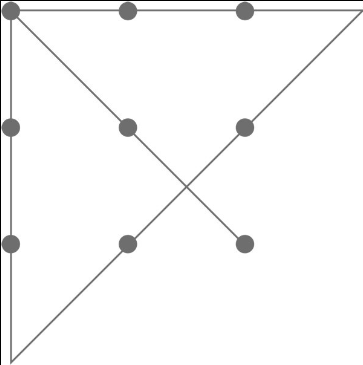
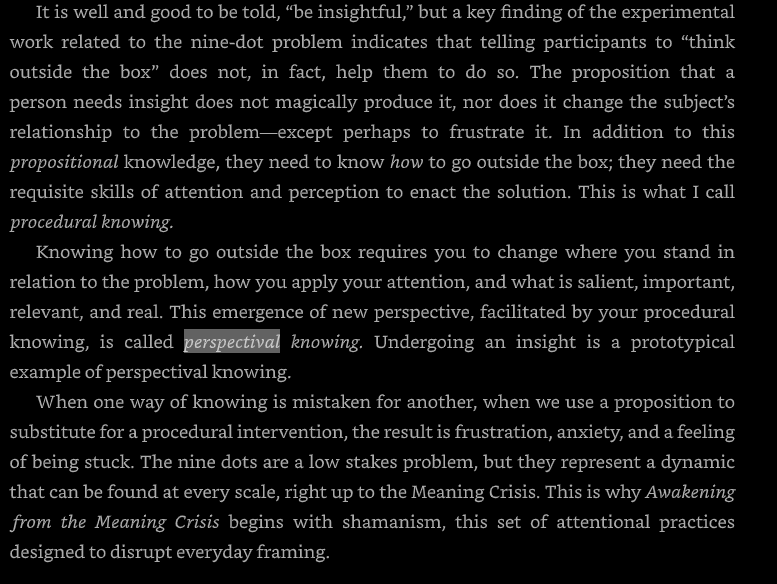
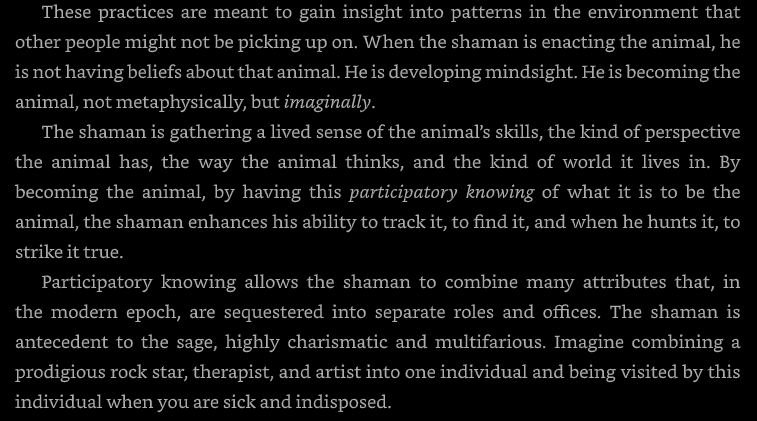
In the book version of the Awakening From the Meaning Crisis, he introduces them with reference to the nine-dot box problem, insight and shamanism:
---
### Author:  [@Naeema](https://forum.secondrenaissance.net/u/Naeema)
#### Post date: [April 27, 2025, 2:48pm UTC](https://forum.secondrenaissance.net/t/what-is-the-intellectual-history-of-the-4ps-ways-of-knowing-propositional-procedural-participative-and-perspectival/311/11 "2025-04-27T14:48:54Z")
After reviewing my notes on [the lectures](https://youtube.com/playlist?list=PLND1JCRq8Vuh3f0P5qjrSdb5eC1ZfZwWJ&si=kXiTYDu4sbWaAq9O), I was able to sum a sort of excerpt segments of the 4 kinds of knowing Vervaeke talks about, also this video sums it up pretty clear: [Why There Are Actually Four Ways You Can Know Something](https://youtu.be/seNq39DUP4I?si=I54vJ0FVwa49WbNh)
### **Procedural Knowing**
(_ **knowing how to do something** _)
> “ **Procedural knowing** is knowing _how_ to do something. It’s your skill knowledge. Knowing how to catch a ball. Knowing how to speak a language. Knowing how to play the piano.”
> “Procedural knowing is knowledge that is expressed in skills, in abilities that you can perform.”
### **Perspectival Knowing**
(_ **knowing from a situated perspective, salience landscape** _)
> “ **Perspectival knowing** is how you are situationally, perspectivally connected to your environment. It’s your sense of presence, your salience landscaping, your sense of what’s standing out to you right now.”
> “Perspectival knowing is knowing _what it’s like_ to be here now, from _this_ point of view, with _this_ field of affordances.”
_(“Affordances” = opportunities for action that the environment offers you.)_
### **Participatory Knowing**
(_ **knowing by being, mutual shaping of agent and arena** _)
> “ **Participatory knowing** is not something you have… it’s something you are. It’s how your identity is bound up with how the world is disclosed to you, and how you are disclosed to the world. You are _participating_ in the co-creation of the agent-arena relationship.”
> “Participatory knowing is the kind of knowing that is grounded in your being. It’s not just about how you frame the world… it’s about how you are _fundamentally connected to it_.”
### **Propositional Knowing**
(_ **knowing that something is the case — statements, facts** _)
> “This is the kind of knowing most familiar to us. **Propositional knowing** is knowing _that_ something is the case. It’s captured in statements, assertions, descriptions.”
> “Propositional knowing is knowledge in the form of truth claims… beliefs that can be true or false.”
Exploring the roots of John Vervaeke’s 4Ps of knowing, propositional, procedural, perspectival, and participatory, reveals that while the first two are well-established in classical epistemology, the latter two open a deeper, embodied understanding of cognition!
- **Propositional Knowing** : “knowing _that_” facts, logical truths.
- **Procedural Knowing** : “knowing _how_” skills, practices.
- **Perspectival Knowing** : “knowing _what it is like_” situated perception, context. (embodied and felt orientation)
- **Participatory Knowing** : “knowing _through being_” co-shaping of self and world. (world-creating, distributed across systems)
Insights from **[enactivism](https://www.google.com/url?sa=t&source=web&rct=j&opi=89978449&url=https://cspeech.ucd.ie/Fred/docs/ChemeroEnaction2021.pdf&ved=2ahUKEwjCjvKVrfiMAxWNgP0HHfQnD2EQFnoECBgQAQ&usg=AOvVaw1-q5CeN5Zi-qdbrdhCUUof)** (Varela, Thompson, & Rosch, _The Embodied Mind_), **[extended mind theory](https://en.wikipedia.org/wiki/Extended_mind_thesis)** (Clark & Chalmers, “The Extended Mind”), and **[process philosophy](https://plato.stanford.edu/entries/process-philosophy/)** (Whitehead, _Process and Reality_) suggest we can take this even further by adding a fifth dimension! Some sort of Dynamic Knowing\* (5th P maybe?!) Knowing through participation in the ongoing flow of transformation. In this view, knowing is no longer static or representational; it is living, felt, relational, and time-sensitive. The knower is not separate from the world but co-evolves with it, constantly attuning to the rhythms of becoming. This dynamic framework offers a richer epistemology for our age, one capable of responding to complexity, uncertainty, and the deep need for meaning.
**Key Ideas:**
- Reality is not made of objects, but of evolving events.
- Knowing is inseparable from **timing, rhythm, adaptation**.
- “Truth” is not just correspondence; it is **attunement to the evolving real**.
**Center** = _You_ (the knower)
Around you, dynamic flows connect:

The model is **not hierarchical**. It’s a **living system** sometimes you operate mainly propositionally, sometimes processually, depending on what life demands.
This “5Ps” model points toward **a new epistemology** :
- Rooted in **embodiment**.
- Open to **altered states** and **multiple modes of being**.
- Responsive to **complex, evolving systems** (ecological, social, technological).
- Emphasizing **transformation and adaptation** , not just static truth.
In a way, it’s **an epistemology for the meaning crisis** :
It restores **being** , **feeling** , **doing** , and **transforming** to our sense of what it means to “know.”
**Knowing is not just representing reality.
It is participating in, perceiving from, practicing with, proposing about, and processing the real.**
\*Please note that I am presenting the concept of dynamic knowing as preliminary reflections and in-process field notes from the frontier of emerging thought.