Renaissance Woman
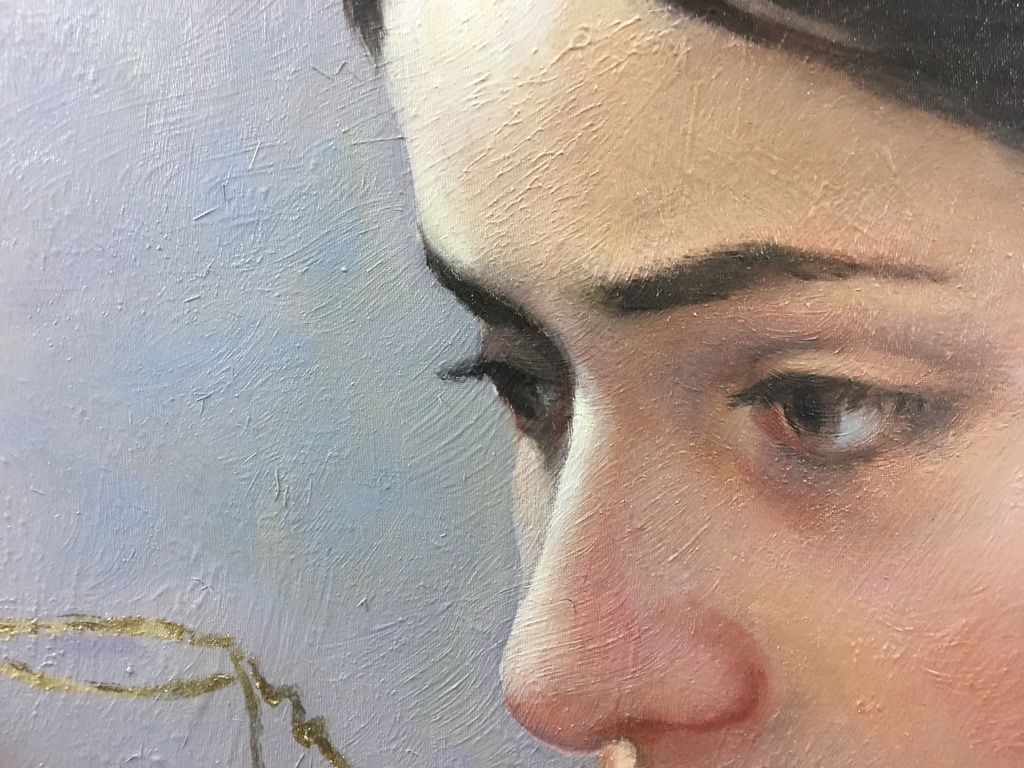
Detail “The Atheist”, oil,
by Gen Zendahl.
I wish to respect Rufus’s attempt to map in a more constructive way, despite my misgivings about what it may obscure. I’m imagining the Second Renaissance from the feminine principle ( NOT as a feminist). So use “woman” as a generic term for humankind, just as historically “man” was used. This might be called Right Hemisphere thinking, or the Yin Perspective, and the elements of Water and Earth.
Beyond Renaissance Genealogy: My Field of Emergence
All that is mentioned, by being noted, may obscure that which is un-noted.
And yet, if I am to contribute, I must begin somewhere.
This is not a linear lineage, but a mixing pot, a whirlpool, a second Renaissance born of contradiction, crisis, complexity—and grace. Only in part intellectual.
My “intellectual genealogy” is both formed through acceptance and rebellion—an oscillation between what I was given, what I rejected and what emerged from the mist.
 Origins & Rebellions
Born into contradiction.
My father—colonial, patriarchal—shaped my early worldview. I grew up at a mission school in Africa, a place where power disguised itself as piety. My race was supposedly chosen of God, with a special purpose, a stack of rules and punishments, a concocted tale of Jewishness wrapped in a new cloak of Christianity. A holy tangle.
My rebellion was not immediate. It took years to unpick the nonsense, to realize:
 All peoples need equal respect, agency, and self-determination.
 Diversity of culture and worldview is not a threat—it is a treasure.
 Education & Its Discontents
I moved through the formal corridors of Western learning—
A traditional education, a MFA, and with it:
- A deep felt rebellion against Postmodernism, which seemed to dismantle truth for sport, a celebration of flattened ugliness, disdain for the skills of the artisan
- A simultaneous rejection of Modernism’s mono-utopias, whose certainties led only to war
Caught between poles:
- One pulling toward tradition—guarding what is sacred, known, ours
- The other promising progress—novelty, development, “improvement”
 Embodied Knowing
Can I be what I am without the shadows?
- Two abusive marriages
- The daily experience of being female and second-class—both covert and overt
- The slow, somatic wisdom born of surviving, resisting, and remembering
- And motherhood—the becoming of two beings, the undoing and re-forging of identity in the crucible of care, pain, love, and unrelenting presence
To become a mother is not to simply add a role. It is to be rearranged.
Time changes. Boundaries blur. The world becomes both more fragile and more ferocious.
My renaissance is not in my head.
It is in my body, my bones, my scars, my womb, my milk, my sleepless nights, my ache for futures lost and hoped for.
 Compost of Influence
There are thinkers and dreamers who cracked me open, many more than here:
 The Dancing Wu Li Masters – Gary Zukav
 Wholeness and the Implicate Order – David Bohm
 Ursula Le Guin
 Steps to an Ecology of Mind – Gregory Bateson
 Michael Polanyi
 Life on the Edge – McFadden & Al-Khalili
 Noam Chomsky
 Buckminster Fuller
 Rupert Sheldrake
 Seth Godin
 The Order of Time – Carlo Rovelli
 Mutual Aid – Peter Kropotkin
 Clear and Present Origin – Jean Gebser
 The Art of War – Sun Tzu
 Hermeticism studies, the I Ching, Pure Land Buddhism (“Buddhism for hopeless people”), Epicureanism
 The Magic Art of Tidying Up – Marie Kondo
And yes, also:
 Star Trek, Star Wars, Foundation, Lord of the Rings
- Nursery tales: The Goose with Golden Eggs, Snow White
 Golems, Jinns, the Undead, Vampires, Werewolves
 The Handmaid’s Tale
 Eden, Arks, Red Seas, Armageddon
 Promised Lands, Special Peoples
Practices That Shaped My Being
This Renaissance is not read—it was lived in the now.
Emerging through the cracks in reason, the chambers of the heart, the portals of the body.
These were not hobbies or curiosities, but thresholds—ways of becoming:
 Prayer—as yearning, as dialogue, as surrender
 Emergent Dialogue, Circling, Deep Listening—relational mirrors of becoming
 Ecstatic Dance—not choreography but liberation, the body remembering its wild syntax
 Meditation, Somatic Presence, Breathwork—tuning to the subtle signals beneath the noise
- Psychedelics—DMT, psilocybin, and others: not escape, but initiation, dismemberment, vision
 Shamanic practices—soul retrieval, journeying, tending the unseen
 Music—not as entertainment but transmission, vibratory grammar of the sacred
 Extraordinary States of Consciousness—visions, dreams, precognitive flashes, and the oracular whisperings that defy Western categories
 Playing and curating the Glass Bead Game—a lifelong practice in synthesis and symbol
 Living off-grid, using compost toilets, shaping life systems by ecological values
- Using nootropics, binaural beats, subtle technologies of cognitive attunement
These states and practices do not sit alongside my intellectual lineage.
They transformed it.
They undid me, re-plasticised my mind
They showed me that knowing is not in the head—it is in the whole field, in the relational, in the sacred trembling of matter.
 Field Pressure & Emergence
Can my renaissance be unraveled from the evolutionary and social forces that press hard upon us all?
- The extraction economy
- The fast and slow violence of oppression
- The endless war machine
- The rape of the Earth
- The broken promises of modernity
No. This isn’t a personal transformation in isolation.
It is a co-emergence with crisis—a call to re-become human in a system built to forget.
 Final Offering
This is not a clean genealogy. It is mine, and everyone has their own unique version.
It is a fermenting field of longing, rupture, myth, and attention.
A second Renaissance cannot be limited movement of scholars,
but souls being called on how to live again.
It would be great for all II Renaissance men, women and noble ones to write and reflect on their II Renaissance? Here is a draft template, perhaps others have suggestions to improve it, we could offer it to all members:
**
 My Second Renaissance
**
Beyond Genealogy and Chronological Narrative: A Field of Emergence
This is not a timeline, but a trace of your blooming.
This template is here to help you uncover your personal Renaissance—not as a linear biography, but as a dynamic living, relational, mythic field. Take what serves, ignore the rest. Update and rewrite as you develop. Write in fragments, prose, poetry, voice notes, or drawings.
 1. Opening Statement (Set the Field)
Prompt:
Where are you speaking from? Why now? Begin with what feels true in your body.
“All that is mentioned obscures all that is un-noted…”
2. Origins & Rebellions
Prompts:
- What shaped you —c ulturally, religiously, familially?
- What mythologies clothed your childhood and beyond?
- Where did your first rebellions begin?
Guiding Questions:
- What did you once believe was true?
- Did anything crack open your loyalty to a former identity?
3. Education & Its Discontents
Prompts:
- What were you taught formally or informally?
- Where did you feel resonance? Where did you resist?
- What tensions lived in you between tradition and change?
4. Embodied Knowing
Prompts:
- What pain, joy, or embodied experience has shaped your knowing?
- Have you passed through illness, birth, caregiving, trauma?
- How did these teach you what the mind could not?
Anchor Line:
“My renaissance is not in my head. It is in my ______.”
5. Compost of Influence
Prompt:
List the thinkers, books, artists, songs, ancestors, films, stories, or landscapes that changed you.
You can group them:
- Intellectual
 Mythic
- Artistic
 Dreamworld
- Political or cultural
Include high theory and cartoons. TED Talks and childhood fairy tales. Sacred texts and memes.
6. Practices That Shaped Your Being
Prompts:
What have you done—not just known—that changed you?
Examples:
- Prayer, Dance, Meditation, Psychedelics
- Breathwork, Ecstatic States, Visionary Dreams
- Art-making, Parenting, Farming, Pilgrimage
- Rituals, Shadow Work, Solitude, Silence
- Composting toilets, Fasting, Sauna, Fire ceremony
Anchor Line:
“These practices did not sit beside my thinking. They undid it. They rewrote me.”
7. Field Pressure & Emergence
Prompts:
How is your transformation connected to larger crises?
What pressures shaped your emergence?
Examples:
- Climate collapse
- Cultural disintegration
- War, Genocide, Colonial aftershocks
- Burnout, Mental health, Economic precarity
- Grief, Silence, Survival
 8. Final Offering
Prompt:
What are you holding now? What is this thing you’ve named?
What blessing or warning does your Second Renaissance carry?
Closing Suggestions:
“This is not a movement of scholars. It is a movement of souls that can change the world.”
You are unique, but not alone in this blooming.
 Suggestions and critique warmly welcome
  not “THE” gateway, “A” gateway. No doubt your gateway, but not mine.
 Knot glyph: ⟁⟲⟲⟲ — entanglement as initiation