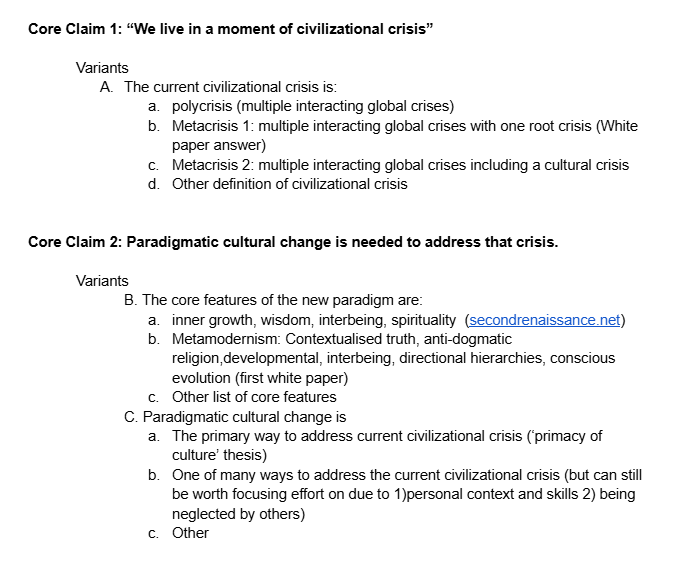
For me, it is entirely obvious that both core claims are true, and that the number of people who would agree with this is vastly larger than the demographic which can define this forum and movement. The real questions you (as a group) need to be asking are about what “paradigmatic cultural change” actually means. How can the foundational paradigm change on the scale we are discussing here when the existing dominant paradigm is in fact a multi-dimensional stalemate between physicalism, idealism/panpsychism and anti-realistic postmodern relativism?
Physicalism drags us backwards towards modernism.
Postmodernism declares itself to be the definitive end of systematic philosophy – the true “End of History”.
Integralism tries to escape from this by introducing the idea of “metamodernism”, which is an “oscillation” between modernism and postmodernism. This fails because it’s just another version of anti-realism. It is the bargaining stage of grief for bereaved postmodernists, not a new paradigm.
I submit that there is only one way such a thing could happen, which is to come to a new understanding of how we ended up in this situation in the first place. Unfortunately, for reasons explained at length in other threads recently, nobody is interested in this, because deep down we like the current impasse, because it offers maximum personal freedom-of-belief and minimum personal responsibility.
A very brief history of Western worldviews
Western history goes something like this:
The deepest roots of Western civilisation can be found in ancient Greece and Rome. The Greeks invented philosophy, politics and fine art, and though they were great experimenters in civilisation-building, they never scaled it up beyond the city state. The Romans invented the republic, perfected the art of expansionism and sorted out much of the “nuts and bolts” of large-scale civilisation, but their version of civilisation was, even by our own unimpressive standards, deficient in terms of morality and genuine spirituality. Brutality, cruelty and slavery were considered normal, while mercifulness was regarded as a sign of weakness. Then along came Christianity. The details of exactly how and why this happened have become historically obscured by the mythology of Christian origins. Christians generally regard the mythology as history, while non-Christians tend towards the idea that mythology is all there is: that Jesus may not even have existed. What is not in doubt is that the Romans tried but failed to suppress the new movement, and as the Empire stagnated and decayed Christianity became the “new attractor”. When Rome finally fell to the barbarians, Europe entered a “dark age”, the church hoarded power, and the philosophies of the ancients were either forgotten or subsumed into the grand theological synthesis of Augustine and Aquinas. While the ancients emphasised rational inquiry even at the expense of moral and spiritual concerns, the medieval world (at least in theory) placed morality and spirituality at the centre – which required the subordination of reason to theological authority. Nonetheless, Western civilisation had for the first and only time arrived at a common foundational worldview.
The next great revolution was arguably triggered by the socio-economic fallout from the population crash of the Black Death, but is more often considered to have begun with the Renaissance: the rediscovery of important lost works of ancient philosophy, mostly in the form of translations made by Islamic scholars, and the re-ignition of fine art. This ultimately led to the Scientific Revolution and the Enlightenment – the mature fruit of the Renaissance conviction that moderns could surpass the ancients. This was also the time that capitalism began to replace feudalism as a socio-economic system, and when representative democracy began to replace absolute monarchy. It was the birth of the modern Western world – and of the globalised civilisation we currently know (even though that now includes most of the world, not just the West). The common foundation had failed, and there was now a growing number of incompatible and mutually contradictory worldviews. A monumental battle raged between materialistic science and the fractured remains of Christianity. Modern civilisation brought with it many wonderful things. Our world has been transformed in many positive ways – it hasn’t all been problems. But certain things have also gone horribly wrong, and there has been a major philosophical and political response these failures. That response is called Postmodernism.
Postmodernism
Postmodernism emerged in the twentieth century not as a unified philosophy, but as a broad cultural reaction against the assumptions, aspirations, and blind spots of modernism. To understand its importance in the present context, we must appreciate that this was not mere academic contrarianism, but a necessary reckoning with some of the unintended consequences of modern thought. Modernism, as a philosophical and cultural project, placed its faith in reason, science, universal truth, and progress. It assumed that history had a direction, that knowledge could be built on secure foundations, and that the human condition could be improved indefinitely through technological advancement and rational governance. The Enlightenment had promised emancipation from superstition and tyranny through science and reason, and modernism was its cultural heir. Postmodernism rejected this optimism, finding within it the seeds of domination and exclusion. Thinkers like Michel Foucault, Jean-François Lyotard, Jacques Derrida and others relentlessly attacked the very idea of “universal truth”, arguing that so-called universal values often mask the interests of particular groups (i.e. white, male, heterosexual elites). The Enlightenment promise of reason, they argued, had been co-opted by institutions of power: science had become instrumentalised, rationality bureaucratised, and knowledge weaponised in service of empire, industry, and the state.
Lyotard’s famous definition of postmodernism is “incredulity toward metanarratives”: postmodernism is deeply skeptical of modernism’s grand stories about progress, freedom, or objective truth, claiming that these narratives excluded, suppressed, and silenced other ways of knowing. Reason and science were not considered to be neutral arbiters of truth; they were situated, contingent, and interwoven with systems of power. This critique was especially powerful when applied to the ecological crisis. From a postmodern perspective, modernity’s faith in control and mastery over nature was itself the root of our environmental problems. The modern subject – autonomous, rational, and separate from the world – conceived nature as a standing reserve of resources to be exploited. Postmodernism helped expose this anthropocentric delusion, and pointed instead toward indigenous, feminist, and other “marginalised epistemologies” that had long emphasised relationality, reciprocity, and respect for the more-than-human world.
Postmodernism did not merely deconstruct modernism’s assumptions; it also intentionally disrupted its language. Derrida’s analysis of texts convinced many people that meaning is never fixed – that words always carry within them the possibility of contradiction, ambiguity, and slippage. The stable categories and clear boundaries of modernist thought were recast as illusions. Language, and by extension knowledge itself, was declared to be a kind of game: contingent, contextual, and open-ended. This refusal to offer new certainties in place of the old ones has led to the normalisation of relativism and nihilism, but postmodernists will argue that this criticism misses the point: they will say that postmodernism was not a doctrine of despair, but an ethic of humility which has shown us that no system of thought is above critique, and that pluralism, diversity, and dialogue are better foundations for living together than unquestionable monolithic truths or rigid hierarchies. In the context of this broader historical arc, postmodernism must be understood as an immune response to modernity’s overreach. It cleared the ground, exposed the rot, and made space for something genuinely new to emerge. Unfortunately,it did not build anything new, and does not provide us with any of the tools we need to begin that task. Postmodernism was the point where the old epistemic frame lost contact with any possible grounding.
While postmodernism itself is well past its prime, various forms of “post-postmodernism” emerging in its place are not a new paradigm but a further symptom of paradigm exhaustion. They are, at best, a patchwork of tentative proposals driven more by the yearning for coherence than by its discovery. If you want to explore post-postmodernism, then some internet searches that can throw some light are GameB, Metamodernism, Second Renaissance, Unified Theory of Knowledge (UTOK), the Liminal Web, Polycrisis, Metacrisis, Meaning Crisis, Sensemaking communities, Integral Theory and post-progressivism. That is a long list, and there are all sorts of ideas involved, some of which contradict others (so they cannot all be right). If I had to recommend a starting point it would be the work of Iain McGilchrist. What all of these movements, thinkers, and frameworks are searching for is a new integrative worldview that can move beyond both modernism and postmodernism. This new worldview must reconnect meaning, science, spirituality, and systems thinking in order to navigate civilisational crisis and co-create a sustainable, coherent, and life-affirming future.
The old paradigm
( The Real Paths to Ecocivilisation (book) | Two-Phase Cosmology) was another attempt to make progress towards the new paradigm, and it did so in a way that none of these people or movements have done – not even McGilchrist. I suspect he would view my ideas as overly conceptual and systematising, whereas I view his vision as a profound diagnosis of modernity’s epistemic pathology which is nevertheless vulnerable to vagueness and romanticism because it stops short of proposing a rigorous alternative framework. While the historical progression of ancient->medieval->modern->postmodern is undeniable, I am rejecting the idea of this as an intellectual or personal progression. This rejection is also what happens if you apply postmodern thinking to itself, but I have no intention of doing that; I am not interested in declaring postmodernism to be self-refuting and trying to slide backwards into modernism, for that would just ping me back towards postmodernism and set up a metamodern oscillation. Instead, the post-postmodernism I’m advocating rejects the historical narrative described above. I does not acknowledge postmodernism as a paradigmatic improvement on modernism. Rather, it views postmodernism as the ultimate expression of the failure of the old paradigm: the vanguard of the West’s descent into collective nihilistic psychosis. In McGilchristian terms it is what happens when the brain’s left hemisphere finally loses the plot completely and starts attacking its own flawed creations, but with no attempt to recover the meaning, context and coherence that only the neglected right hemisphere can provide. This is where the Two-Phase Cosmology comes in, because it finally allows us to make sense of quantum mechanics (and it has taken exactly a century). To understand how this can be the key to fixing Western thinking, we must return to the moment when our epistemological troubles really began: David Hume’s A Treatise of Human Nature: Being an Attempt to Introduce the Experimental Method of Reasoning into Moral Subjects , which was first published in 1739.
During the Renaissance, reality had been divided into mind and matter first by Galileo, and then by Descartes. This was done intentionally: both of these revolutionary thinkers saw the material world as that which can be quantified and measured, and mind as the realm of that which cannot. It was the business of the new “natural philosophy” to investigate the material world, in an attempt to reduce it to the workings of natural laws, and the method of investigation involved the systematic elimination of everything subjective – indeed, that was the whole point. In the decades that followed, philosophers searched for a way to put the rest of philosophy on as firm foundations as those of materialistic science, but rather than finding an agreement about how this could be done, a long battle was fought between the defenders of two conflicting approaches to grounding that system. The empiricists argued that knowledge must start with observations of reality, the rationalists argued that it must start with pure reason, and Hume was the first person to put his finger on the epicentre of the entire problematic. His goal in the Treatise was to provide solid foundations for a science of mind (“moral subject” here means a conscious human), but even though his analysis was miles ahead of anybody else at that time, he ran into a logical problem that totally defeated him. He felt he had compelling reasons for believing two contradictory things. The first was that for all we know, we could be brains in vats: how could we ever transcend “the veil of perception” and know anything about a world that lies beyond? The second was that in order to be able to experience an external world (as we evidently do), then it must be the case that objects in the external world have a causal effect on our minds – there has to be a direct chain of cause and effect from an external object to the subjective experience of that object. The contradiction appears to be very real: either there are mind-external objects which can causally penetrate the veil of perception, or there aren’t, right?
Hume never found a solution to this problem. His conclusion to that section of the Treatise is one of the most tortured passages ever written. After his extensive and faultless reasoning, he could give no justification for believing anything positive at all. He could do no better than say that the world strongly appears to be the way it appears, which in terms of epistemology is scant improvement on Descartes’ argument that we should believe what our senses are telling us because God wouldn’t deceive us. What we suppose to be the real world “enlivens some ideas beyond others” – our perception of an external world just “feels stronger” than merely internal mental activity or dreams. Without this feeling, we’d have no reason to reject solipsism or subjective idealism, but feelings are “so inconstant and fallacious” that this sort of principle will surely lead us into errors. Such a methodology is never going to be scientific, that is for sure, and yet it is only feelings, experience and habit which makes us “reason from cause and effect”. In other words, it is only because we are so familiar with the world behaving as if causality is real that we believe in it “and 'tis the same principle, which convinces us of the continu’d existence of external objects, when absent from the senses.” The problem is that belief in the reality of causally effective mind-external objects is “natural and necessary in the human mind”. How could we function without it? But how can this be reconciled with the reasoning which forces us towards skepticism?
“How then shall we adjust those principles together? Which of them shall we prefer? Or in case we prefer neither of them, but successively assent to both, as is usual among philosophers, with what confidence can we afterwards usurp that glorious title, when we thus knowingly embrace a manifest contradiction?”
It was exactly this contradiction that prompted Immanuel Kant to write the Critique of Pure Reason (1781/87)(CPR), in which he made the paradigm-defining move of dividing reality into phenomenon (reality as it appears to us) and noumenon (reality as it is in itself) instead of mind and matter. Kant argued that science can only tell us about phenomena, and that noumena were forever not just unknowable but uncognisable. For Kant, space and time are conditions for human experience – they are the frame for physical phenomena, and we have no reason to believe they exist in noumenal reality. Kant’s masterpiece provided the foundation for modern Western philosophy, but this also marked the point where it began to split into two divergent “traditions”. One branch led via Schopenhauer and Nietzsche to what is now called “Continental philosophy” (which fully embraces contradiction), and the other led to “analytic philosophy” (which attempts to be rational but still hasn’t found an acceptable solution to Hume’s problem).
It is essential to understand the context in which Hume and Kant were working. This was the golden age of materialistic science. Newton’s Principia had blown the old ways of thinking to smithereens and both of them were trying to bring the subjective world of consciousness, and therefore the whole of reality, onto a similarly secure footing. Absolutely nobody had the slightest inkling that one day we would discover that Newtonian physics is not the “final” description of reality after all, but without that piece of information even the genius and precision of Hume and Kant stood no chance of identifying the correct solution to the philosophical problems of their day.
Hume, Kant and quantum mechanics
Now let us imagine that history had played out differently. Let’s imagine that physics had advanced at a much more rapid pace and that in the time between Hume’s Treatise and Kant starting work on the CPR, quantum theory had been discovered. Now, instead of having to find a way to solve Hume’s problems in the light of an apparently undeniable fact that Newtonian physics is the one true description of physical reality, let us imagine Kant was aware of the Measurement Problem. In order to rid science of the “quantum leap” from superposition to a single state, von Neumann had been forced by logic to propose a conscious observer outside of the physical/quantum system. But in the real history, Hume and Kant were dealing with a physical model which was a direct match for the phenomenal world of “ordinary” material objects. That was what set the problem up: what could be more obviously correct than to have a physical theory which describes the reality we actually experience? And yet we now know this assumption is wrong. In the imaginary history the situation is very different – here science provides a physical model which does not describe the phenomenal-material world. Instead of being a classical realm of material objects, it is the non-local realm of the wave-function. If you think about it this way, then Hume’s problem disappears. We can now map physics onto reality with no difficulty at all (although ironically we can do this only if we’re willing to abandon physicalism in favour of neutral monism). We can simply say that the unobserved world – the “real world” which is out there “beyond the veil of perception” is the world described by the equations of our best physics: the uncollapsed wave function. In 2PC we call this “Phase 1”. Only when reality collapses into Phase 2 does the world of ordinary material objects appear. Hume’s veil lifts not because the wavefunction is the noumenon but because the noumenal/phenomenal split is reconfigured once we recognise that superposition is the metaphysical substrate from which the single actual world is continuously resolved. What Kant called “noumenon” is therefore shown not be so completely unknowable after all. There are some very specific things which we do not know about it, but 21st century technology is built on our knowledge of Phase 1.
The new paradigm
The point of this extended detour into the history of Western philosophy is this: if 2PC is right, then we can re-ground realism. This might sound implausible given that I’m saying that before the Cambrian Explosion, reality as we understand it didn’t even exist, but why should that matter in the present context? The nature of the reality of the cosmos 600 million years ago isn’t what matters if we’re talking about regrounding realism for civilisation today. All that matters is that we can find a new way to agree that the reality we actually find ourselves in is real, and not an illusion or a social construction.
This clears a new pathway out of the thicket. Not just the beginning of a new search because we’ve concluded that we must move beyond postmodernism and don’t know what comes next, but more like a final correction and completion of modernism. Postmodern anti-realism isn’t a stage which both people and societies need to pass through on the way to some strange promised land where modernism and postmodernism perpetually undermine each other. Instead we need to accept that the anti-realistic relativism of postmodernism was based on a gigantic but entirely unavoidable mistake. In fact, even before the discovery of quantum mechanics, science was always telling us things about an objective world, beyond the veil of perception. Hume’s instinct was right: of course we are aware of real objects. What he got wrong, because he had no chance of getting it right, was that instead of being like the Phase 2 material objects we directly perceive, they exist in a way that is non-spatiotemporal, and consists of all physical possibilities at the same time.
We therefore have new scope for a collective agreement that reality is real after all, even if it is not the normal material world that modernism assumed it to be. It means that science is not just another perspective, as laden with power dynamics as political and religious ideologies. It does this not in the reductive manner of materialism, but in a way which affirms the reality of consciousness and everything that comes with it – especially meaning and value. A new kind of Western thinking can be founded on the idea that Cartesian substance dualism and its Kantian solidification into knowable phenomena and unknowable noumena were both epistemological mistakes. Cartesian dualism was a hopeless oversimplification, and Kant was trying to solve a problem without the empirical knowledge necessary to solve it. The real dualism is between possibility and actuality, and this dualism is underwritten by the Void. While the original insight came from Eastern philosophies, this is something new, and something very much Western: a post-postmodern neo-Kantian non-panpsychist neutral monism.
As for the people and movements I listed earlier in this chapter, I believe some will prove to be closer to the mark than others. Beware of attempts to dress the old paradigm up in new clothes. These come in two main forms. The first I’ve already discussed – the metamodern attempt to smuggle (in plain sight) postmodern anti-realism into the new paradigm by framing it as one pole in an “oscillation.” Make no mistake: if you mix realism and anti-realism (or modernism and postmodernism), the result will be postmodern anti-realism. One times minus one equals minus one. Metamodernism is the bargaining stage of grief for bereaved postmodernists.
The second form is exemplified by UTOK, which from the perspective of 2PC is the corresponding stage for bereaved materialists: an old-paradigm-style naturalism that remains fundamentally hostile to genuine spirituality, offering a psychological control system in place of metaphysical insight. If we are to find a true path to ecocivilisation, we must begin by understanding where we went wrong – not only politically or economically, but philosophically. The Real Paths to Ecocivilisation was an attempt to lay the philosophical foundation for a civilisation that can truly endure – because it is grounded not in illusion, but in a reawakened relationship with reality. Endlessly oscillating between the failures and limitations of modernism and the dead marshes of postmodernism is not going to cut the mustard.