Hello Second renaissance forum!
I hope you are doing alright 
Healing Consumerism and Capitalism from within families, traditions and work
My family summer vacation is getting close to end. I spend a week at the farm of my uncle and I want to give you a bit of context and then ask you for advice.
My uncle founded the farm in 1992 as a sheep farm but is now also doing different types of grain. For him its not a job but a calling. In Germany we can also call work - Job -
but we also have - Beruf - so its rather that for him. He is deeply connected to the land and its traditions and people in various ways. He often talks about how
things have gotten out of balance and that many people (that live in cities especially) have lost respect and connection of nature.
My uncle’s daughter ( my cousine ) has two sons. One of them asked me, because I know - computers - if I knew :Landwirtschaftssimulator 2025. In English that program is called Farming Simulator
I only had time to investigate this game further when we alsready left the farm, but what I found was quite disturbing. Here is an AI Summary, of the “worldviews or perspectives” transported by the game:
Here’s a structured read on both angles, grounded in what’s actually in the game (base game vs. community mods, since that distinction matters for your analysis).
LLM output start
1. Technological dependency: machines, manufacturers, and financial relationships
Scale of licensing. Farming Simulator 25 (GIANTS Software, published by GIANTS/Focus Entertainment) ships with over 400 authentic machines and items from more than 150 international brands, including Case IH, CLAAS, Fendt, John Deere, Kubota, Massey Ferguson, New Holland, and Valtra. This is the highest brand count in the series to date — FS22 had already passed 100 manufacturers through years of DLC, while FS25 launched with 150+.
The business model behind it is essentially a licensing/advertising arrangement, not a one-off deal:
- Manufacturers grant GIANTS the right to digitize their real machines (exact specs, liveries, branding) in exchange for what functions as embedded advertising to a farming-literate audience — the same demographic that buys the real equipment.
- GIANTS in turn markets this licensing as content: the developers regularly release detailed factsheets on social media (speed, weight, cost, capacity, gearing) as teasers, which is standard sponsored-content promotional rhythm.
- Even peripheral consumables are branded — stretch film and net wrap for bales come from real brands like Rani Plast, John Deere, or Fendt, in different colors, and hand tools like chainsaws carry real-world branding too.
- Post-launch monetization continues the same pattern: brand-specific DLC packs (e.g. a Fendt pack, an AGCO IDEAL pack, a Mercedes-Benz Trucks pack) function as paid extensions of the same licensing relationships rather than neutral content updates — each DLC is effectively a manufacturer getting a dedicated, purchasable showcase.
Implication for your analysis: the “technological dependency” here isn’t just simulation realism — it’s a closed loop where the game’s design incentives (bigger/faster/newer machinery = better yield/efficiency) mirror and reinforce the real agribusiness upgrade cycle (John Deere, CLAAS, etc.), and the manufacturers get a soft-marketing channel embedded in entertainment aimed partly at the next generation of real farmers and equipment buyers.
2. What kind of agriculture does the game emphasize?
This is the more interesting finding: the base game’s economic logic is built around synthetic input optimization, and “organic” is not a built-in path — it’s a community mod.
- Base-game yield mechanics reward chemical/industrial inputs directly: fertilizer application gives up to a 45% yield bonus across two applications, weeding gives up to a 20% bonus, and plowing adds a further 15% bonus, with herbicide or a weeder recommended “from the moment weeds come up”.
- Manure/slurry (organic-style inputs) exist as alternatives, but they’re framed as one fertilizer option among synthetic ones — there’s no in-game certification, price premium, or systemic “organic” economy in vanilla FS25.
- A community mod (“Bio Farming”) adds exactly the organic-agriculture layer the base game lacks: it introduces a certification system where a field keeps “ORGANIC” status only if you use organic manure/slurry/digestate (with yield bonuses of 6–12%) and mechanical weed control like harrowing or hoeing, and loses that status the moment you use synthetic fertilizers or chemical herbicides. This didn’t ship with the game — it’s third-party.
What this tells you analytically: the “default” agricultural model the game teaches and rewards is conventional/high-input farming (synthetic fertilizer, chemical weed control, mechanization scaling) — because that’s also exactly the model the licensed manufacturers sell equipment for. Organic/ecological farming is possible but requires either manual restraint (playing sub-optimally against the game’s own reward curve) or installing community-made mods that graft an entirely separate certification economy onto the base game. That’s a meaningful signal: the commercial/licensing structure (point 1) and the agronomic ideology embedded in the reward system (point 2) reinforce each other — both point toward conventional, machinery-and-input-intensive agriculture as the “efficient” path, while organic/regenerative practice is an opt-in afterthought rather than a parallel, equally supported system.
If you want, I can go deeper on any one thread — e.g. a breakdown of which manufacturers appear tied to which DLC pricing tiers, or a closer look at how the Bio Farming mod’s economy compares (price premiums, cost/yield tradeoffs) to conventional play.
================================================
When reading through this I noticed immediately notied how the values of the game where almost diametrical opposed to what my uncle is living. So how can it be that my uncles grand
children want to play games that would implant on them such harmful world views?
I asked then gpt to generate a Copmarison Infographic showing an alternative game path, that still is connected to real world social and technical technologies:
LLM output start
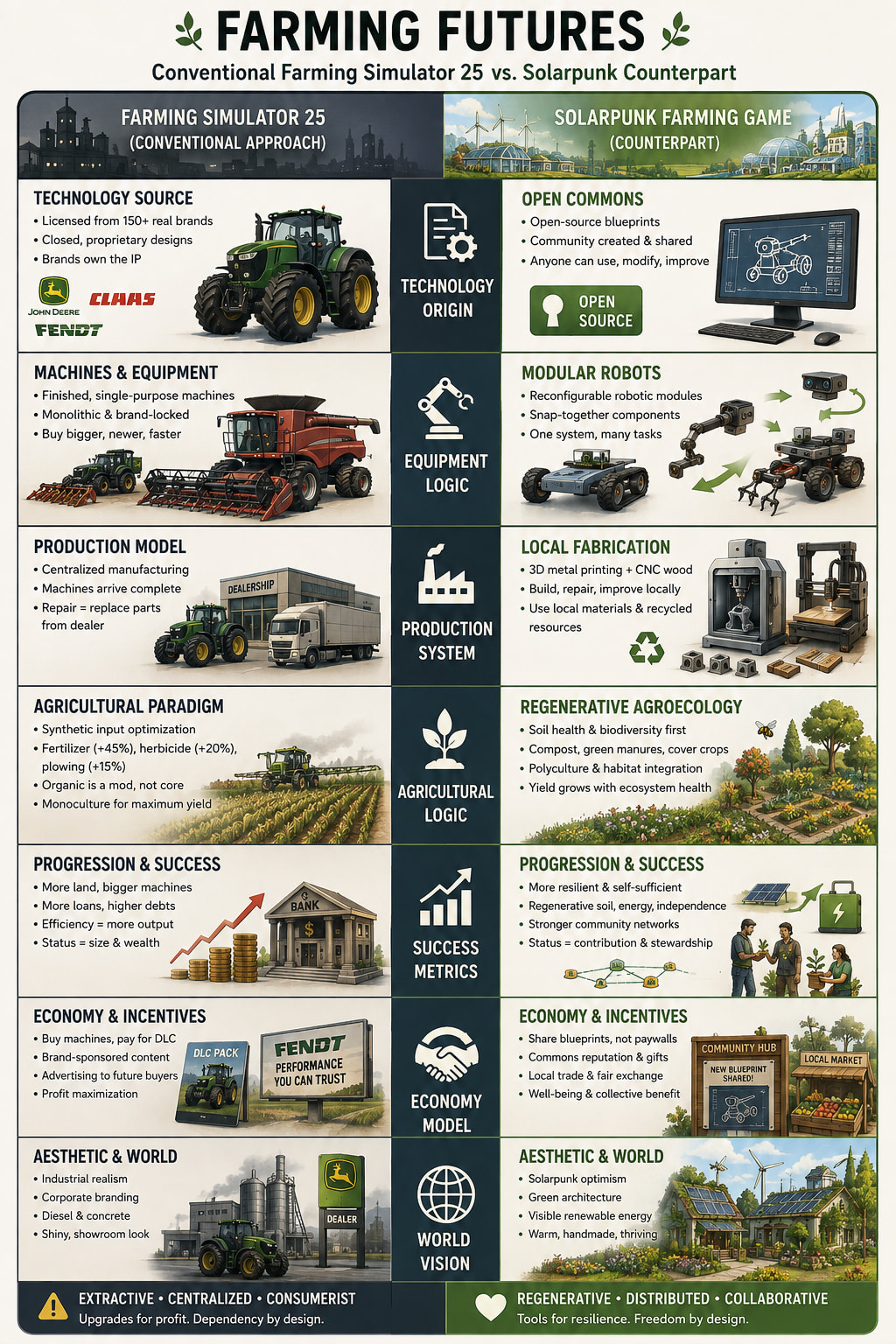
================================================
How do you think about Solar punk as a world view? As a starting point to think about better relationships with technology?
Have you engaged with game creators to communicate values? Do you see games also as liminal spaces, as - developmental spaces?
I’m almost finished with my story. Additionaly to the game story my cousine then told be that she wanted to do something good for her sons, so that they could see something outside of the farm.
So this late summer she is planing to buy a trip on a AIDA Ship : AIDA Cruises - Wikipedia
For me AIDA is a symbol of Consumerism, with all the entailing negative effects.
But now here is my second question space:
The principle of paid vacation from work is also tied to Capitalism. But if you are a family with 2 kids.
What kind of - vacation / style - experience could you have that still allow for interesting experiences. I think: developmentalspaces.org already goes a bit to far for my cousine.
Lets invoke the notion of - Zone of Proximal Development - from Psychology: are there Spaces that are family compatible where people can relax but yet have the possibility of being introduced
to concepts beyond consumerism vacation types ( all inclusive hotels)?
Do you know of such spaces in Europe?
Thank you for reading (8k of attention) and your consideration
regards Andreas