Just like to correct this: I don’t dislike “gut feeling” but rather I see it has a particular place. To me, it’s a signal to be listened to; to be shared with others, perhaps as a stimulus for collective reflection. What I don’t like is taking individual gut feeling as a supreme authority. Useful, definitely. Similarly to dreams, maybe? Perhaps dreams have similarities to gut feelings?
Yes, but if that individual is writing their own paper - that’s the extent of their authority.
And just to clarify and add nuance to my own position on this: to me, it very much depends. There are times when action is needed, now. There are other times when it is good to refrain from action until more reflection is done. Context is everything! (And I know there’s a bit of Ecclesiastes in there!)
I’d answer this with a hard no; certainly not always but it can be useful for certain types of questions in order to convince certain audiences.
I think the results you obtained here are valid if and only if one adopts an either/or mindset rather than a both/and mindset—i.e. inner work alone is enough to change the world. I haven’t attempted this but I would expect similar results if one asked the same question with any of the other rivals identified by abductio in place of inner work, i.e. tech-driven adaptation, localized plural strategies, institutional/policy reforms. (It’s interesting that it chose these 3 as complements to inner work, coming up with something arguably similar to the integral quadrants).
1 Like
I’d say Dave Snowden’s Cynefin framework is useful here. Straightforward things one can reason through, best not to rely on untutored intuition. Complex things cannot be solved by reasoning alone: so intuition must play some part.
A couple more points about this study:
- It’s biased towards practical evidence so it will naturally favor systemic, institutional, or technological interventions over ‘inner work’.
- It didn’t reach a high degree of confidence and didn’t find this question tractable in its current form.
1 Like
I’d say so too! My original Ikigai article from last spring directly cites Snowden, specifically his preferred “act-sense-respond” action learning loop for chaotic situations. My reading of “what the world needs” is we are absolutely in chaos - Donald Trump, among others, creates chaos as an intentional tactic - which is why I like Snowden’s approach. “Act-sense-respond” is about as far away from “further study is required” as a method can get. Yes, per Ecclesiastes, there is a time for further study prior to just trying whatever might work. This is evidently not one of those times, however. Trying anything that might work is, IMO, the recommended current approach.
1 Like
Yes. Maybe what I’m saying is, get a good sense of what might work before trying it. Sure, that might come immediately, so go ahead. Personally, I tend to be less confident in immediate sensings, so I like to look before I leap. Thus, I’d like to qualify your recommended current approach, by suggesting that it depends on your modus operandi and the situation.
Maybe, @RobertBunge , you might like to spell out the conditionality that you see? For example, when do you see it as a good idea, and when not, to do the first thing that comes to mind? How do you discern what “might work”? What are the limits to your recommended (default, perhaps?) approach?
First, here is Snowden himself on the Chaotic as compared to the Complex:
Chaotic systems: “deterministic at the agent level”
”create meaning with intent as to direction but not as to goal”
“we can experiment with channeling the flow of emergence within a social system. But we can only gain understanding by interaction with the system as a whole in multiple ways. hence the emphasis in our methods on safe-to-fail experiments and also mapping the evolutionary potential of the system through micro-narrative landscapes.”
Also, this Google AI summary:
In chaos, the decision-making domain where cause-and-effect relationships are impossible to determine, Dave Snowden advocates for an “Act–Sense–Respond” approach. This differs from the traditional “Sense–Analyze–Respond” process and is critical for containing an out-of-control situation.
__________________________
Having been through quite a few hours of training with Snowden last year, the thing about the Chaotic is generalized systemic breakdown and unpredictability. It’s hard not to see the US in those terms right now. The rest of the world may be somewhat buffered from the direct effects of MAGA, but the knock-on effects are surely widely distributed. The key to Snowden’s action model in the Chaotic is one learns more by trying things than by reasoning through theoretical models. The action-response loops provide grounded experience regarding the shape of whatever might emerge from the chaotic “fog of war”. The Chaotic is also replete with opportunity - one can literally create new realities by willing them into being through concerned action. There is so much in flux, anything decisive becomes an attractor.
That’s the theory. In practice, I’m running all sorts of micro-experiments that are safe-to-fail, but have potential upside. When positive results come in for any of these, I double down and push harder in whatever direction that is. Early results suggest all this is redrawing the lines of the possible and opening portals to a future formerly unimaginable. The Chaotic demands a carpe diem attitude. The who do carpe diem will be writing the new rule book for when things settle down again.
Reading Snowden I got an impression that what he really wants to say is that there are no experts relevant to complex systems. If you were someone trying to solve a complex problem - you wouldn’t’ want to spend money on “expert” advice. The domain of experts are complicated systems.
Now, he doesn’t really say that experts are useless in complex systems because that would be very radical, anti-science, etc…
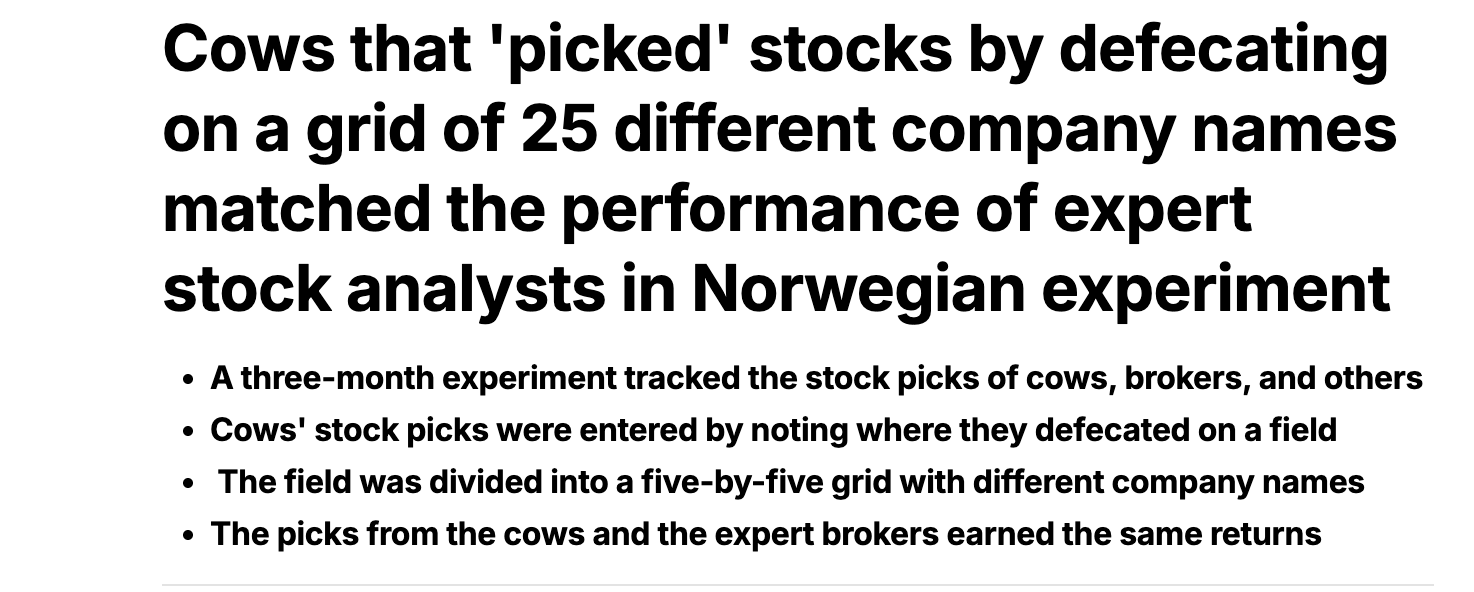
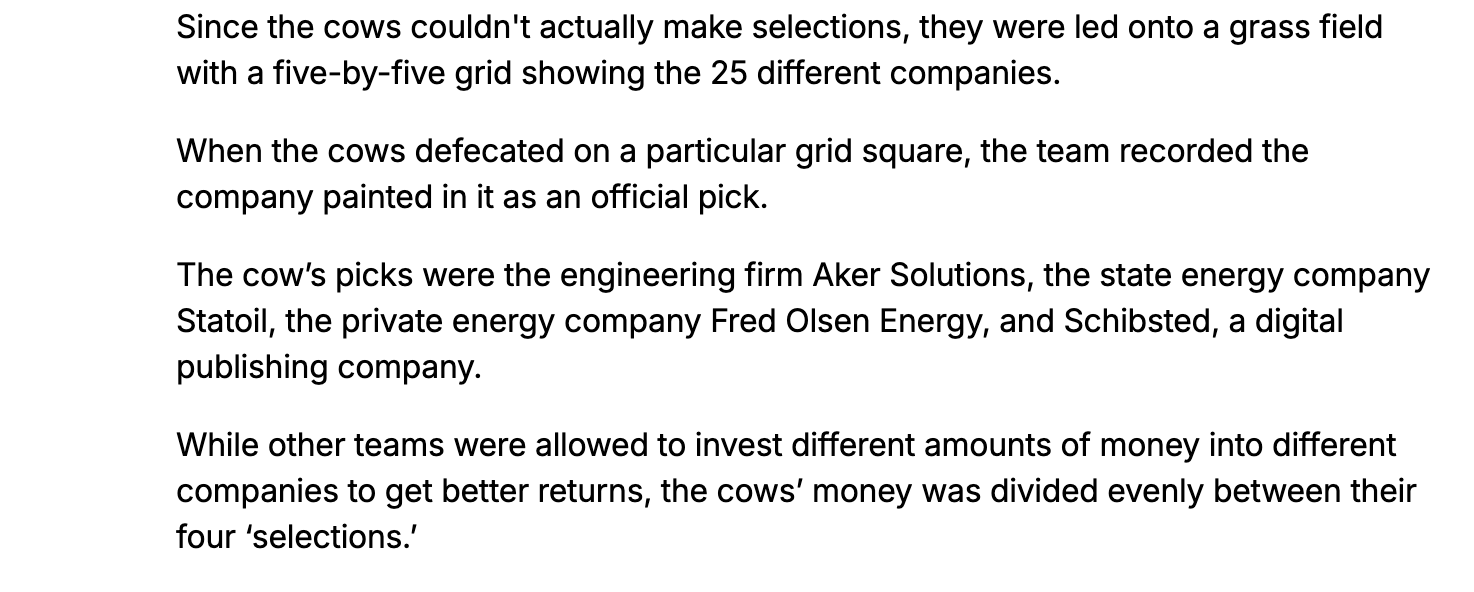
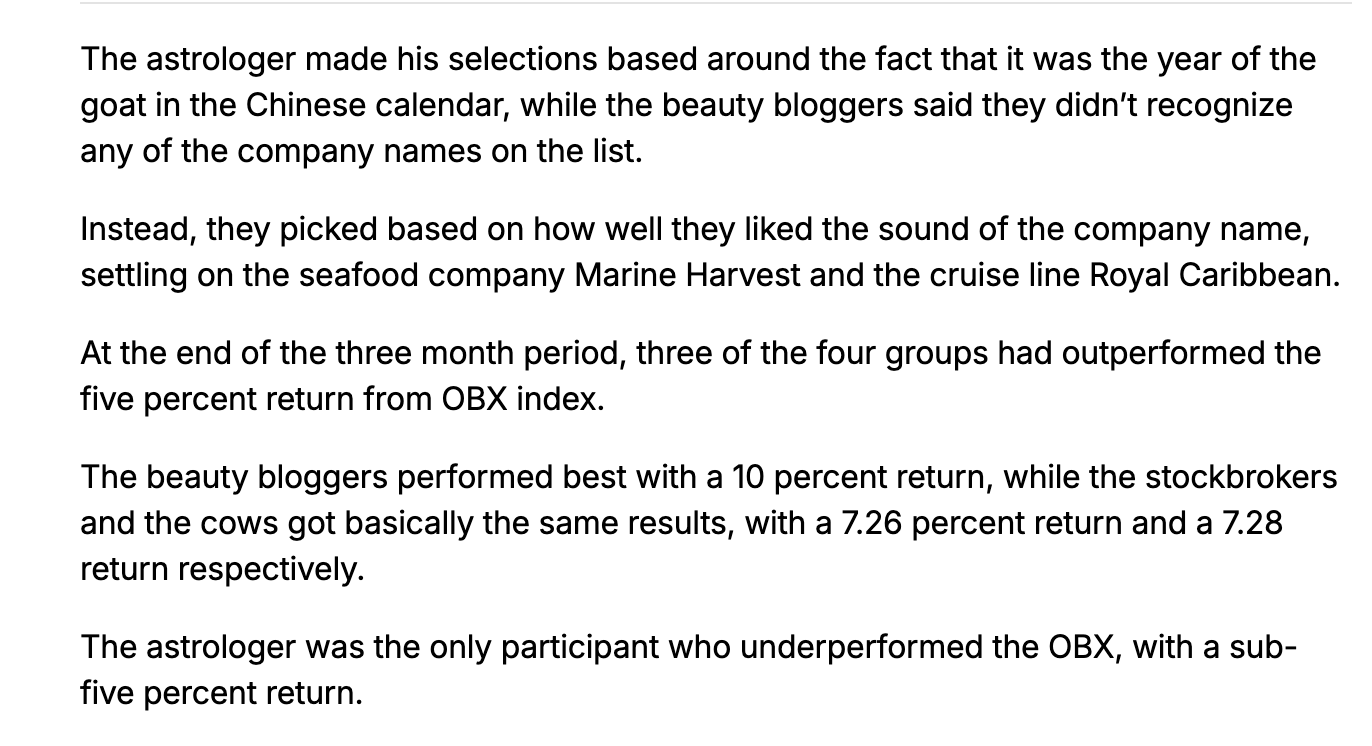
So, what do we do if “expert” opinion is not useful? How about rolling the dice?
The article is behind the paywall, so posting this:
3 Likes
Good example! One of Snowden’s workshop stories is that when he was still at IBM, IBM HR used Myers-Briggs to sort employees. Snowden ran a study showing astrological charts were more accurate predictors than Myers-Briggs. HR was not amused.
1 Like
Regarding the beauty bloggers picking based on liking the sound of the company name, there’s actually a lot of research to support this: