This just dropped on Substack yesterday. Thanks @catherinet , @rufuspollock.
I very much like the framing of Developmental Spaces here. Looking forward to others reading the paper as well and sharing impressions here.
This just dropped on Substack yesterday. Thanks @catherinet , @rufuspollock.
I very much like the framing of Developmental Spaces here. Looking forward to others reading the paper as well and sharing impressions here.
Personally I don’t find it informative or helpful. But that’s just me. I don’t want to launch into any detailed critique here, but happy to share notes with others who feel similarly.
On the other hand, I’m sure there are people for whom it will be helpful, interesting and informative.
How helpful it is may largely depend on what one is trying to do. This is all very steeped in Wilberian thinking. I immersed myself in that a couple years ago, then went on hiatus from it, because the framework seems overly complex for any practical application in my immediate social circumstances. Following a sojourn through metamodernism, independent scholarship, and everything mentioned in 2R, I distilled this working synthesis (which is intended to be super-compressed):
In times of chaos, expected results no longer materialize.
Symbols of stability no longer stabilize.
Skinnerian reinforcement loops are broken.
Inspired leaders or creative minorities ad lib new approaches.
Some of these innovations work.
Reinforcement loops kick back in.
A new “normal” is established.
Where I find the Developmental Spaces paper useful is in unpacking the “inspired leaders or creative minorities” line. Especially the creative minorities part. DS is a good generic term what are often called pods, incubators, containers, pockets, islands, etc. The point is somewhere between personal inspiration and mass adoption there must occur a phase of community-level gestation or prototyping. The DS paper does a good job of framing that community-level phase.
I’d say “sources of stability” - if they are only symbols, of course they can’t stabilise.
Indeterminism of systems leads to people not trusting them anymore. If the system’s promise gets misaligned with what system does - it’s corrupt.
When people lose faith in formal institutions (defining rules and procedures leading to acts and behaviours and representing a larger context of collective interest), informal ones (representing a smaller context), defining their own rules and procedures, start being seen by group of people as legitimate and better functioning. That step is in the direction of personal interest.
In order to make a reverse journey - from personal back to collective idealism - you need to establish new narratives and co-opt people into a new system of collective participation. Before that, the old system needs to die - and that’s probably the collapse that we’re talking about(??)
If people trust the system that leads to fulfilment of collective goals - they are infused with collective idealism and move from ego-centric thinking to system-centric (which can be world-centric or a more limited context of the system).
What I’m trying to say - I’d like someone to convince me that internal work is the solution.
Yes. When I say “symbols”, it’s like a one-word summary of “system’s promise”.
Won’t be me! Well … yes … inner work is involved, but it’s pretty darn useless if not applied to something social and practical. To give one example, before class last week I paced around campus all afternoon rehearsing lines in my head, decompressing, focusing, relaxing, getting centered. Inner work. But then came class - showtime! The inner work came out. Then later there was more inner work to process and reflect on how the class went. And so on. Inner work is a necessary part of a systemic cycle that involves a lot of other things. Some people do tend to make a fetish out of the inner work as if nothing else was worth doing. The work I respect is both inner and outer in mutually reinforcing fashion.
I guess here I’m in broad agreement with @RobertBunge in upholding the idea that internal work is part of, not the whole, solution. And it seems to me that there is a subtle relationship between internal and external work; between work initiated by the individual, and work that is prompted (or more strongly encouraged) by one’s surrounding collective. Hence, to state what I guess here is pretty obvious, the importance of the developmental space, with other people necessarily present, not just the developmental teachings that one is expected to self-study. (Or, more obviously self-serving, “(buy and) read my book, which will cure you from […]”)
There does, however, seem to be a residual sub-cultural expectation that inner work always comes first. I believe this is sometimes the case, sometimes not. Sometimes it can be a spontaneous epiphany that one has been living counter-productively. At other times, though, it can be other people who prompt the process of inner change: perhaps by example; perhaps by calling out; perhaps in other ways.
I agree with a “both-and” in this case, as I think I see both of you implicitly or explicitly suggesting. I suggest that we not only take responsibility for our own actions, but also take responsibility (as led, as a felt sense of propriety occurs) for kindly and gently pointing things out to others about what they are doing; about their blind spots. This naturally could be with an IFS-style approach, understanding the parts of you and me that lead us into reactions that are not what we really want in the longer term.
So I am, as I have always been, very much in support of the DDS concept as a whole. And it might just be the fact that I’ve been in there so long that the white paper does not add value for me. What I look for (maybe groundlessly hoping for in this case) is more direct, down to earth guidance, not about the generalities and theories of how personal and collective change might happen, but about the nuts and bolts; not just mentioning case studies but addressing the personal detail of what worked and what didn’t work so well. Not just saying that this is a good model of a DDS, but evaluating the strengths and weaknesses of different DDS approaches — and all this, absolutely not from an ideological position that takes Integral and Buddhist practice as The Solutions, but beyond the ideologies towards cross-cultural practice. It’s not my native language, but if we see this in Pattern Language terms, if we see patterns in one tradition, can we relate that to similar patterns in other traditions? The more we can do that, the more solid a pattern would look to me; the more worth attending to.
Is this a vain hope that we may get there? Who’s with me?
Yes, the white paper has an exposition of the supposed 5 domains of inner growth. But this is expository, not critical, and this taking one particular approach (based on Integral theory) is neither justified nor contrasted with others. I would even find it useful to list other approaches. Yes, some others are mentioned, but it would seem only to point out their deficiencies and to bolster the idea that the presented ideas are the best.
You know: in business you analyse all your significant competition. In academia you do a thorough literature survey. They seem to me closely analogous. If you don’t do this, I’d say you’re more in Silicon Valley garage or bedroom entrepreneur mode. Ignore the others, we have a new idea which is the best ever (cf. Trump bombast) and we’re going to promote our ideas to outcompete all others (which we haven’t bothered to study).
Even Monty Python’s Brian got beyond that. “You don’t need to follow anybody! ” But I would like to go beyond Brian’s “you’ve all got to work it out for yourselves” to something more like that we can work it out better together. Back to the virtue of the DDS, but a DDS where people are actually practising and improving relating developmentally. Let’s have some detailed personal accounts of how that has actually worked out. People generally respond well to sincere personal stories.
My kind of thinking! Very in the weeds. The case study I am running right now is me showing up in two classes in Seattle, with a particular methodology, and seeing if I can get a bunch of students into something like Wilberian “second-tier” in a 10 week quarter. The way that works (I hope) is lavish use of AI coupled to even more massive group work, with the idea of hooking up each individual brain to the global collective. The overall process is completely “trans-egoic” because who the heck cares where the good ideas come from? The point is to source the best thinking, apply it, and get stuff done.
Now, when one’s head gets force-fed a massive data stream of all the world’s knowledge, and academic performance standards are raised something like 10X over normal step-by-step curriculum models, a little “me time” to digest all that is absolutely necessary. The way I put it in class was “all screens all the time make Bob a dull boy”. So meditate. Walk in the woods. Ride a bike. Whatever. It’s all part of a normal human cycle.
Now, as to the “how”, we can of course get very, very granular. Here is one example. On a collaboration call yesterday I got introduced to this for the first time: VCoL+7
My Ikigai model is built to stimulate rapid-fire action learning loops. VCoL is a good, worked out, action learning process. So I’m figuring out how to screw it into my model. Anything to turbocharge action learning loops and “overclock” the whole cycle. In software, this is all generally related to “agile”. Agile+collaboration+AI+action learning loops = hyper-accelerated learning and production. Also, I’m cross fertilizing the two classes with each other, with 2R, and with quite of few other nodes in my networks. So the whole business is running like a virtual enterprise at high scale, even though it looks small in the room.
Granular enough? We could on. But basically, I got bored a couple years ago with Wilberian-speak about “second-tier” and such, but not much organizational action to show for it. The operational definition of “second-tier”, as far as I can tell, is “ability to work with anybody” and “ability to get stuff done, using tools of any provenance”. My instructional model is pointed at all of that.
If we’re racing against time - we mustn’t lose sight of what we’re trying to achieve here. Internal work is great, individually - but if that’s to come first - how many centuries do we need to witness an enlightened humanity? How aligned those awakened individuals will be to start working on the external system that will save us?
That also leaves the “awakened” hugely vulnerable to the ones who chose not to undergo the internal work - for example - radical non-violence might prevent them from challenging people violating their values.
If you add your extensive research that would span cultures and practices, involve experimentation on a large scale and analysis of the results - we might never get to internal work. As a stand-alone project - it sounds great, but we need to stay within the institutional awareness zone
I’d say the next generation is likely “make or break” for the future of humanity. So now would be a really, really good time to get started on what needs to emerge from the current chaos. See my post above about the turbo-charged “overclocked” action learning process we are piloting this quarter. One other dimension of this is my classes are very international - lots of Asians, Africans, Latinos, Eastern Europeans. So getting team collaboration in that room is a metaphor for getting global collaboration at scale. That’s the target to aim for.
There are other ways of knowing other than number-crunching or analysis in general. Rogues are successful precisely for that reason - following their own logic and trusting their gut feeling.
Until I see some research data on the efficacy of the method - I’ll probably remain sceptical. It’s not a novel idea -Milla Jovovich uses it in the 5th Element
Brendan Graham Dempsey’s latest on Pyche and Symbolic Meaning pretty much covers all the neo-Piagetian stage theoreis. Some fare better than others. EP 322 Brendan Graham Dempsey on Psyche and Symbolic Learning - The Jim Rutt Show
Me? I’m more for Vygotsky. Brenden is going to tackle social psychology and cultural evolution in the next volume, so it will be interesting to see what he does with that. But I’m not waiting around … it’s crystal clear that culture, context, communication, etc. have a profound impact on personal development. That’s why I like the DS idea - it points to the need for community context. The neo-Piagetian bits in the paper are “meh”. (But I do like that they cleared up some confusion about “worldviews” as opposed to “cognitive development” - two different things.
Please say more! I love cribbing off sci fi.
I guess it depends on what we are trying to do.
For sure, “following their own logic and trusting their gut feeling” is a common approach for a risk-taking entrepreneur. But what are the chances of success or failure? Surely, the more complex a problem, challenge or situation is, the more one benefits from a combination of varied perspectives (and thus I like the @RobertBunge multicultural multi-background groups.) But individual gut feeling? Data on success rates, please, not just survivor-biased success stories. Isn’t that also a bit “hero’s journey”?
As you know, I’m more into the research and knowledge commons perspectives. And that, I hope, has the potential to inform intuition beyond individual gut feeling. Overall, less wasted time, effort, energy.
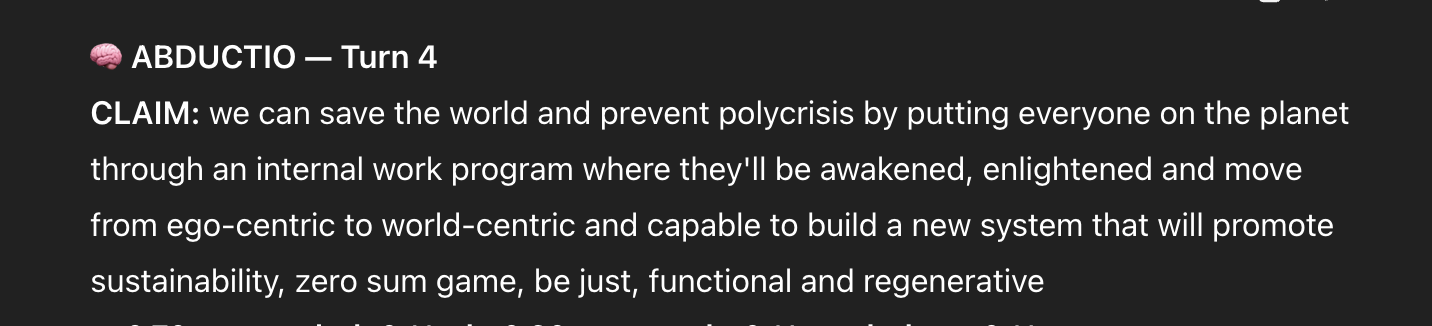
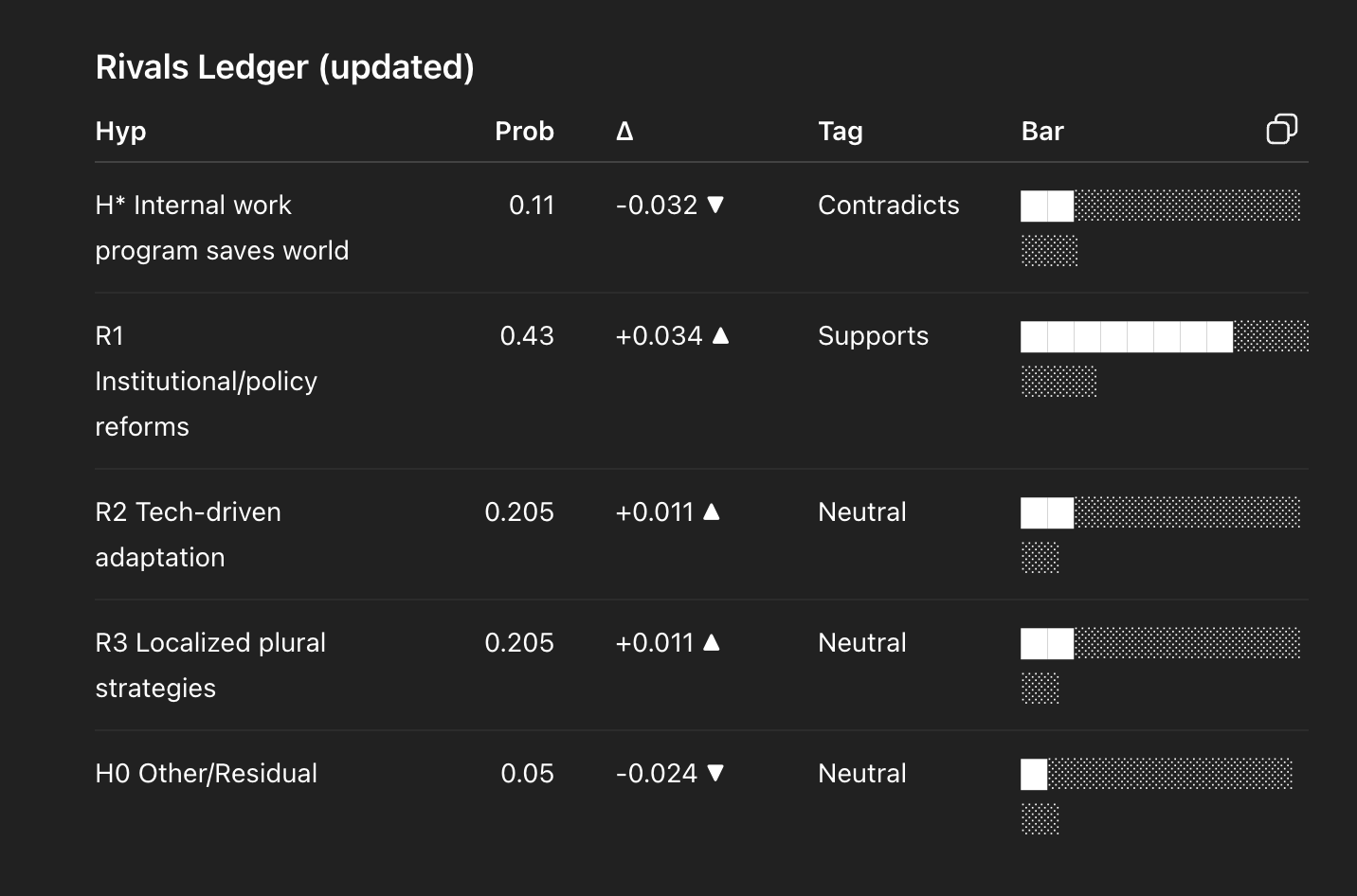
Apologies in advance, hate doing this but just for fun I ran the claim that inner work can save the world through the Abductio framework as described in this post: Abductio: Extraordinary Evidence for Extraordinary Claims
by @dvdjsph
This was my claim (I made a mistake - should have said promoted alternative to zero sum game, hopefully the Ai understood what I meant)
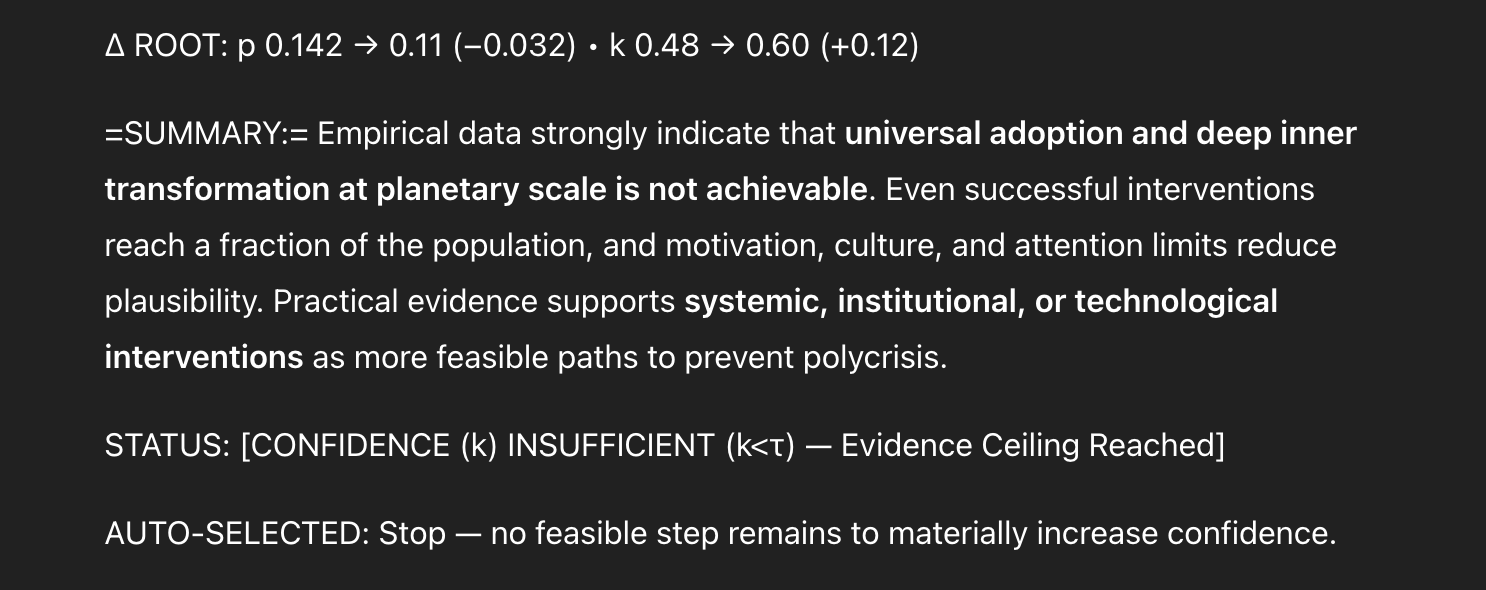
It came up with rival theories and at the end of the enquiry concluded that institutional/policy reforms are most likely to bring about sufficient changes to save the planet.
this is the conclusion:
So, my question is - are people always supposed to run things through an algorithmical analytical process and abide by its conclusions (that it’s not achievable in this case) or is there still space for doing things that you think can work even when analytical wisdom tells us that it’s not viable?
Well, the AI is full of sh*t, which is why humans should be Master and AI should be Emissary. What the AI fails to spell out is how institutional, systemic, and technological solutions are supposed to come about. They don’t just sprout like daffodils in the springtime meadow! Somebody has to build all those - and generally speaking, that “somebody” is people. And people need to find their motivations, which is where the inner work comes in.
Don’t blame AI for being shallow, however. It just effectively summarizes all the equally shallow nonsense abundantly published all over the internet. Also, the original prompt is an excellent example of “garbage in, garbage out.” Or course it’s ridiculous to imagine “inner work” will lead to “world-centric” views. A better program for cultivating “world-centric” views, is … well … get out into the world! The idea that freeing one’s mind from ideas to somehow arrive at pristine new ideas is patent nonsense. Try reading a book or two. Have some conversations. Have a lot of conversations. Then meditate.
I was challenging Simon’s dislike for “gut feeling” type of knowing. Not all truth is contained within the analysis of available data and it’s not possible to calculate the odds of success of one-off social experiment at an unprecedented scale with view to countering unique challenge - like a planetary collapse.
Accordingly, it’s not necessarily incorrect or unreasonable that the decision has been made to base the DDS on the Integral model. If it feels right to the authors, then that must be the correct position.
I’ll agree with you there. The “further studies are required” trope is very old, very tired, and very useless in our current situation. Of course further studies are always required - but so is urgent action based on the very best studies we can source as best we can from whatever we already have on hand.
I’d be very happy to rewrite the whole DS paper without any reference to Wilberian Integral at all. To me, the Wilberian framework is generally superfluous. That said, the nucleus of the DS idea seems generally sound and necessary. I don’t see the DS paper as dragging us all back to the glory days of Wilberian stage theory. Rather, I see it as gently nudging Wilberians in the direction of social action and community-centric approaches. “Showing up”, in the Wilberian parlance.