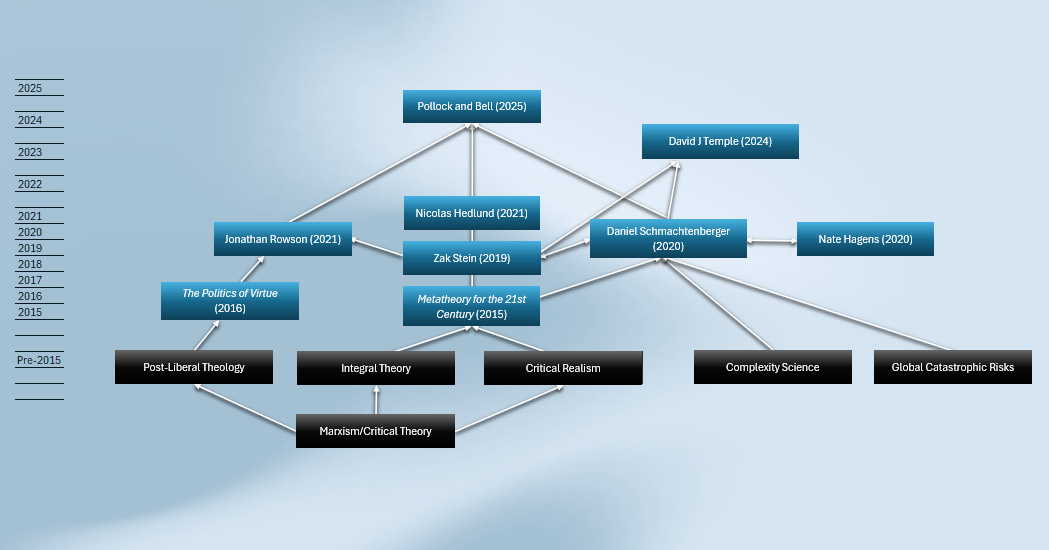
Hi folks, after thinking about how to write up my recent Metacrisis talk, I’ve ended up with this sort of different piece, drilling down into the first part of the talk about the more recent metacrisis discussions.
Curious to hear thoughts and feedback, including on this map of ‘lineages’:
@JonahW, I’ll be delighted to consume any information you develop on this. (AI says Schmachtenberger is most associated with the term).
That said, my focus is turning more and more to the solution space. For that purpose, abstracting from the details of who said what in which order about the metacrisis seems most advisable. It’s enough to mention that “metacrisis” is becoming a common way to describe the world. To motivate solutions thinking, as a minimal package, I’d say Thomas Malthus + Club of Rome on the environmental side and post-Marxian structuralism on the systems side frame the topic. Toss in Vervaeke (or others) on the Meaning Crisis to get to the phenomenology of it. The basic challenge is resource sharing on a fixed planet in which growth and competition are embedded systems with several thousands of years of cultural momentum behind them. The meaning crisis is people seeing the dangers, but at a loss about what to do. The starting point for solutions thinking and action planning is 1) grasping the problem, 2) processing it emotionally, and 3) figuring out plausible change strategies. Current work on the metacrisis seems weighted more heavily toward 1) and 2). I’m hoping to soon see more on 3).
Yea I like your one sentence summary! And I agree that solutions thinking and action planning is critical. The final ‘open question’ I listed at the end of my piece is
“In what ways can an accurate theoretical diagnosis of the structure of the metacrisis guide practical action to address it, and what precise forms might such action take?”
And I do think there are different answers to that question out there. One view would be that the details of the theoretical diagnosis are not that relevant to the precise solutions that are necessary, so that coming up with solutions is basically a separate research domain, which seems like what you’re suggesting.
Another view, which I associate with the metatheory approach as well as the more recent systems modelling approaches, is that the details of the theoretical diagnosis are very important in determining the right response.
As an example of this there’s an important difference in the proposed solution space depending on whether you think there’s a single ‘root cause’ such as capitalism, or whether there are multiple interacting causes (e.g. in different integral quadrants, or as part of a formal systems model). In the former case, you have a single leverage point at which to focus your efforts. In the latter case, you end up recommending multiple simultaneous solution vectors (alongside monitoring of the holistic ongoing interaction). Though even here, the precise nature of the system model or mapping potentially makes a big difference to what solutions stand out as most relevant to a particular organisation or individual.
The phrase attributed to Einstein - “Everything should be made as simple as possible, but not simpler” - is pertinent here. It’s always possible to analyze the world more granularly. But the more detailed the model, the more difficult it is to do anything with it. So there are practical trade-offs.
To go with a high level abstraction, we have a case of multiple self-reinforcing growth functions that require inputs running out of their required inputs. Which means the hitherto unbounded functions are flirting with negative first and second derivative inflection points. The second derivative is likely already negative - which is what yields “metacrisis” intuitions. The first derivative also going negative will be read as “collapse” The indicted strategy is to migrate systems away from the exponential to alternatives that are periodic and naturally bounded.
To get slightly more concrete, there are three broad categories of exponential function that generally follow something like a compound interest law: population, capital investment, and technical innovation. Limits to Growth and Planetary Boundaries are going to hit both returns on capital investment and population first. You can see the negative second derivative for population (and even the first derivative in many cases) already in global demographic charts. Capitalism is ripe for a significant business cycle shock as well. Technical innovation seems more unbounded, but the endless thirst of AI data centers for energy, water, and other material resources suggests that tech as well is not immune.
The cultural cause of the practices contributing to the exponential functions can conveniently be summarized as on-going repetition of behaviors that were highly adaptive in different circumstances centuries ago. The great structural historian Fernand Braudel traces three broad systems cycles in history: politics, economy, culture. Of these, culture is far the stickiest, with civilizational ideals and practices evolving on millennial scales.
We can model human psychology in extremely nuanced ways, but to pivot to the solution space, it helps to travel light, at least in the making the initial turn. The basic question is - can we change culture and civilization through conscious awareness and effort? Or do we need to bang into physical hard limits first, and sort out post-collapse culture later? Participants in what Toynbee would call a “creative minority” will be at work making the pivot now, in advance of collapse, which will seed the next turning in civilization.
I’m curious what kind of example you have in mind here? Do you mean the pragmatic importance of ‘common denominator’ views that people can politically get behind? Though I’d agree with that, it would still be true that more detail in the model means more practical applicability to the extent that it can be agreed on? Isn’t that what we see in physics (since you mentioned Einstein)?
Layered communications strategies tend to work better than putting forward too much complexity too soon. This insight is embodied in all sorts of school curricula, not to mention effective storytelling or logical exposition. Dickens for example, did not try to make the first sentence of Tale of Two Cities do all the work, even though that well-chosen sentence did in fact effectively foreshadow the entire work.
Going with political examples (as you suggest) something like a “We will fight them on the beaches …” speech or “government of the people, by the people, for the people” generally works better than strategy documents with dozens of detailed bullet points. Or to be more precise, the synthetic inspirational view is needed first, to capture attention and support for the detailed implementation plan to follow later. Or to take another example “we hold these truths to be self-evident …” occurs near the top of the document. The bill of particulars comes later.
My thing right now is “Pivot to solutions!”. Details can certainly follow … As evolution of the detail of the “Pivot to solutions!” program, for example, I was earlier today working out some details in a UTOK space about how certain specific practices are good for breaking neurotic loops, freeing up energy for cultural creatively. Those details, in turn, are available in many, many books by dozens of authors. We’ve had all the books all along. What’s needed are catalytic agents to spark what strikes me as a ripe and ready cultural phase transition.