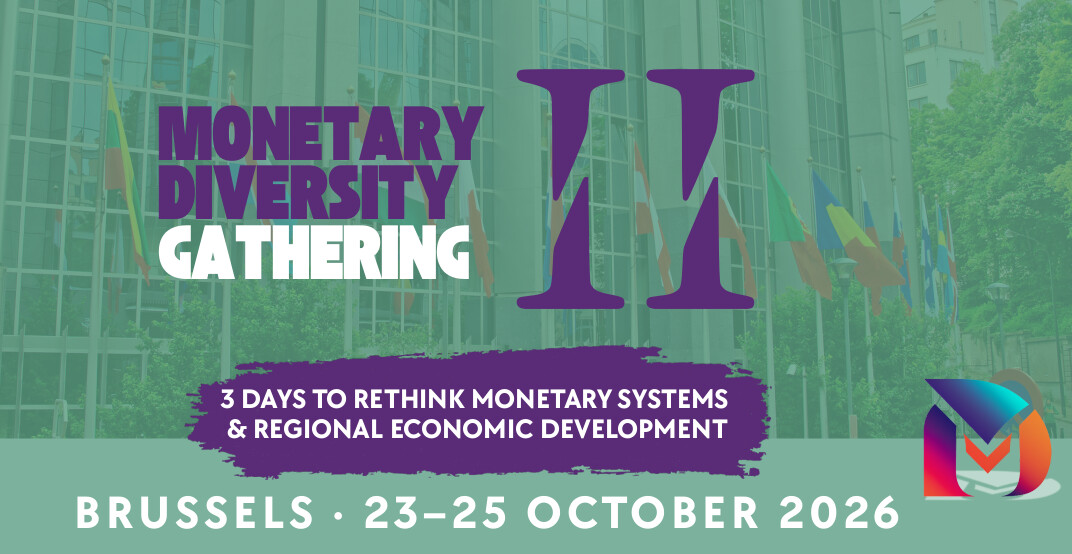
Two years after MDG1 and a fantastic gathering that officially launched the MoDi Network… The conversation returns and Monetary Diversity (MoDi) is proud to announce a brand new European Monetary Diversity Gathering, taking place in Brussels from 23–25 October 2026.
This three-day professional gathering will bring together municipal and regional representatives, institutional actors, digital infrastructure providers, researchers and monetary innovators from across Europe to explore one central question:
How can new monetary infrastructures strengthen territorial resilience and public innovation?
We’ve brought together the best of the monetary field for three days of idea exchange, high level talks, and practical demonstrations.
Three days to rethink monetary systems and regional economic development. October 23-25, La Tricoterie, Brussels.
The detailed programme is still being fine-tuned, more in the coming days. 140 seats, 85% pre-registered already
Hope to see many of you there
This may have been of interest to me a decade ago. Unfortunately I can’t be blind to the unrelenting tide of far right populism that will see (anything positive/progressive) in Europe gradually (or perhaps rapidly, going by history) dismantled. Focusing on communities, rather than wider systems, seems to be the best way to put hope and effort.
If you see hope in wider systemic change then I am very interested in understanding from where that derives.
Let’s suppose, for the sake of argument, the AfD comes to power in the Bundesrepublik as a whole. Does that mean the Deutsche Mark is coming back? Radical nationalism sounds great, until one analyzes where such nationalism got most nations the last time it was tried. A Europe divided into 30 or 40 national regimes with 30 or 40 national currencies would be nice pickings for Russia, China, US, etc.!
If the ghost of Otto von Bismarck came back to guide German nationalism today, I can picture him in the AfD. What I can’t picture is him being so stupid as to dismantle all German influence in the EU, effectively handing the whole business over to the French. Serious nationalists in the EU today are very interested in getting national interests maximized within the EU framework, not in losing wealth, power, and influence by pulling out entirely.
In the US, MAGA is doing pretty much the opposite of making the US “great” again. The US, in general, seems greatly diminished from where it was a few years ago. Therein lies both problems and opportunity for Europe. The problem is, Europe will have to do a lot of heavily lifting fiscally and militarily that it once gladly let the US do on its behalf. Looking at alternative currency arrangements is going to have to be part of that work. Or would you seriously trust your future to the dollar? Or the ruble? Or the renminbi?
As for pure progress, my general recommendation is to look to social capital at local community levels. Could your local community survive through local production and barter arrangements alone? If not, there is work to do …
I think this rather misses the point. Systems have tipping points - they don’t need to be formally dismantled; enough institutional erosion and reinforcing political feedback can transform them into something quite different. Your argument also assumes that nationalist movements will ultimately behave rationally because destroying institutions that underpin their prosperity and influence would be self-defeating. History provides remarkably little comfort here. In 1932, one could equally have argued that no serious German nationalist would destroy constitutional government, persecute productive citizens, provoke much of the world and ultimately reduce Germany to ruins. It would plainly have been irrational. Unfortunately, history didn’t care. Or consider Yugoslavia: in the late 1980s it would have seemed economically and strategically absurd for nationalist politics to tear an integrated state apart—yet within a few years precisely that process had produced fragmentation, ethnic cleansing and war. The EU doesn’t need to disappear or the Deutsche Mark return. If enough governments undermine courts, environmental protections, minority rights and democratic constraints, the buildings in Brussels can remain exactly where they are while the system they represent becomes something fundamentally different. So, “history does not stand still” isn’t especially reassuring. The question is what countervailing force you see that prevents the present feedback loop from reaching a tipping point. You’ve indicated none, quite rightly, since one cannot really point to something that doesn’t exist…
Most probably, the feedback loop is that current systems deteriorate until they hit rock bottom. In the 1932 case, that feedback involved Soviet troops marching through Berlin in 1945. So yes, everything can get much, much worse before there is any discernible counter-trend toward better.
That said, I don’t believe the community of those-who-can-see-it-coming need to just sit back and wait for the worst. One thing about “current systems” is they come in all shapes and sizes, and some of them do rather well against a background of more generalized collapse. Co-ops, for example, have historically emerged mostly when society itself was in larger crisis conditions. It strikes me that local action for self-sufficiency and collaboration is a good hedge against various scales of macro-breakdown. The welfare state model - at the EU level, the national level, or at smaller levels - has structural weaknesses in the current situation. There will never be enough cash to spread around to make everyone happy, and that cash that does get spread will almost inevitably be purchasing less and less. The whole “buying happiness” idea looks headed for a hard fall. Developing happiness the good old fashioned way through personal contributions to society seems all-in-all better advised. Would that be “progress”? Or “regress”? Of somehow both at the same time?
Yes but … Having just been on a conference call a few hours ago to organize a regional health care co-op, it’s not like the macro environment is irrelevant. For example, a key question for the worker-owned nursing co-op we are organizing will be the potential for government health care funding for patients. The current business model for the nurses is focusing on privately funded patients primarily, because Medicare/Medicaid reimbursements to providers are in decline and unreliable. What will become of US health care funding? Depends a lot on inflation, interest rates, tax levels, money supply, and other macro factors.
My main contribution to the local co-op movement is to keep an eye on the macro and help the care providers (who are nurses, not business majors) navigate systems complexity to allow for the generation of reliable revenue streams. Ultimately, this is all positioning for politics, up to and including the national level. It’s not like corporate medicine is just going to roll over and die for us! To win this game, we have to prove a model that works better for patients and caregivers alike. Ignoring the big picture is not the best idea for that, even if most of the serious action will be entirely local.
The diversity we allude to refers to (among others), diversity of scale. Plenty of “community level” currencies and tools will join us in Brussels. Some are MoDi´s Friends and Partners
Monetary diversity is useful for local community building. Let’s look at means of exchange at various scales -
The most primitive (and essential) “currency” is no currency at all! It’s reciprocal relationships in which people who know each other pass goods and services back and forth without anyone keeping score. That’s what happens in families, within small communities, on effective teams, in workgroups, etc.
Beyond such Dunbar number scale groups, trust needs tokens of some type. The medium of exchange has to speak for itself somehow. Portable commodities with intrinsic value (like metal coins) or symbolic instruments that are widely accepted (paper, digital, other proof of credit) enable transactions up to and including global scale. From 1945 till fairly recently, the US dollar served as a lingua franca for such global exchange. Other national currencies could always convert to dollars and national governments owned US Treasuries as a core asset to back their more local currencies.
Now, with the US reverting to crude mercantile imperialism (on 19th century or even earlier models), anyone not wishing to become a US colony is forced to de-dollarize to some extent. Anyone who holds US Treasuries or US currency is subject to expropriation if the US simply creates more dollars. (Not to mention US tariffs, sanctions regimes, and so on). The problem is - the obvious international candidate to replace the dollar as common denominator for global trade relationships has not emerged. The Euro and other major national currencies all have weakness in this regard.
King Dollar is dead (or at least not looking entirely well), but long live what, exactly? That’s the point of the upcoming conference. Meanwhile, if anyone planning to go off-grid, form an intentional community, seed an eco-village, or endow a secular monastery is using dollar-backed assets to source external goods and services, US government policy has leverage over you to some extent. Comfortable with that? If not, exploring monetary alternatives (local, regional, and international), is an important tool for diversifying dependence and not letting the US (or any other power) have a veto over more local actions.
Liberal political theory puts a lot of stock in constitutionalism. I do not. My political inspiration is drawn more from the school generally called “realism”. Some core sources for that include Machiavelli, Hobbes, Clausewitz, and Burke. It’s a “politics is the art of the possible” sensibility. Back in my undergraduate days, I studied all the great revolutionary movements (French, Russian, Chinese, Latin American) and tried to understand what works and what does not. Constitutions, in general, are what winners draw up after they win. They are also what winners tear up after they win. Benjamin Franklin’s famous quote is very on-point: “It’s a republic, if you can keep it.”