Seemingly identical to a [[Collective action problem]] (aka coordination problem / free-rider problem etc), it is a multi-person prisoner’s dilemma, tragedy of the commons etc. Especially used for these showing up in a broader societal and political context.
Original source (see below) seems to be Meditations on Moloch where you have the following near the top:
It’s easy enough to imagine such a state. Imagine a country with two rules: first, every person must spend eight hours a day giving themselves strong electric shocks. Second, if anyone fails to follow a rule (including this one), or speaks out against it, or fails to enforce it, all citizens must unite to kill that person. Suppose these rules were well-enough established by tradition that everyone expected them to be enforced.
So you shock yourself for eight hours a day, because you know if you don’t everyone else will kill you, because if they don’t, everyone else will kill ‘‘them’’, and so on. Every single citizen hates the system, but for lack of a good coordination mechanism it endures. From a god’s-eye-view, we can optimize the system to “everyone agrees to stop doing this at once”, but no one within the system is able to effect the transition without great risk to themselves.
And okay, this example is kind of contrived. So let’s run through – let’s say ten – real world examples of similar multipolar traps to really hammer in how important this is. [emphasis added]
As can be seen by the context, a multi-polar trap is simply a classic collective action problem aka prisoner-dilemma type issue – the example he has just given is precisely a classic prisoner-dilemma example, albeit a multi-person version with a very dramatic story. Furthermore, the following examples he gives are all collective action problems e.g. a collective fishing situation with externalities etc.
Other usage and examples that people are also confused why invent a new term for an existing concept
See e.g. discussion in https://www.reddit.com/r/slatestarcodex/comments/3vcrbb/whats_a_multipolar_trap/
Or https://conversational-leadership.net/glossary/ which states as follows and where the very next paragraph discusses the tragedy of the commons clearly indicating this is just a collective action problem (but given a new name).
The multipolar trap is a term used to describe a situation where self-interest compels multiple parties to act against their collective interest, leading to detrimental outcomes or even destruction.
Origin
AFAICT this term came from [[Slate Start Codex]]'s post [[Meditations on Moloch]] which is quite influential within the general space – I suspect this was many people’s introduction to collective action problems, free riding etc.
Commentary
Not really sure why this term is used rather than e.g. collective action problem?
[[Daniel Schmachtenberger]] often uses this term, but why he uses this rather than ”collective action problem” is unclear.
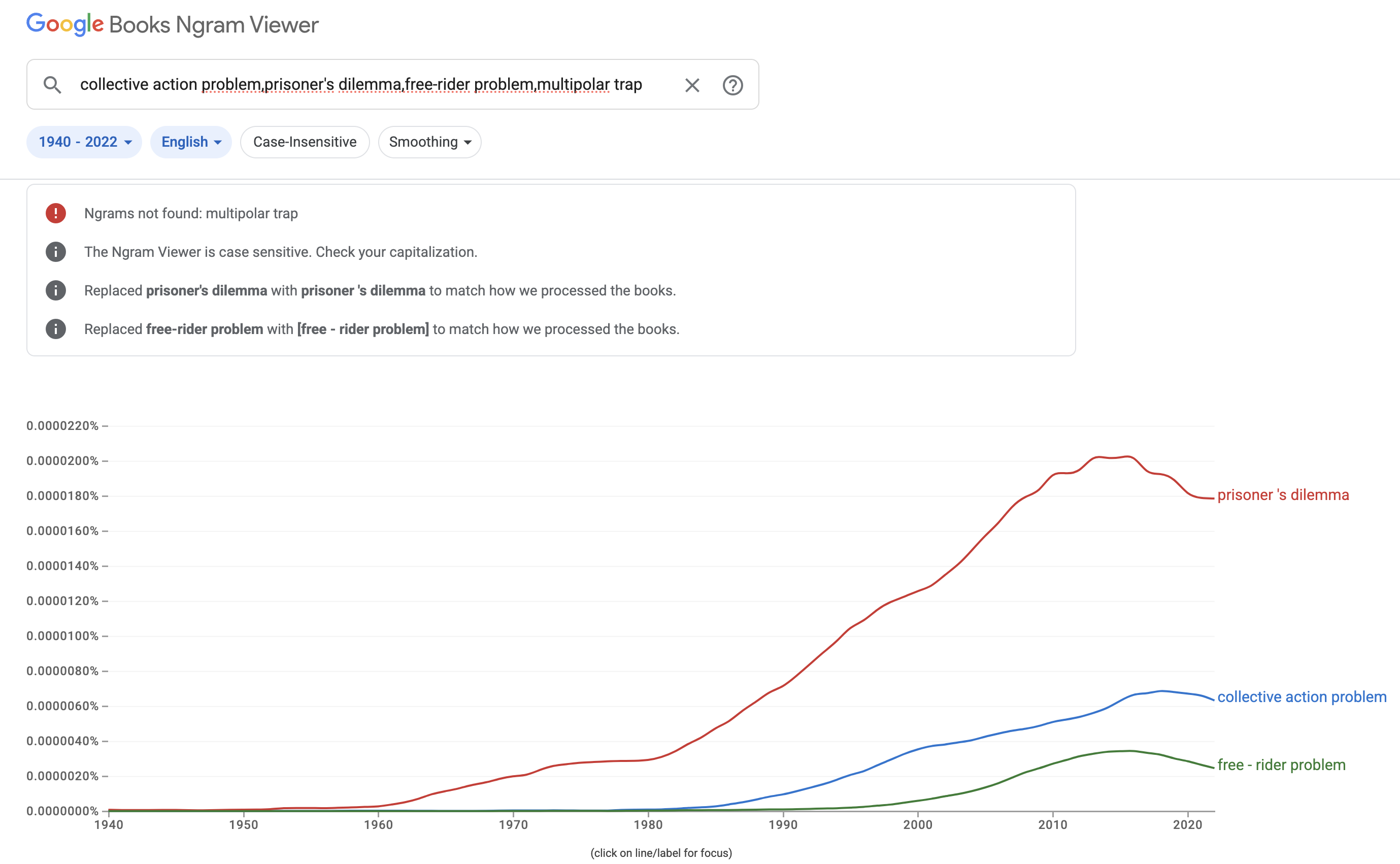
Multipolar trap does not even show up on Google ngrams relative to other terms:
[[Category:Concepts]]
[[Category:Examples of inventing new terminology for existing concepts]]