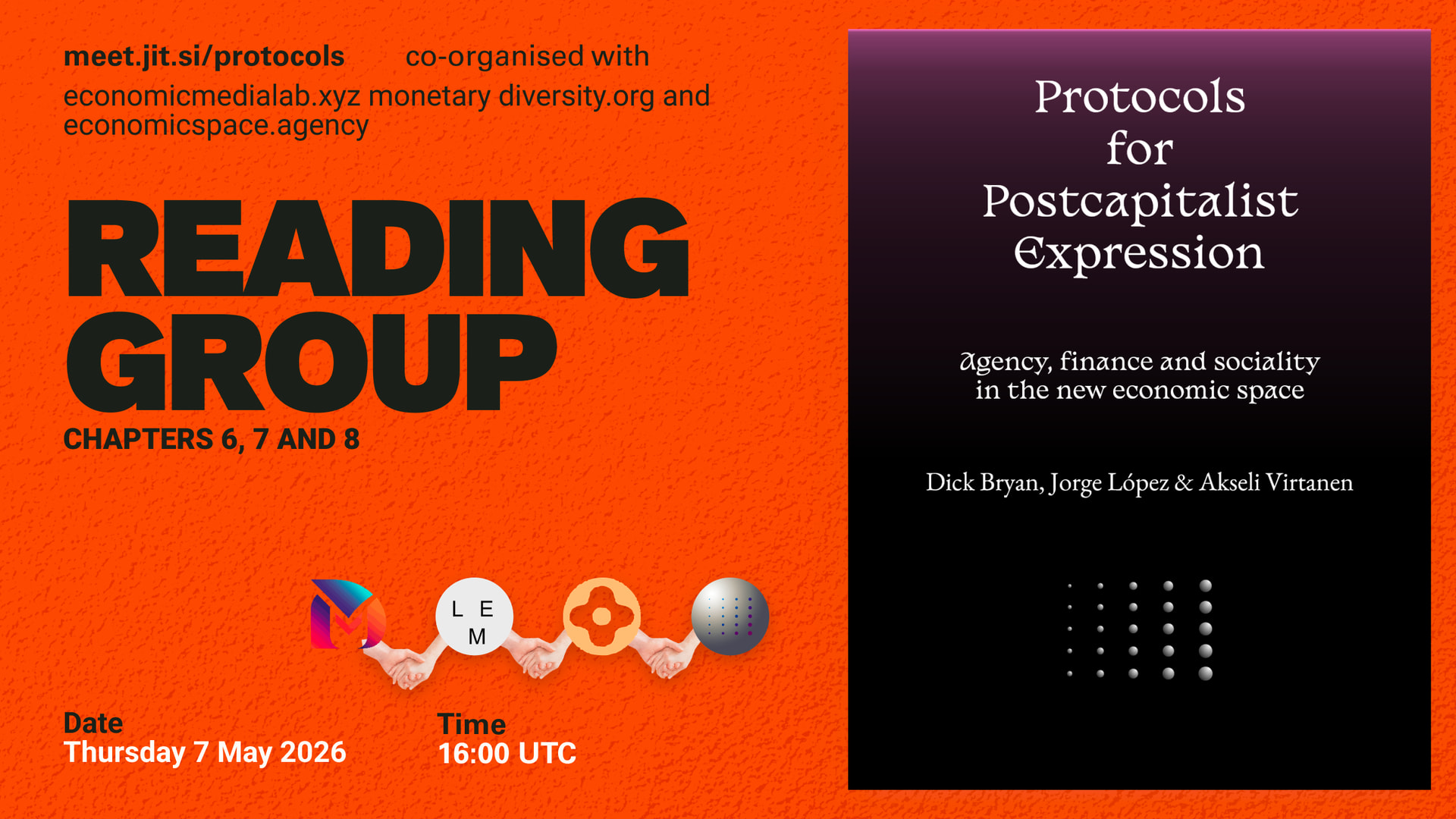
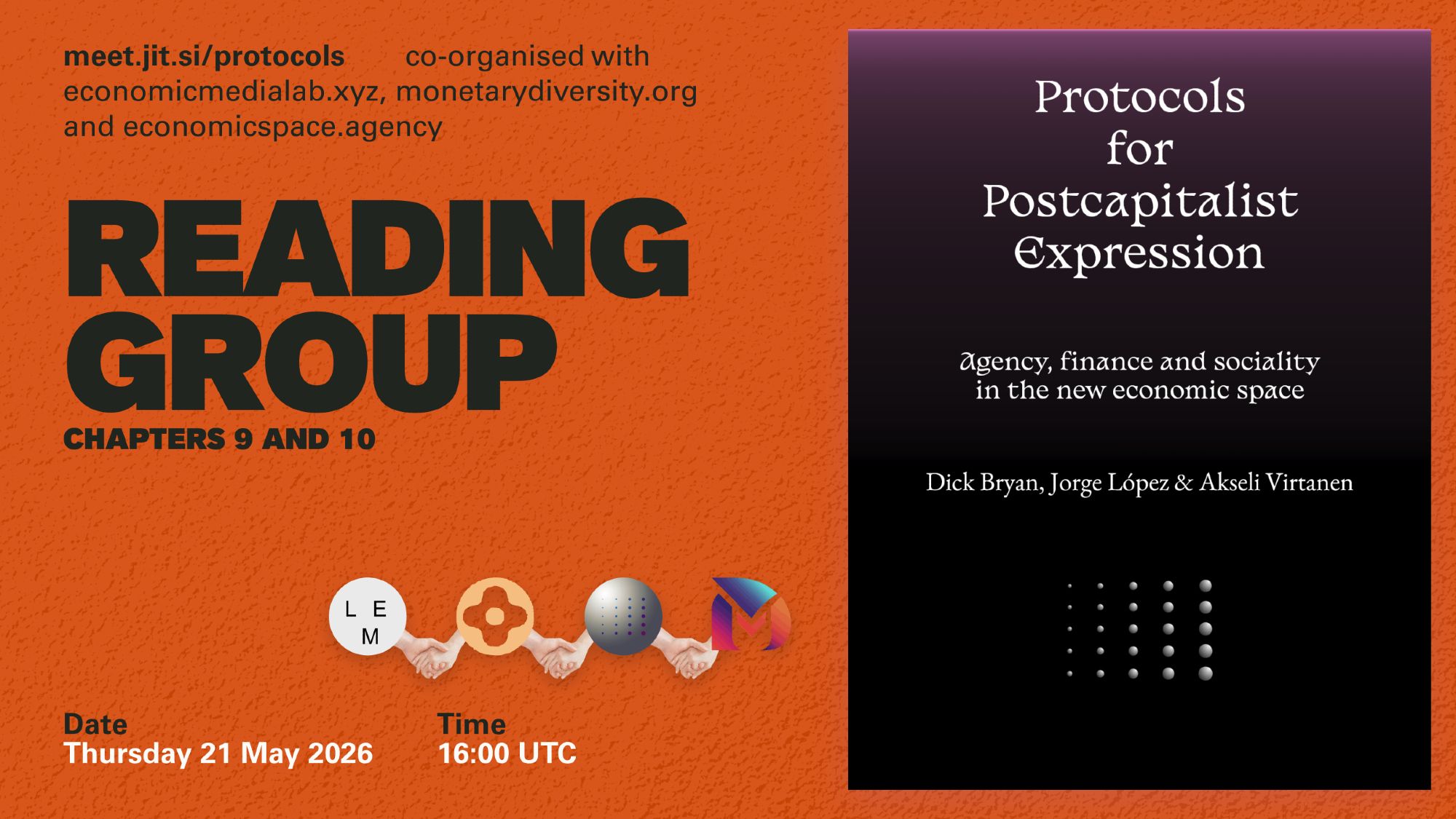
Protocols for Postcapitalist expression - Reading group

What would a postcapitalist, internet-native economic system look like?
Could that system secure collectively defined social and environmental benefits and create liquidity for their production?

To look for answers, at https://www.cryptoleftists.xyz we will be reading Protocols for Postcapitalist Expression

Join us for the launching session with the authors where we will discuss the foreword and the 1st chapter. Full schedule and reading materials on our tldraw.

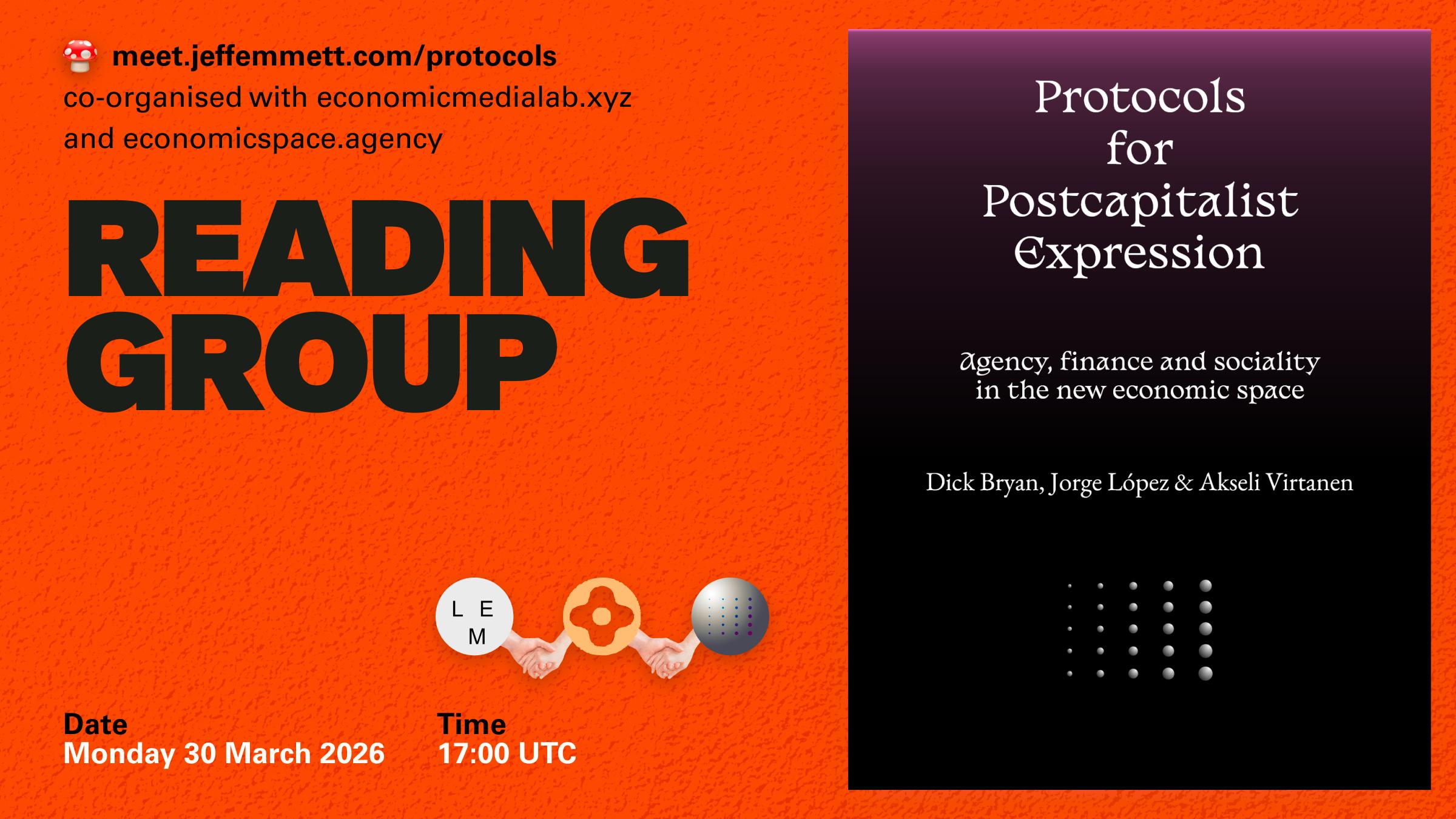
Event Title: Launching session of Protocols for Postcapitalist expression with authors
Event type: ⁠ Discord
When: 30th March, 17UTC
Description:
In Protocols, the authors build the conditions for a system where economic processes are not dictated by profit, and where what counts as value-creation and is rewarded by dividends can be collectively determined by the network. Care, the arts, the environment will not be after-thoughts to be subsidized by states or the rich, they can be at the core of the economy’s value proposition.

This book develops protocols that can generate all these processes. A blend of theoretical engagement with big economic ideas, media and information analytics, and careful protocol design of token-related processes of distributed exchange, matching, netting and clearing, Protocols systematically builds an alternative to neoliberal capitalism, centrally-planned socialism and reformist social democracy.

In an expressive, creative, risk-sharing, data-rich network of investing, producing, exchanging and lending, standard economic propositions get stood on their heads, and new political possibilities emerge.

1 Like

Unless life gets in the way, I plan to be there!

I’m got an R&D team of grad student developers working on @dvdjsph ‘s Promise Protocol. We’re looking for use cases. It seems like there is a strategic fit with postcapitalist thinking. Below is a quick AI brainstorm just to kick start the idea generation process.

2 Likes

This was worthwhile. Looking forward to future sessions!

1 Like

Thanks for joining last guys guys (# living in the #spread)

  • What counts as liquidity?
  • What counts as collateral?
  • What counts as “surplus” and
  • Who decides each of these?

Next session :smiling_face_with_sunglasses:

Event Title: Protocols for Postcapitalist expression Chapters 2 & 3
Event type: ⁠Reading group
When: Thursday 9th April, 16 UTC
Where: Jitsi Meet
Description:
After a great 1st session that you can watch here, we are gathering on Thursday 9th April, 16 UTC (and every 2 weeks after this) to discuss Chapter s 2 & 3. Full schedule and reading materials on our tldraw. Feel free to use it as a note taking space too :wink:
You are welcome to select a few passages that we can read and then think through in the call :wink:

My theoretical work lately has been a lot about systemic contextualizing. Namely, given a system that works in a particular way, what is external to that system that could potentially destroy the system or at the very least force it to restructure or adapt? In classic micro-economics “externalities” are ignored. By contrast, “externalities” for me are a central preoccupation.

From that POV, from a classic micro-economic framework, under capitalist rules of the game, what counts as “liquidity” is well-defined as cash and cash-equivalents. Markets decide how liquid any given asset is. Reading everyone from Niall Ferguson to Nassim Taleb, however, I’m acutely aware of many historical examples in which assumptions about collateral, underwriting, credit worthiness failed spectacularly and “liquidity” effectively became state-fiat in the form of bailouts. Up until fairly recently, US bonds, backed by the “full faith and credit” of the US government were the effective global liquidity standard. Will that continue? There are contextual factors at play at the moment that cast some doubt on this.

One thing that is not entirely clear to me about post-capitalist text for the reading group is if it is descriptive or prescriptive. My sense of liquidity in a descriptive sense is it works as I have described above - classically, until some Black Swan wrecks the system, and government steps in. Prescriptively, that’s not my idealized future, unsurprisingly. My most idealized system - something that might be truly “post-capitalist” would involve underwriting mapped tightly to sustainable matter/energy flows, rather than fictitious fiat money in which governments imagine they can relegate laws of nature to negligible “externalies”. I imagine in that world, a world with far stricter accounting standards, transactional liquidity would be harder to come by.

2 Likes

I would say it is prescriptive.
I understand that after the book was published, they have been formalising (mathematically describing) the Economic Space Protocol (ESP) and the next phase (which I hope is already undergoing) involves “moving” that formalisation into software.

My understanding is also that the ESP aims to offer anyone the chance to do what you have just started doing: describe their “most idealized system”, transform it into software and invite other people to “play the game”.
How to create network effects or, at least, gain a critical mass within each of the “economic spaces” we co-create (and of course, interoperability) are big questions that I guess the book will delve into.
The systemic contextualizing you mention is also key IMO. What makes economics spaces designed with the ESP resilient or capture resistant?

Thanks. Skimming the book again, I get back to my usual foci of system boundaries, system environments, and transition pathways between system state A and system state B. In this case, the top of mind question then becomes, in which systemic container does the ESP design discussion make the most sense?

My first observation on this is that considerable matter/energy remains tied up in the interlocking systems of Capital-Nation-State as described by Kojin Karatani. However, there are entropic limits to that “Borromean Knot” (Karatani’s term) as pointed out by Peter Pogany, Nate Hagens, and many others. Pogany, in particular noted the global political-economic system is prone to periodic entropic breakdown and rearrangements. Retrospectively, for Pogany those breakdown phases were French Revolution-Napoleon and WWI-WWII. Pogany passed in 2014, but its hard not to see him as prescient about the implications of MAGA for current global disorder. In Pogany’s terms, that’s clearly a global phase transition (Pogany: “chaotic transition”) to whatever comes next. To me, ESP architecting makes sense as a design study for what might come next. (After various combatants spend enough billions of dollars on munitions deconstructing current global infrastructure and exhaust themselves). In US terms, I’m working on post-Trumpian reconstruction. Of course, serious implementations at scale will need to wait for current political storms to break. By analogy, the Bretton Woods conference took place in 1944, but implementation could not proceed till after 1945.

OK, so after the Persian Gulf is well and truly wrecked, after NATO is fully dismantled, and after Europe embraces German rearmament as a good thing, what sort of world might emerge next? Probably multi-polar. To call MAGA the kernel of new world “system” is a horrible parody on the very notion of “system”. The global brain needs to be more than the contents of one quasi-dictatorial head. My best guess is the global brain will involve a distributed network of regional political-economic power centers. Karatani (based on Kant) as well as Pogany and others theorize about what that might look like.

There is currently a pragmatic global discussion about currency of account. I seriously doubt any given nation-state, not the US, not China, not any others, is going to have free reign to issue fiat money that the world in general takes seriously. Right now we are in a breakdown phase for the post-WWII dollar regime, but the next thing is not really here yet, so hedge with gold, yuan, yen, bitcoin, whatever. Certainly, no sane nation would limit itself to US dollar mechanisms for settlement of account. The design of a future, multi-polar, transnational settlement of account is what is seriously on the table.

What Pogany points out very clearly is that world-systems, when they coalesce, need bio-energetic foundations. Bretton Woods was built on petrol, just as the 19th century British Empire ran on coal. Whatever ESP might become, we need to attend to what will fuel the real economy it means to represent. Here is where I think environment stops being external to economics. “Value” is going to need to reflect environmental inputs. That’s a big discussion - bigger than just this post - but I wanted to at least set the stage for my future contributions. Definition of liquidity, credit, tokens, ledgers, etc. will need some kind of matter/energy dimension to be more than just a crypto-supported update to current systems like QuickBooks.
1 Like

All of you living in the spread!
Let´s reimagine production
Let´s reimagine staking

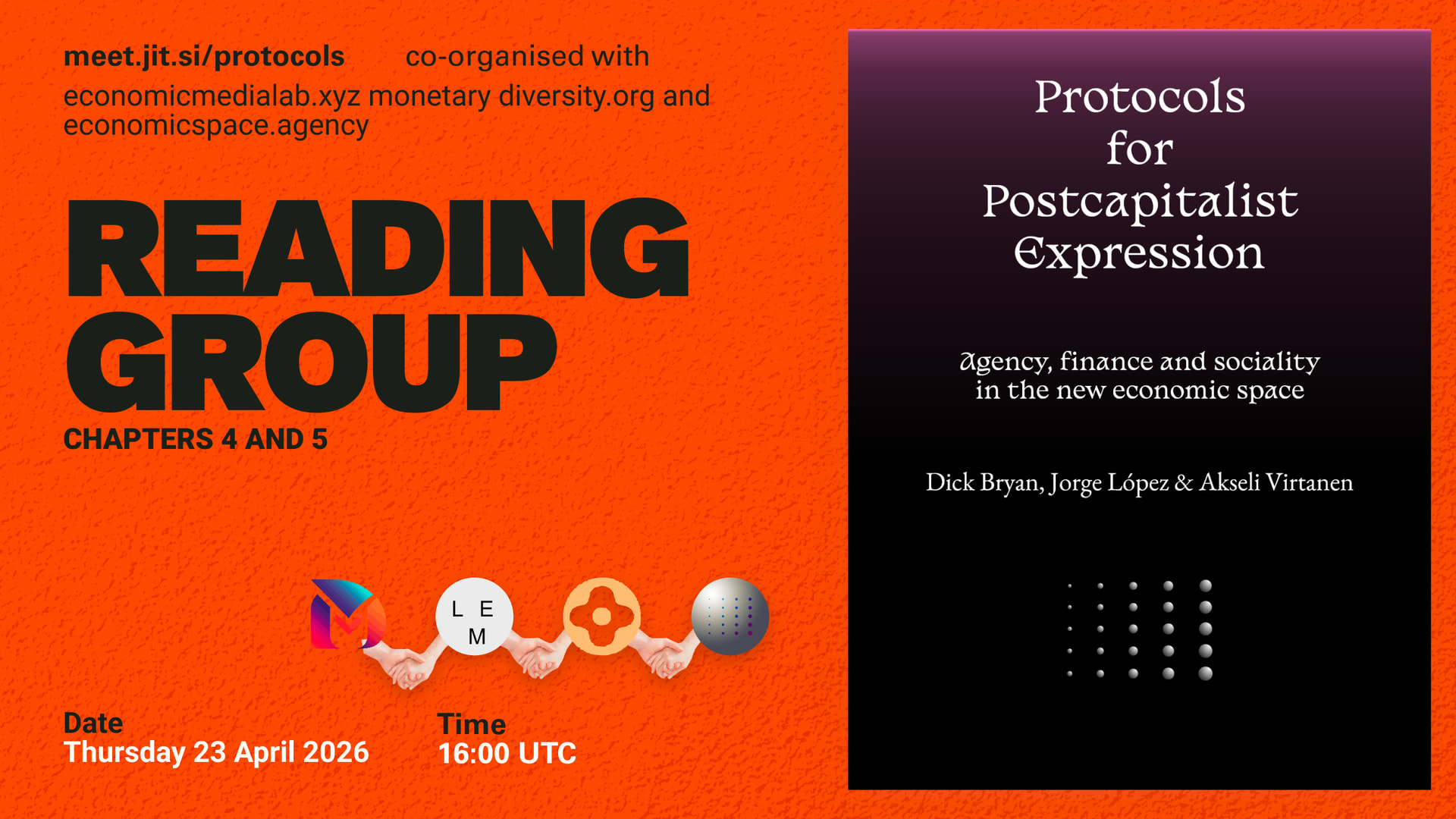
Event Title: Protocols for Postcapitalist expression Chapters 4 & 5

Event type: ⁠reading-group

When: Thursday 23 April 2026 at 18:00
Where: https://meet.jit.si/Protocols

Description: After introductory sessions (recording here) we are gathering on Thursday 23 April 2026 at 18:00 (and every 2 weeks after this) to dive deeper into the Economic Media Protocol: chapters 4 & 5 introduce performance and staking ::eye::
Full schedule and reading materials on our tldraw

Feel free to populate our shared journal too ::wink:: and you are welcome to select a few fragments (select - right click - copy link to highlight) and paste them on tldraw that we can read and think through them in the call ::wink::