Resources for developing a deeper understand and intuition regarding LLMs

Hello!

Below I will share some resources regarding developing a deeper understand and intuition related to LLMs. If some of the material resonates with you we might engage in a conversation on what this could mean for our daily habbits or relationships with computing.

https://arxiv.org/pdf/2609.03344

Quick meta question:

How do you read papers? Do you sit alone infront of your computer or do you have a kindle like device , sit outside in the sun or in a cafe with other people?

In my perfect world, I would have paper copies of everything. In a Victorian library. With servants bringing me papers on my demand, which I could scarcely locate myself from having randomly scattered them in great piles all over the room!

In this currently existing world, we must however muddle through … My stack of books for reading (in a chair, away from electronics) averages about 5 deep. There are several shelves of books near this computer. Occasionally I grab one to look something up. I read/skim/scan all manner of pdfs at this laptop. I can barely tolerate Kindles. Tablets are good for watching YouTube, but for reading I need larger screens. And screen magnifiers. I use AI summaries and Google search all day long, the way I used to use library card catalogs - to find things. The goal is to sort through great masses of ideas on the way to finding well written pieces that are truly inspirational. Periodically, throughout the day, I go outside and do something physical. My true thinking occurs in such unplugged settings. What happens back at the computer is typing it all up.

Lately, I’ve been catching up with what Hegel meant by “objective spirit”. Society is full of structures that humans created, but to any given one of us, it all seems like some alien thing - a sort of humanly-constructed order of its own - that frames us, limits us, and poses the existential questions each of us must address. From that POV, LLMs are just the latest turning of the “objective spirit”.

“Subjective spirit” by contrast flows through each of us. Honestly, I don’t much care whatever society is throwing out there in its latest structural turn. Like one of my favorite philosophers (no fan of Hegel, BTW), put it - “the order of history emerges from the history of order”. LLM are just the latest thing in the history of order. Social orders come and go. The challenge of ethical action in historical context remains rather similar down through the ages. Namely, grasp the historical context - and discern the ethical demands of the moment.

My advice to youth is pretty simple in the current context. Something along the lines of “get off the damn computer and go play outside for awhile!”. Very dialectical!

1 Like

I like the view expressed by McGilchrist here. I don’t just like it, I think it’s crucial for us to grasp this point; I don’t think we have a choice but to develop a relationship. The question is, what sort of relationship should it be? Can we assume, and keep, the role of master?

2 Likes

As a practical matter, I use AI this way all the time. Intuitive hypothesis formation, followed by LLM hypothesis testing, followed by intuitive reflection on LLM outputs, etc. What I’m asking AI to do is to go to all Internet-connected content, do a massive statistical correlation study on comparative word frequency associations, and show me the results. Silicon is not doing anything neurons are not capable of - it’s just much faster at it - and far less bored by it! The upshot is my intuitive mind gets to range wider than it used to, because I can test hypothesis that are beyond the experience or knowledge base of human linguistic communities that generally don’t read much of the content I would wish to factor into my analyses.

1 Like

Can we avoid a Butlerian Jihad as described here (7 min)

Can you explain what you mean?

So in oneway Frank Herbt dared to ask the question: can we envision a culture without utter dependence on machines and he showed his ideas for that with the dune universe.

Many people use LLMs in quite a different way then most intellectual people. Sam Altman (OpenAI) said people in their 20’s use it as their “OperatingSystem” to decide on everything in their lives. To such degree that people want to marry their chatbots.

So in the paradigm of expansive capitalism, transhumanism etc.. Where people are exposed to technology not because they want to but because other people want to exert more control over other people.

How is it possible to stop this armsrace? Can we just ask AI to stop?

Late stage capitalism seeks to expand the paradigm of infinite growth and expansion into space, its fine if we just grow further in space?

A technology pushed to its extremes reverses its effects. Can we as a society avoid these extrems?

If not people tend to act violently or as Josha Bach says:

- 2:36:40 JB on the difficulties of **transitions of society structures** at the society/collective scale “.. so we do try to find **natural transitions** and they’re not that many natural transitions available at any given point”

- LF: “What do you mean by natural transitions?”

- JB: “so we try to not to have revolutions if he can help it right..”

https://youtu.be/P-2P3MSZrBM?si=P5_PEIjJlKZdLnZc Lex friedman disallows embedded you have to click on it.

I’m not seeing that we are trying to avoid having revolutions.

Does that make sense?

To be frank, no, it doesn’t make much sense to me. I’m not sure what you’re referring to when you say a technology pushed to its limits. I know McLuhan’s framework, but I don’t see what you’re applying it to.

Also, not sure what you meant by asking AI to stop. Do you mean this rhetorically?

How would we avoid a revolution? And why?

For me the wider issue is the extent to which we have become over-reliant on language itself. That may sound rather strange, given that language is largely what allows a complex society to function in the first place. But alongside language is experience, and I think we increasingly confuse the description of something with knowing it.

This becomes particularly interesting with LLMs. An LLM can produce a magnificent description of swimming while remaining, rather inconveniently, unable to get wet. It can discuss grief without having lost anyone, forests without having stood in one, fear without ever having been frightened. Its entire world is representation.

Humans aren’t restricted in this way. We communicate and learn through ceremony, work, play, music, touch, making things, sitting around fires, walking through forests, getting things wrong together and occasionally just shutting up. Yet a great deal of modern life has steadily reduced these forms of communication while expanding the amount of time we spend exchanging representations of experience through screens.

So I think your question about how and where we read papers is more important than it might initially appear. Reading something alone on a laptop isn’t necessarily the same cognitive event as reading it outside, discussing it with somebody over coffee, or taking the ideas away and testing them against something encountered in the world.

There is another part of this which interests me. Human cultures have also used ceremony, contemplative practices and psychoactive substances to alter ordinary modes of perception, sometimes quite radically. Psychedelics are particularly interesting here because of their effects on systems including the default mode network. Whatever interpretation one places on the resulting experiences, they can rather forcibly demonstrate that our normal linguistic, conceptual model of reality is not reality itself. Modern Western society largely pushed such practices to the margins, although that is beginning to change.

So my concern with LLMs isn’t simply that we’ll outsource too much thinking to them. It’s that they have arrived at a point when we were already spending an extraordinary proportion of our lives inside language, abstraction and representation.

The proposed “cognitive immunisation” might therefore require something slightly paradoxical: not better arguments about LLMs, nor another 40 papers about their effects on cognition, but occasionally closing the laptop and doing something that cannot be turned into a prompt.

Preferably outside.

1 Like

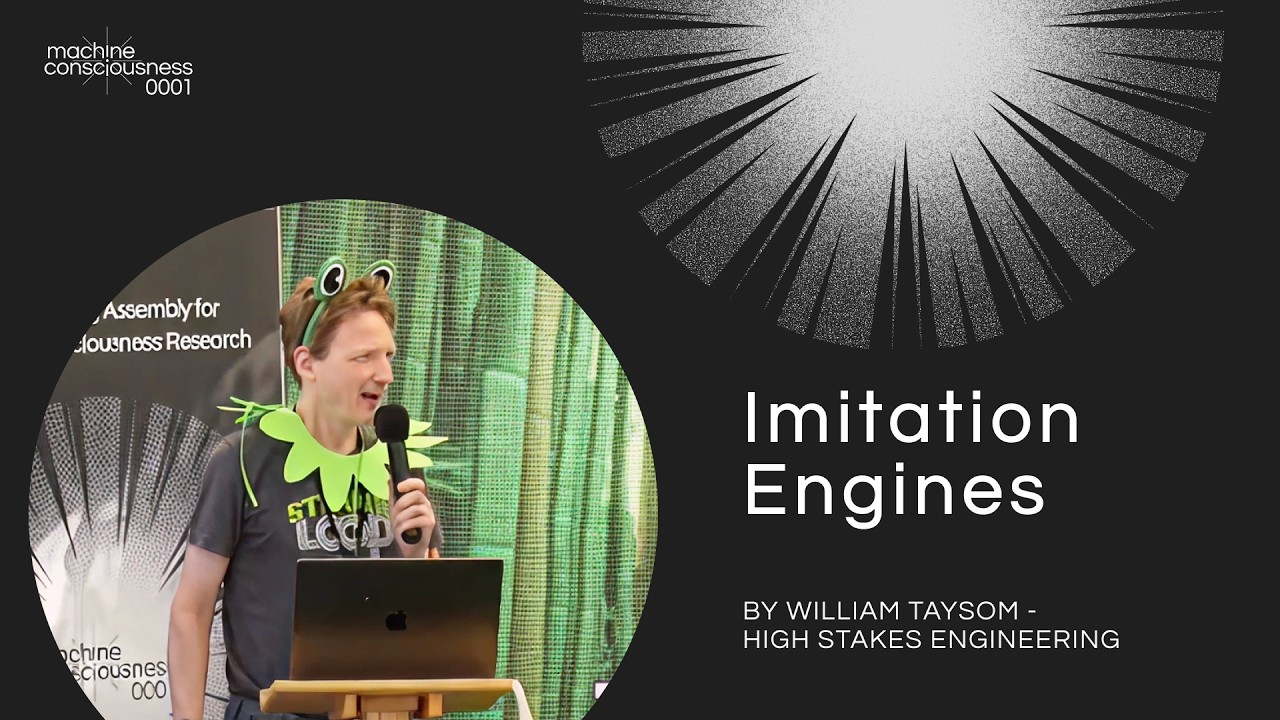
Imitation Engines - William Taysom - wild rant there is content but also style and presentation, what have these things done to us?

I’d like to offer a recent case study in how the human-LLM-human process outlined above works.

For at least a couple years now, I’ve suspected that Hanzi Freinacht’s stages of history model derives too directly from specifically Western experience. I tried exploring that hypothesis in multiple online forums (like this one), but the problem came back that not many forum participants had the requisite knowledge or interest in China, Japan, India, Islam, Africa and other non-Western cultures to really put my ideas to the test. So I needed a thought partner who at least has a knowledge base I can engage with, short of me relocating to Oxford, Cambridge, Harvard or some such. Below is a link to the Hanzi model. Below that is how I recently used LLMs to stress test it.

https://medium.com/@hanzifreinacht/the-6-hidden-patterns-introduction-b3d5cc63fa50

So what I did was to put the article above on a browser tab and then factored that article through multiple Gemini prompts of the form “How well does the model in the linked tab align with [some culture’s] history?” I did this for all areas listed above, as well as Korea, Russia, and few others. On principle, a good university library would support the same exercise - and I’ve been doing it that way for multiple decades - but the LLM is quicker and the output is tidier.

By way of quick summary, the Hanzi model holds up surprisingly well over the first three stages (Animist, Faustian, Post-Faustian). Those three really were pretty much all over the world. The LLM asserted similar universality for the Modern, but I smelled something “off” in the detailed output. Namely, in too many geographies, the Modern only arrived as embodied by European or US gun ships. The development was completely inorganic from the local POV. Also, I asked the LLM to clarify how the Song Dynasty related to the Modern. The LLM concurs with human scholarship that the Song was the most “modern” thing going in its era (but I had to kick the LLM a bit to get that out - illustrating that human riders need to guide the horse on occasion!) Anyway, what I came away with was a very different shape of the “modern” than would be implied by standard stage theory. The modern is not some organic development that happens willy-nilly to all cultures in the course of time. It’s a historical structure that emerged in one specific geography and then got foisted onto all the others! How those other civilizational cultures are dialectically appropriating the foreign-imposed “modern” is a much larger story I would gladly wish to explore (but not, for brevity’s sake, in this current post. As for the “Post-modern” and the “Metamodern”, on a global basis, these are hothouse plants, barely visible outside elite urban settings. To call these two “stages of history” is really stretching the point quite a bit. To my historically trained eye, they look more like fashion trends within the Modern, and moreover, fashion trends lacking appeal beyond certain very niche markets.

Then, to really drive the nail home, I asked the LLM to assess recent US history under the Hanzi model. Guess which level MAGA clocks in at? That’s right - the Faustian! How, exactly, can these “stages of history” be running backwards like that? Shouldn’t we all be gender-fluid, vegan, yoga practitioners by now? In short, the LLM sessions supported what I suspected all along - the “stages” model is too Western and too unidirectional to support its many ambitions. The LLM did not exactly hand me a better model (that’s my job), but it did suggest a few interesting directions in which that analysis might lead.

I see all of those temptations, choices and micro-decisions being something that individuals themselves should grapple with.

I agree that phenomenology is a thing - but I don’t see how LLM describing swimming is violating it. It’s the same with painters depicting nature or synths reproducing acoustic sounds. Let’s say it somehow offends or diminishes the real thing. So what?

Humans are restricted in many ways - and we’re gradually removing some restrictions using everything available.

We’re getting progressively over-reliant on medicines, technology and other externalities of modern life. A person who lived 300 years ago was also becoming over-reliant on something that hadn’t existed in the preceding period.

1 Like

From the software development trenches @rufuspollock Moldable Development Patterns (draft) · GitHub

Found by my Friend charles blass from switzerland: They Are Closing The Library. We Are Guarding The Wrong Door.

Shared by ( human!) friends over bluesky: If anything should go wrong.

Lately Habermas opened my eyes to what Hegel’s “objective spirit” is all about, and I can’t help but see objective spirit in the emerging cultural influence of LLMs. Even in the days when the printing press was cutting edge information technology, language itself (and culture and symbolic systems more generally) were beyond the reach of human subjectivity. Creative spirits could give language and culture a nudge and launch new phrases and ideas into that raging stream, but the stream of linguistic performance itself was beyond the direction of any given person. Language makes us as much as we make language.

Banning LLMs from cultural-linguistic influence will likely work just about as well as prohibiting Jungian archetypes from entering dreamscapes. In short, it won’t work. At all. Banning AI makes about as much sense as prohibiting the sun from rising. What might work better for the intended purpose (things like preserving human freedom, dignity, and intellectual capability) is to focus more positively on the tools and applications people should prefer to be using. For example, I’m not using AI to write this, because one of the points of writing this is to connect neural pathways in my own head and to seek resonance with other humans who might chance to read it. AI is quite useless for any of that, so it never tempted me for a minute to inject AI into the process. But if I want a summary of current AI policies across thousands of colleges and universities, for example, it would be a complete waste of time to approach that task using anything other than AI. Is it really all that revolutionary to note that different tools do different jobs?

Thankfully, I have retired as a college professor, so I don’t have to give much of a care any more about plagiarism, publication trails, getting tenure, who gets what grade, which degree leads to which job, and so on. That’s all pretty broken anyway. If AI blows that entire house over, I’m not sure it will be that much of a loss. As for human intelligence, for some reason all of a sudden conversations about Kant and Hegel have been popping up in my local coffee shops! These conversations also include working class tradesmen exploring religion and philosophy in a search for meaning. Subjective spirit - the quest for the truly personal - will find its way through! Education will rise again - if not in the schools, at least in the coffee shops.

Commenting on my own comment … it just now occurred to me how I might handle the LLM/plagiarism situation if somehow I were forced back into a classroom and needed to apply grades to homework assignments. Here is a summary in bullet points (these are the sort of mental notes that were about as close as I ever got to actual lesson plans).

  • The point of this entire class is to get you more connected with yourself - your values, your energies, your skills, your interests, your situation in the world.

  • The assignments given are exercises for you to work various “muscles” to build yourself up.

  • I really don’t care about your “output”. In any case, less is more. Work very hard to do the right things, not just to do a lot of things.

  • As far as writing is concerned, it’s really an opportunity for you to express yourself to yourself. Start with rough, raw notes. (Finish with rough, raw notes, as far as that’s concerned!). You are trying to connect your feelings to your thoughts. No machine can do that for you, so don’t waste any time with machines!

  • When you share your writing with others, it’s not about the writing itself. It’s about the relationships you wish to form. Fine with me if you use LLMs to clean up the grammar, translate it, rearrange it into bullet points, etc. But that’s all just packaging. Unless the feelings were real in the first place, the packaging is useless. Focus on the feelings.

1 Like