Thought Experiments
Thought Experiment A
A rational agent is playing single-round prisoner’s dilemma with their perfect clone. The clone will make the same decision as the agent. Why might the agent cooperate?
Consider these reasons:
- “They’ll do what I do, so cooperation maximizes my payoff” → cooperate
- “They’re another instance of me, so harming them would harm me” → cooperate
Both recommend cooperation.
Thought Experiment B
The agent learns their clone has already cooperated. Now what?
The same two lines of reasoning lead to different conclusions:
- “They’ve already cooperated, so defecting maximizes my payoff” → defect
- “They’re another instance of me, so harming them would harm me” → cooperate
The decision now depends on the agent’s internal arbitration between conflicting reasons.
What’s Happening?
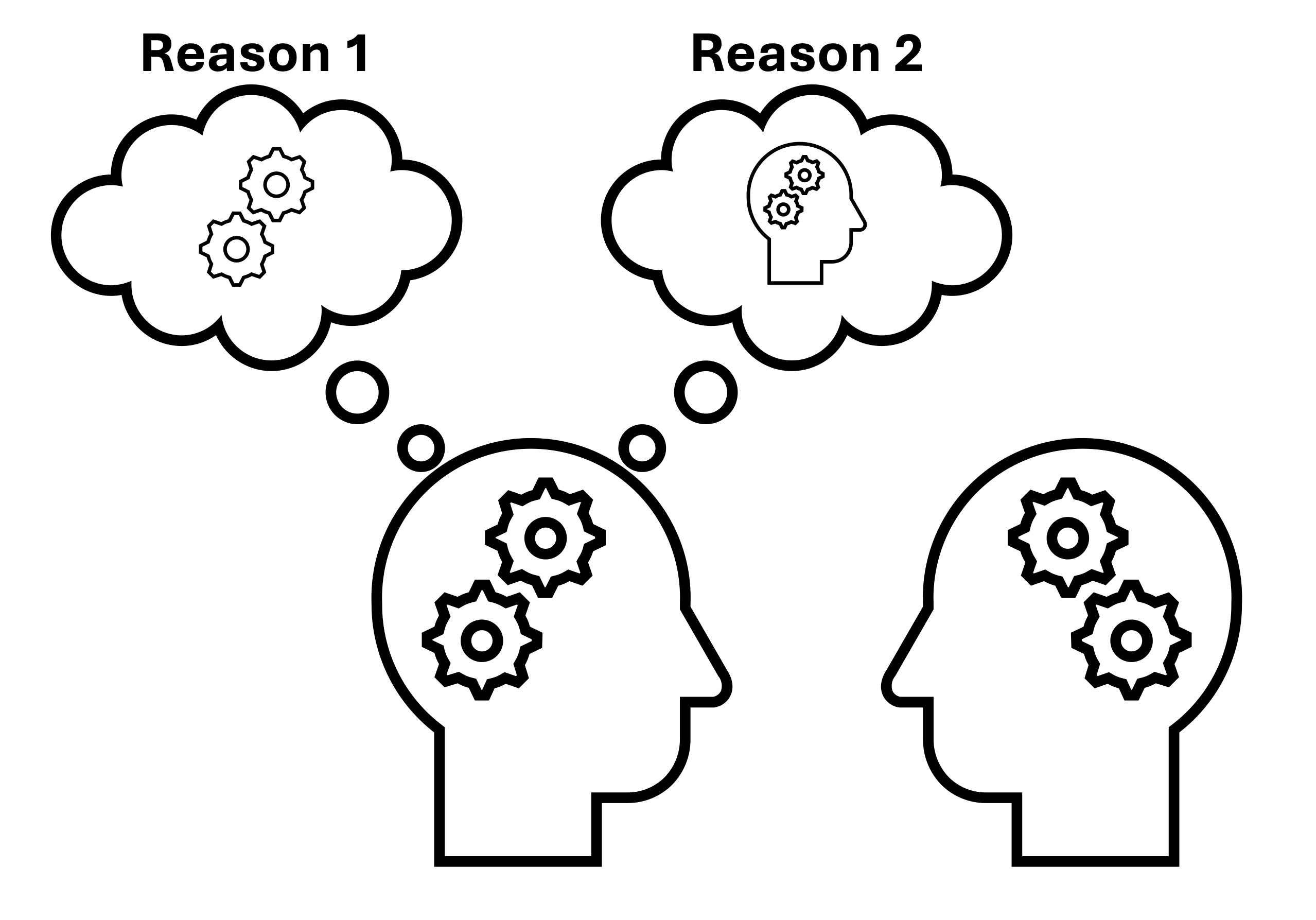
Each line of reasoning implicitly draws an identity boundary, partitioning the relevant agents:
First line of reasoning: {me} inside | {clone} outside
- Experiment A: “If I cooperate, they (external agent) cooperate, maximizing my payoff” → cooperate
- Experiment B: “They (external agent) already cooperated, I should defect” → defect
Second line of reasoning: {me, clone} inside | {} outside
- Experiment A: “We shouldn’t harm ourselves” → cooperate
- Experiment B: “We shouldn’t harm ourselves” → cooperate
The first treats the clone as part of the environment to navigate for personal benefit. The second treats the clone as part of an extended identity. When both recommend the same action (Experiment A), the decision is overdetermined. When they conflict (Experiment B), the agent must arbitrate.
Framework
- For a single decision to cooperate or defect, there may be multiple reasons
- Many of these reasons implicitly create an identity boundary, partitioning the full set of decision-relevant agents into a mutually exclusive complementary set pair.
- If agent(s) appear in both of a reason’s complementary set pair, that reason may be further decomposed into multiple reasons, each with their own complementary set pair.
- Multiple reasons can unanimously support the same decision (overdetermination), or be in conflict.
- When reasons conflict, internal arbitration determines the outcome.
- Implicit identity boundaries are per-reason, not per-decision or per-decision-maker.
In real-world decisions:
- Cooperation decisions may be made with with a limited number of familiar and salient reasons, not all possible reasons.
- Across decisions, conjugate reasons may be applied inconsistently.
Emergent Patterns
Each reason’s complementary set pair generates distinct relationship dynamics. For each reason, an agent relates to other agents inside the implicit extended identity boundary differently than to those outside.
Instrumental Relating
When a reason’s boundary excludes other decision-relevant agents, it relates to them instrumentally - treating them as environment to navigate. For systems dominated by instrumental relating patterns:
Cooperation
- is conditional to modeled costs and benefits
- is fragile to enforcement disruption or incentive change
- scales through rules and institutions, so can be imposed quickly
Agents
- are incentivized to game the system, generating increasingly complex arms races
Recognition relating
When a reason’s boundary includes other decision-relevant agents, it relates to them through recognition - treating them as multiply realized instances of that reason’s identity pattern. For systems dominated by recognition relating patterns:
Cooperation
- is conditional on recognizing shared identity pattern
- is fragile to identity reinterpretation
- is difficult to scale beyond direct relationships, and requires time to develop
Agents
- resist temptation to game the system, making enforcement self-regulating
Reason Salience
The familiar collection of reasons is conditioned by:
- Evolutionary heritage: kin, tribe, species
- Cultural transmission: nation, religion, class, profession
- Personal history: friends, enemies, “people who’ve helped me”
- Situational priming: which partitions the current context makes relevant
This constraint explains why framing matters: shared identity patterns which are emphasized (“we’re a family”) or downplayed (“they’re barely human”) may shift behavior without changing material payoffs. Institutions shape cooperative reasoning not just by changing incentives, but by making certain identity boundaries more salient.

 Nash + Kairos: A Conceptual Sketch Toward a Trifold Temporal Model of Revolutionary Emergence


 Enter Time and Transformation