Unrival 2027: A Letter from the Future

Letter from the Future exercise

In agreement with @RobertBunge’s suggestion to discuss specific approaches to my call for sharing Letters to the Future, I’m posting my full letter here. Feel free to copy this format, i.e. post your own Letter from the Future as a new thread so we can discuss your vision. Feedback on my vision is also greatly appreciated.

A Letter from 2027

A Vision of the Unrival Movement

Estimated Read Time: 5 minutes

Autumnal Equinox, 2027

Dear changemaker and exhausted inhabitant of the tumultuous third quarter of 2025,

I write in a spirit of hope and solidarity—but also urgency, hoping to convey something of the tremendous agency latent in your world right now. Keep running the race to awaken it, even as things appear to grow graver. Now more than ever, look within for a vision of a future marked by beauty and possibility—one within reach if you dare to define it and live toward it.

Having made it through the last two years, I can report that an unequivocally positive cultural moment is in the air—a relief we’ve never needed more. I want to tell you about the part of this change I witnessed firsthand.

The Beginning: A Circle of Ambassadors

It started, as world-changing things always do, with a small group. I remember its inception clearly. We were a circle of ambassadors to the subconscious—hypnotists—and we knew we had access to a unique leverage point for transformation, even as the whole world was crying out for it.

But here’s what made us different: we weren’t just another group of well-meaning practitioners. We understood something fundamental about the architecture of the human mind. As Dr. John Kappas once articulated with startling clarity:

“Before we begin to explore the way in which our life script is written by our subconscious mind, you will have to accept one fact. The TRUTH ABOUT YOURSELF is that YOU ARE A SUCCESS! Yes, right now! No matter how down-and-out you may feel, you have succeeded in carrying out your current life script. You were programmed by your past, and success in any endeavor means carrying out your subconscious plans. You have done this well. The only problem is that your subconscious script is not the pattern you want for your present and future.”

— Dr. John Kappas

This insight became our north star. We weren’t trying to fix broken people—we were helping successful executors of unconscious scripts rewrite their programming.

The Iceberg Problem

Picture the human mind as an iceberg. The conscious, goal-seeking mind—everything you think determines your behavior—accounts for only about 12% of total mental activity. The unconscious, that vast 88% beneath the surface, often pursues aims completely at odds with our conscious goals. We’d been trying to steer the ship by rearranging deck chairs on the visible tip while ignoring the massive force beneath.

But the real breakthrough came when we realized this same pattern operated at every level of society. Justas individuals have unconscious programming that sabotages conscious aims, society has a collective unconscious—deep scripts that oppose our stated goals. We hadn’t failed as a civilization; we’d succeeded brilliantly at executing a script no one consciously wanted.

The Four-Front War We Were All Losing

For years, we’d all been fighting on separate fronts, each convinced our approach was the answer:

Mindset

The inner-individual realm, mastered by hypnotists and therapists.

Behavior

The outer-individual sphere, addressed through policy and incentives.

Culture

Our inner-collective programming, the focus of deep, slow work.

Systems

The outer-collective structures built by technologists and reformers.

We were all trying to solve a four-dimensional problem with one-dimensional solutions. Like the blind men describing an elephant, each of us had a piece of the truth but mistook it for the whole.

The Bridge: From Insight to Integration

The movement that emerged—which we called Unrival—wasn’t born from a single discovery but from integration. The name itself carried a dual meaning that emerged almost spontaneously from our early dialogues: to outcompete or transcend old patterns, and to undo the rivalry between our inner intentions and outer reality. Did it arise through spontaneous dialogos, or was it clever marketing? We’re no longer certain, and perhaps that ambiguity is part of its power.

What made Unrival revolutionary was how it bridged the inner and outer dimensions of change. We started with our hypnotic leverage point—helping individuals align their conscious goals with subconscious programming. But we knew individual transformation without systemic change was like trying to swim upstream in a toxic river.

The Technology That Changed Everything: The Promise

This is where things got interesting. We developed something deceptively simple yet profound: the Public Promise. By making carefully crafted commitments and recording their fulfillment—kept or broken—as a matter of public record, we created something unprecedented: integrity as a trackable metric.

The Promise was our Trojan Horse—a simple gift that carried a revolutionary change within.

Think about it: throughout history, trust has been the most valuable yet unmeasurable currency. Politicians promise, corporations pledge, individuals commit—but accountability remained ethereal. The Public Promise changed that. It connected a person’s inner commitment (Mindset) to their public actions (Behavior) and held them accountable in a way that rebuilt our collective trust (Culture) and reformed our institutions (Systems).

Within months, the evidence we generated for the efficacy of this approach was unparalleled. It became difficult to deny that the mind’s power—channeled through commitment and accountability—could yield therapeutic and societal benefits few in mainstream institutions were comfortable admitting. “Just imagine the impact of this power finally being understood,” people remarked as it unfolded.

The Cascade Effect

Of course, popularizing a single modality wasn’t the point—it was the first domino. Once merit became demonstrable in one arena, the effects cascaded in ways we never anticipated:

  1. Individuals who aligned their conscious and unconscious minds discovered staggering personal agency.

  2. This personal integrity, made visible through Public Promises, began rebuilding social trust.

  3. As trust grew and people succeeded together, we began healing our collective culture.

  4. New systems emerged organically, designed around transparency and mutual accountability.

Because the movement globalized quickly and adapted locally, its development cannot be traced precisely. In some places, it took a decidedly political route—voters even saw Unrival listed as a new option on local ballots. Many are surprised by its modest origin: a coaching platform focused on goal achievement that began with hypnotists who believed rapidly scaling inner work would yield positive second-order effects few could imagine.

The Oldest Technology, The Newest Era

What we discovered wasn’t new—it was perhaps the oldest technology imaginable: the Promise. But by combining this ancient social technology with modern understanding of consciousness, collective behavior, and systematic change, we unlocked something profound. We showed, beyond reasonable doubt, that a new era of healing and transformation had arrived.

Your Turn

The future you’re hoping for is possible. The tools are all around you—scattered across disciplines, hidden in separate silos, waiting to be integrated via a declared inten. The work isn’t to invent something new but to bridge what already exists by declaring your intentions to make them viable.

Look for the hypnotists and the healers working on Mindset. Find the reformers changing Behavior. Connect with the artists and philosophers shifting Culture. Partner with the builders creating new Systems. And most importantly, understand that you need all four.

The race isn’t just to awaken agency—it’s to integrate it across every dimension of change. That’s the real promise of Unrival: not a single solution, but a unified approach to the magnificent, messy work of human transformation.

Add your letter →

Keep running. We’re waiting for you on the other side.

With solidarity and hope,
A witness to the turning
2 Likes

My pragmatic 2025 predictions for 2027 - two years out - involve non-trivial probabilities of highly problematic political and/or economic developments in both US and global contexts. Because of the specific nature of what those developments may be, my 2027 position will not be enhanced by being overly specific in 2025 (on an Internet forum) about the specific nature of what the 2027 scenarios might be. So my imagined 2027 self won’t be painting too clear a picture for 2025, because 2027 will have its own challenges. A generally low profile in 2027 may well be quite advantageous.

In 2025, my main concern is to set up both me and everyone else I interact with in the best possible way for what 2027 might look like. For that reason, my main activism is hyperlocal. That is married to international work that is generally theoretical. My 2027 local goals are to preserve as much of the generally pleasant local environment we currently enjoy here, and to be involved with the ongoing development, strengthening, and enhancement of a variety of locally grounded communities of practice. At an international level, I hope to continue evolving the sorts of perspectives under discussion in this forum, and to form peer relationships with partners the world over. Some of those of those partners will have degrees of freedom I may not in 2027.

This isn’t mean to be an exercise in pragmatic prediction; if I were to predict a likeliest case scenario for how things will look in two years, it would be far bleaker, truth be told. Instead, this is an exercise meant to motivate action towards a vision of a better future, under the assumption that we have agency, and our intentions can influence what is likely to take place.

Thanks for the clarification.

As a pre-writing exercise, then I will envision a version of 2027 that I might wish to see, with a plausible (but not at all certain) pathway for how we get from here to there. Some elements of that pathway include:

  • US authoritarians overplaying their hands and getting significant pushback, even from the political right.
  • A significant - but not fatal - economic downturn putting everyone on notice that extractive growth is not a viable long-term model.
  • Enough natural disasters again, to put everyone on notice. Sadly, without victims and causalities, it’s highly doubtful the climate change story is going to sink in at popular levels. I would very much prefer that everyone read science books and change their minds about climate that way. Sadly, I see nothing in the historical record that suggests ideas alone have the capacity to change culture.
  • A lot of my intended positive work 2025-27 is against the background of gathering metacrisis storms, with the desired results for 2027 being along the lines of successfully constructed lifeboats for those able to visualize what is likely coming.

Expounding on the successfully constructed lifeboats is what this exercise is all about. The question is, when these system shocks arrive, who has prepared the lifeboats? What do they look like, how do they operate? To me, that should be the purpose of groups like this one, or any group of intellectuals. Anything else is rearranging the deckchairs.

The format of the Letter from the Future exercise is important; it asks you to imagine a group you are part of (e.g. this one) and the best-case scenario of how it might impact the world. This isn’t a trivial question at all. The letter is meant to be sent, hypothetically, to someone likely to not be part of the group in the future you envision. In other words, what difference would it make if your group never existed? What would someone lose out on by not partaking in its shared purpose? This is crucial, as it’s easy to rationalize chaos when the correct response is action.

I think the boat metaphor is quite apt here. I’d upgrade it to an ark, given the parallels to the biblical story (this has been something of a theme in my own thought for the last 6 years or so). I.e. we have a deluge coming that some foresee, and most don’t, and the ones that do appear crazy to most. But at some point, the rain comes and doesn’t let up as it normally should, indicating we’re in no ordinary rain storm. Are we there yet? I’m not sure, but my contention is that we will be at some point. The ability of the various systems we depend on to recover from systems-level shocks is deteriorating, and since the systems are interdependent, there will be cascading shocks at some point.

I believe we are witnessing the beginning of this in real time - but there’s that whole boiling frog effect that makes this seem more debatable than it actually is. The legal system’s inability to recover from a serious shock, for example (take Citizen’s United) impacts the political system, which impacts the economic system, which impacts… you get the point. Ecological shocks will only add fuel to the fire.

I agree with your prognosis that people will be put on notice about the system’s having failed, but I’m not so sure there will be collective agreement on the causes of the failure, nor a viable alternative put forth - unless small groups of concerned and motivated individuals see the problems clearly and offer solutions. Without this prospect, most likely, people will be rushing to exchange their belongings for gold once the dollar loses its reserve currency status. Will there be a general consensus, among those waiting in the long lines to purchase gold, that extraction was the problem? Or will roughly half of them be of the opinion that we should have listen more to Milton Friedman and Ayn Rand rather than Keynes and MMT advocates? According to thinkers in the former camp, who are still revered by many, extraction is decidedly NOT the cause of the problem. Everything else equal, I think people will be too busy trying to adapt to alarmingly unfamiliar circumstances rather than making progress on economic debates that have been raging for centuries.

I hope I’m not coming across as cynical or argumentative here. The exact opposite is my intention; I am hoping to conjure a vision of an exit plan that works. I believe that an orderly exit from the ship doesn’t have to be a plunge in cold water, necessarily, as there are viable systems that are clearly better than those we depend on now. The question is, will an exit plan be prepared? Or will we give swindlers, cheats, and grifters the opportunity to propose theirs?

I hate to be the Chicken Little here, but I think we’re past the point where we can depend on our systems to recover from shocks - i.e. where healthy pushback can curb authoritarians, as it would have a couple of decades ago. This strikes me as betting on the repairmen to fix the leaks after the titanic has struck the iceberg, as the water sure looks cold, and who wants to board a lifeboat?

If I did not believe it possible to answer these questions satisfactorily, I wouldn’t bother. Going back to the monetary issue, for instance, I could see one region having a mature mutual credit system that would enable exchange as effectively as money. I.e. solve the double coincidences of wants problem without regressing society’s monetary evolution a thousand years.

Still pre-writing ….

Based on my prior work ( Chaos Compass: Career Navigation for Turbulent Times | by Robert Bunge | Medium ) I agree that rationalization is a poor response to chaos and that action is required. Where our approaches differ is in time horizon. My proposed action program in chaos is: “act-sense-respond”. This was borrowed directly from Dave Snowden and Cynefin. Between 2025 and 2027 I imagine hundreds of such action loop cycles. If we knew what 2027 is going to look like, we would not be in chaos, would we?

My model is comfortable visualizing 2027 as a response to the Ikigai question “what does the world need?” My model is quite a bit more skeptical about projecting 2027 with respect to “what can we get paid for?” “Paid” in this model is a proxy term for any pragmatic outcome at all (not necessarily financial). As as in - what will work? What will pay off? Chaos navigation between 2025 and 2027 - and beyond - will involve lots of agile, hand-to-mouth, adjustments in the arena of practical desired outcomes.

So reframing your letter ask to align with my approach, perhaps a letter from 2027 to the present about we learned through 2 years of practicing chaos navigation. The situation in 2027 will be vaguely dystopian, but not spelled out in any great detail. Tonally, I’m imagining something along the lines of Moses addressing a grumbling people worn out from years of wandering the desert. Specific challenges and responses will be suggested, but the reader will need novelistic imagination to flesh out pragmatic sequences and timelines.

Under Peter Pogany’s model of “chaotic transition”, which I embrace, during chaotic transitions all manner of approaches will be put to the test, and quite a few of these approaches will be generally retrograde. Per Pogany, the prior chaotic transition was the WWI-WWII period, which featured a contest between highly contrasting models like fascism, communism, and regulated capitalism. One would expect similarly variant models to find favor with one group or another as current systems fall apart. The Friedman/Rand program is really a throwback to what Pogany calls GS1 - the British-led laissez-faire system of the 19th century. That system hit hard limits in the early 20th century and WWI signaled its breakdown. Some kind of intentional social policy was obviously required, with Hitler and Stalin offering alternatives that looked compelling to many. In the end, the New Deal prevailed in the US, which preserved capitalism, but was far from laissez-faire.

The irony of the current situation in the US is the laissez-faire crowd are so keen to dismantle the work of FDR that they have climbed in bed with a political movement that is nationalizing industries along the lines of British Labour of the 1960s. It’s utterly incoherent. Big government is supposedly the problem, but government is nosing into formerly private enterprise all over the place. While simultaneously laying off government bureaucrats needed to support state-driven economic management. The only safe prediction is systemic breakdown. Our speculations about what 2027 might look like must start with an analysis of what might likely be left standing.

My general strategy for “lifeboat” design is sticking to essential matters - food, clothing, shelter, personal security - and avoiding ideology as much as possible. Political discourse nowadays is very far Through the Looking Glass. The key to preparing for the future is to build localized systems that work. The cream will rise by the by.

Ikigai, “what does the world need” and “what can we get paid for” - that’s usually framed as an opportunity. The more wrong, the more opportunities.

1 Like

I tend to agree. The classic entrepreneurial formula is “find a need and fill it”. As chaos advances, the number of such unfilled needs can only expand.

This may be the reason so many Tech Bros are backing Trump. They well understand that Trump and his cronies will rubbish the world. But they see themselves - and their legions of AI agents - as swooping in to monetize the aftermath.

Is there a pro-social way to play this? That’s what I and my partners at WSS (last Friday’s research call) are trying to figure out.

Sure, pro-social corporates as opposed to volunteer organisations. If your intermediate store of value is money, there’s a whole eco-system that supports its creation.

I am not offering this as a prediction of the future or proposing I know what 2027 will look like. Instead, I am offering a vision of what is feasible to accomplish in two years. This is in no way contrary to the act-sense-respond loop. Instead, it’s an attempt to answer the question, what are we acting for? Without a shared purpose, expressible as a concrete vision, the motivation to act dries up.

It seems I haven’t adequately clarified my approach, because from your writing, it seems to me that we are not so far apart from each other, and I find the tools you are using, like Ikigai and Cynefin, very valuable. I suspect your objections are based on the understanding that I am defining a path that should be committed to and expecting things to turn out that way. In other words, the Waterfall approach to software development. That’s not what I’m doing, but the difference is subtle and I probably haven’t done a great job in explaining it. Perhaps I should add a FAQ section to the site, with one of them being “Why this is not Waterfall”.

Simply put, the error in Waterfall is long learning cycles with huge amounts of interdependencies and unacknowledged assumptions. A plan is developed, representing the ideal end state, and the steps are laid out to get there. Admittedly, this is what my plan appears to be. However, this plan took about 5 minutes to generate, and its purpose is to serve as a litmus test for what can be feasibly hoped for in a given amount of time. I defined a vision with just enough concretions so that backwards induction could be applied to it, yielding the steps that came before, tracing back to the present. The result is something that appears to be a plan that can be committed to, but it’s amenable to “act-sense-respond” cycles, as it is by no means a boxing-in. Should the next step be infeasible as it is laid out, it can easily be adjusted. This is why it is not a waterfall.

There is a time horizon difference in our approaches, however, as I do not limit myself to short action loops. There is value in developing a vision of what larger goals can be accomplished – goals that require several years or decades of join effort to accomplish – otherwise how would you propose addressing climate change, inequality, and the deeper crises they depend on? If we stand back 50 feet and look at reasonable, productive action, it should look like act-sense-respond. However, that doesn’t mean we can’t or shouldn’t use tools like forecasting and and backwards induction - otherwise we can’t even begin to address the big, wicked problems. In particular, we can’t get people onboard a shared, positive vision if we can’t picture it. In my estimation, effective approaches need to get everyone on board, i.e. all levels (a la AQAL) of development and imagination. I see the utility of act-sense-respond, but not everyone will. Many will give in to despair if you can’t tell them what is possible in two, five, or ten years, because many of the problems that feel most despair-inducing are not going to be solved in any one act-sense-respond loop, and if despairing people have to choose between a reasonable suggestion to act-sense-respond for a better future or get rid of foreigners, AI, or other scapegoats, they will probably go with the latter, if they are not inspired by a positive vision. And this isn’t just about dumbing things down; a positive, hopeful vision is necessary for any human to transcend unfavorable conditions and utilize mind to improve the future.

Agreed. Here is a letter that generally meets your specifications. From 1936.

Shoghi Effendi’s letters of the first half of the 20th century are based on prior letters (called “tablets”) of Baháʼu’lláh from the latter half of the 19th century. In the Baháʼí Faith, Baháʼu’lláh’s teachings are considered direct divine revelation. Shoghi Effendi is considered an authoritative interpreter (“guardian”) of Baháʼu’lláh’s teachings.

I don’t know what to make of Baháʼí (or any other religion’s) claims of divine revelation. But I do hang out in a local interfaith group with Baháʼís being the leading element, and I’ve become well-versed in Baháʼí theology and processes. Long story short, I like Baháʼí teaching quite a lot. My niche appears to be using all sorts of secular theorizing to figure out how these visions might come about pragmatically, without requiring Jesus on clouds of glory, the 12th Imam, the Maitreya Buddha, or any other direct and miraculous divine intervention.

The basic elements of my secular version of the Baháʼí vision include Peter Pogany’s GS3, Kojin Karatani’s Mode of Exchange D (global reciprocity), supported by what Pogany calls “strong multilaterialsm” and Karatani’s ideas about world federation, based in turn on Kant’s Perpetual Peace and circular economics. On a process level, my current advocacy is for communication, collaboration, and collective intelligence, all of which speak to the Baháʼí process of “consulation”.

Given that Kant’s Perpetual Peace vision was articulated in 1795 and Shogi Effendi passed in 1957, I’m thinking the 2027 date is on the aggressive side. In agile terms, from here to 2027 is a “sprint”. To sum up, my current work is chasing visions that were articulated centuries ago. Those visions are visionary enough. The clarity I might be prepared to add to such visions is largely of a tactical nature - what we can do right this minute to move in the required directions. On that topic, I have quite a bit to say. My larger future vision, however, is utterly grounded in that of seers who came before.

What seems aggressive to you? I don’t expect left and right to be singing kumbaya by then (much the opposite, actually), but I do think a positive cultural movement that has solutions to offer is possible. I tried to define something like a minimum viable movement in the right direction, based on how I would answer the Ikigai questions (which is a framework I’d heard of but had never used, but am now finding useful, so thanks!).

I think it’s also necessary to look at the history of media and, if we are hoping to change things at that level (as I am), look at what has worked in the past. Below I’ll give a list of 7 principles condensed from Harold Innis’ “Pull Theory” of media adoption, as Marshall Poe termed it in his History of Communication. As I was constructing my vision of 2027, I was basically asking the question, what’s the minimum time frame for getting a new medium pulled into use so it would achieve the sort of traction it would have to in order to make a difference. I’m not talking about widespread use - I’m talking about viability such that it has a chance to compete with other media and win on its merits.

Here’s a more in-depth description of Innis’ pull theory, taken from the introduction to the book “A History of Communication” by Marshall Poe.

Rule 1: Groups of tinkerers discover new technologies. How are new technologies conceived? We sometimes say that protean geniuses – your da Vincis, Edisons, and Oppenheimers – come up with them, but that’s wrong. These folks were smart and creative, but they had a lot of help.20 Others were on the “trail of discovery,” and some were quite close to the end when the discovery was made. Alas, we forget about them in our haste to create idols. We also sometimes say that “necessity is the mother of invention,” but that’s wrong too. Clearly, something impels people to create, but we know it’s not necessity.

For the first 170,000 years of human existence we lived under dire necessity – thirst, hunger, disease – yet we invented almost nothing. Alas, we seem to have forgotten that as well. What the record shows is that groups of interested people – tinkerers – almost always stand behind the discovery of new technologies. Tinkerers do not work alone, and they do not work because they must. They work together with others on problems that may or may not be “objectively” important.

Rule 2: Tinkerers can only discover the technologies in their technome. We like to talk about technological “leaps,” moments at which we jump from now into the future. This is a flattering metaphor, but it’s inaccurate. Like evolutionary change, technological change is almost always incremental. Darwin said natura non facit saltum; we should say technologia non facit saltum. Indeed, the parallel is quite close. One of the principles of biological evolution is that the potential of a species to evolve new traits is constrained by its genome, that is, the set of genes it has available. It might be evolutionarily advantageous for your progeny to have wings, but it’s simply not possible given the genes Homo sapiens has to work with. The same principle holds for technological progress: the potential of tinkerers to invent new technologies is constrained by their “technome,” that is, the set of technologies (in the broad sense) available to them. Leonardo and his colleagues probably would have been pretty excited about building an A-bomb, but the technome they were tinkering with didn’t have the technologies needed for them to conceive, let alone build one. As in all things, you can only do what you can do.

Rule 3: Technological supply does not produce technological demand. We generally say that new technologies are invented because people find them useful. That, however, is not quite right. If it were, then we wouldn’t find that the supply of useful tools almost always outstrips demand for useful tools. For most of our history we’ve had what amounts to excess technical capacity: we can build more tools than we can use. The reason is that tinkerers do not always – or even very often before modern times – produce new technologies because they think anyone will use them. They know that if you build it, sometimes they will come and sometimes they won’t. But they build it anyway, creating the aforementioned excess capacity.

Rule 4: Technological demand, if unfocused, does not produce technological supply. We generally say that new technologies enter mass use because a lot of people want them. That, however, isn’t quite right either. If it were, then we would find that mass demand for useful tools always translates into mass supply, and it doesn’t. That’s because technological demand is often unfocused. For a whole variety of reasons, new tools generally cost more and are worth less when they first appear than once they have been adopted en masse.

This is another way of saying that the barrier to early adoption is higher than the barrier to late adoption. The problem is that the barrier to early adoption is often too high for individuals, even if there are a large number of them. Thus, for want of early adopters, the new tool never enters mass use.

Rule 5: Only organized interests can produce the demand necessary to “pull” a new technology into mass use. We live in an individualistic age and therefore think individuals make history. They don’t – at least not technological history. Only what we will call “organized interests” can make technological history because only they can overcome the barriers to early adoption mentioned above. Individuals are too poor to accomplish this feat, and so are disorganized masses of individuals. Organized interests, however, can “get the ball rolling” because they are coordinated and have a common purpose. They can create, gather, and pool resources; compel their members and others to do their bidding; and focus their power on specific goals – such as engineering and adopting a new technology. Organized interests can take many forms and pursue many purposes. As a general rule, however, we can identify three main types: economic organizations (businesses, industries, classes), political organizations (functionaries, leaders, castes), and religious organizations (believers, priests, orders).

Almost whenever and everywhere we find complex society, we find these sorts of organizations. Clearly there is something essential about them, though just what it is extends far beyond our present concerns.

Rule 6: When it comes to technological adoption, organized interests are reactive and not proactive. We tend to think of organizations – outside ones like revolutionary political parties – as conservative: they generally don’t fix things that aren’t manifestly broken. That’s exactly right as it concerns the history of technology. Historically speaking, organized interests have not adopted new tools in anticipation of some future change in conditions. Rather, they have adopted new tools in response to some ongoing change in conditions, particularly one that makes them unable to do something they want to do. When these conditions arise, organized interests begin to search for, engineer, and adopt new tools. More likely than not, those tools will already be available in prototypical form because of excess technical capacity (see Rule 3).

Rule 7: Organized interests are most likely to adopt new tools in response to fundamentally new economic conditions. We find it very easy to say that Marx was “wrong.” But in fact he was right, at least about the longterm driver of technological development. There have been five fundamental shifts in the way humans make their livings: the Behavioral Revolution (40,000 BC), the Agricultural Revolution (10,000 BC), the Capitalist Revolution (AD 1200), the Industrial Revolution (AD 1760), and the Information Revolution (AD 1940). During each of these shifts, there was an upsurge in innovation, adoption, and dissemination of new tools. It’s not hard to understand why: the old tools, while still useful, didn’t work well under new conditions, so new tools had to be brought into play. By Rules 1, 2, and 3 we know that the prototypes of these tools were available because of excess capacity; by Rules 4, 5, and 6 we know that organized interests under pressure to adapt to new conditions engineered, adopted, and spread them.

Together these rules suggest the following “pull” theory of media adoption: “New Economic Conditions → Technical Insufficiency → Increased Demand from Organized Interests → New Media Technology.” This theory, however, is not quite complete. As we hinted previously, there are two additional factors that affect the adoption process: the timing of adoption and the nature of the technology adopted. As to timing, there can be no doubt that the rate of adoption has been increasing rapidly for at least the last 40,000 years. To take a pertinent example, it took several thousand years for writing to go from idea to widely used implement; it took only several decades for the personal computer to do the same. The rate of adoption, therefore, is a function of time. As to the nature of the technology adopted, there can be no doubt that some tools are naturally more appealing than others. To take another pertinent example, it took more than four centuries following the introduction of the printing press for mass literacy to develop in Europe; it took only a few decades for television to become a staple of everyday life. Reading is hard and not much fun; watching is easy and fun. The rate of adoption, then, is also a clear function of natural ease-of-use and enjoyment.

It’s particularly Rules 5 - 7 re: organized interests that I find relevant here. My goal is to create tension among insurers, educational institutions, and community organizations, to adopt therapeutic modalities that work (e.g. hypnotherapy) but which are still too culturally weird to be adopted without said tension. This is a question of enhancing the inner work with outward verifiability via non-repudiable promises. In this way, therapeutic outcomes would be undeniable for methods that work. To me, this is a thin but powerful wedge.

OK, so we’re getting closer to a 2027 “scope of work”. The larger background is a civilizational tranformation vision along the lines of Shogi Effendi’s, but that to me is a generational project at least. Whatever we do between now and 2027 should be moving in that direction. In 2027, I imagine we will be very much on the road, but nowhere close to “there yet”.

From any number of other 2R discussions, it’s been established (to my satisfaction at least) that high-leverage activities for this group would involve cultural innovation and the dissemination of cultural products and practices that manifest exemplars of embodied change. Some typical metaphors for such exemplars in include “lifeboats”, “seeds”, “pockets”, “islands”, etc. Generally, smallish containers featuring something new, quite likely seeking to establish itself against a darker background more globally.

In that context, your reference to Innis’s Pull Theory is interesting. I’m very much a tinkerer 1) but in no way limited to a single technome 2). My tinkering is radically transdisciplinary. 3) and 4) are well taken. Current work needs to focus on 5), IMO. I’m returning to school today and very much checking out the landscape of “organized interests”. Agree completely with 6). For a different version of 6), see the Technology Adoption Curve: Technology Adoption Curve: 5 Stages of Adoption | Whatfix

Which brings us to 7). Our job now, IMO, is to prototype solutions that have mass market potential when the mass market is good and ready for them. That will, generally speaking, be when current systems go to sh*t completely. It took WWI + Great Depression + WWII last time around. I doubt we’ll be getting off a whole lot easier this time around. It’s an open question if society will have bottomed out enough by 2027 for an explicit mass transformation to be kicking in. My best guess (and it’s totally a guess) is the bottoming process may run well into the 2030s at least. So my feeling in the near term is that it’s all about the lifeboats, quite likely under the radar and generally off the grid.

Letter from 2027 to a lifeboat crew? Sure. I just need to figure out which lifeboat and which crew.

A presenter at our all staff meeting today used the futures model in the linked diagram. This my factor in to the current discussion.

https://www.researchgate.net/figure/Futures-cone-Source-Bezold-C-and-Hancock-T-1994-An-Overview-of-the-Health_fig2_338502728

Do you have anything in mind?

For several years, I’ve been working on a trust-building system for making quality providers of services more easily discoverable. This is based on Promise Theory, a newish field of computer science that could potentially form the basis of much more efficient cooperative systems.

My system (Agency Protocol) would incentivize races to the top in domains in which it is applied. That is, keeping one’s promises, as a service provider, would be provably more rational than cheating/breaking promises. Some examples (note - these are just mocks just the sake of illustration).

It’s infrastructure-agnostic, meaning it doesn’t require any special blockchains or new technologies to implement.

Yes, I have quite a bit in mind, actually.


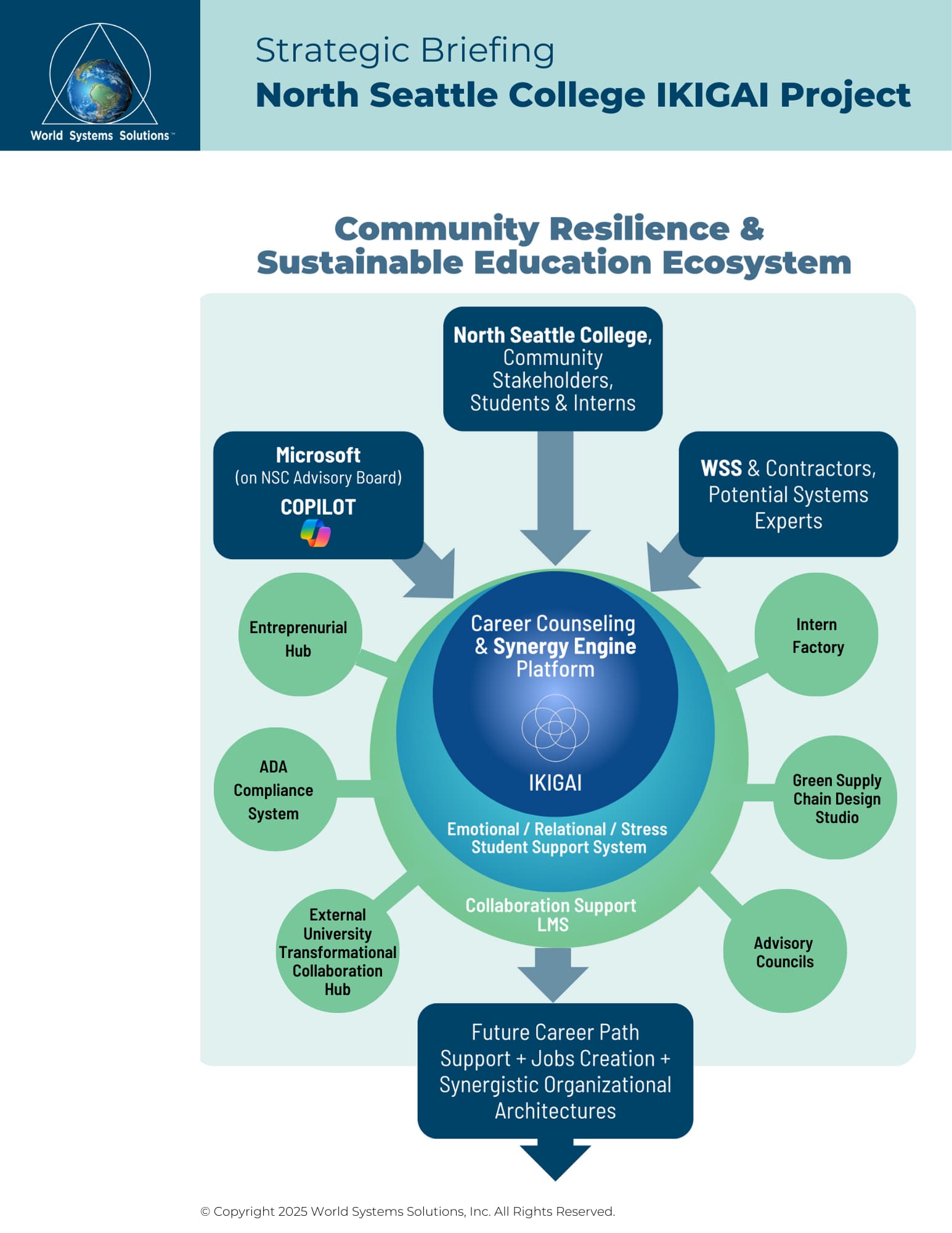
The diagram above was developed by World Systems Solutions in relation to me pitching them a lot of ideas over the summer. (WSS was on the 2R research call of Friday September 19, 2025). WSS has an expansive architectural concept, one element of which is “Synergy Engine”.

It would appear on the surface that an idea like “Synergy Engine” would benefit from Agency Protocol. In any case, Agency Protocol is the sort of thing I want my students thinking about this fall.

At yesterday’s all-faculty meeting, our president College President | North Seattle College Rachel Solemsaas expressed the goal of making North Seattle College the primary technical education hub for the City of Seattle. She also emphasized goals and values of equity, sustainability, community partnering, and an organizational culture that is at once both caring and evidence-driven. (She also served us some yummy homemade lumpia!)

Waking up this morning, my first thought was, “why not turn the entire NSC campus into a Synergy Engine?” They want to lead in technology. They also want a robust partnering network with the non-profit sector to provision student services. Doesn’t it just make sense to get onto the bleeding edge of figuring out how to deploy high tech to orchestrate the non-profit sector? By doing this sort of R&D I hope to Hoover up loose change in a town that features multiple trillion dollar corporations and funnel some of that change to our students, many of who live essentially hand-to-mouth.

My 2027 vision is NSC-WSS and our wider partnering structure will have built a category killer in the pro-social space and this platform is organizing ground level action all over the planet to usher in the civilization of the future.

1 Like

I like the spirit of this, but it’s kind of hard to tell what incentivizes adoption/pulls it into prominence. Do you have more documentation on this? For me, the holy grail is something that outcompetes the models that we want to replace on their own terms, while also embodying the ethos of the new world we’d like to inhabit.

Dozens of documents on my HD. To really get into that we should set up a side channel. In this current forum it seems better to dribble out items a little at a time in the context of larger 2R themes.

I’ve been shopping liminal spaces for the past 3 years looking for the most expansive platforms, frameworks, models, systems, personalities, practices, and movements. WSS is on my short list because it integrates everything from cloud technology to kundalini yoga. Cloud is technical “full stack”. Kundalini is human “full stack”. (If kundalini is off-putting, similar alternative models of the human “stack” are available from a variety of western, eastern, and secular sources.)

If somebody brings more full stack integration potential than WSS, I’ll run over to the bigger, more impressive platform in a quick minute. But right now, WSS is best in show (at least in the area of technical platform architecture for pro-social synergy support.) Anyone with a platform strategy, however, needs to support all sorts of protocols and plug-ins to achieve holonic scalability. So the acid test for WSS will be if they can support ideas like Agency Protocol. So far so good … WSS swallowed my Ikigai model whole for example and my model is benefiting from the expanded context.