Second Renaissance, as if it were a School

Yesterday in the research group, we got to using “school” metaphors to discuss various 2R structures and activities. 2R/LifeItself is far more than a conventional academic study group, but it does strike me that understanding discussions here requires a certain sort of academic background (or personal reading background, for those not fond of collecting college degrees). In this thread, I’m planning on leaning into the cognitive side of 2R. What does one really need to learn and know to fully participate here?

First up, a quick Gemini session on what it takes to understand the 2R white papers:

Gemini:
"To fully appreciate the arguments and theories proposed in the Second Renaissance white papers, it is helpful to have a foundational understanding of several interdisciplinary academic fields. The papers argue that our interconnected global crises stem from the fundamental worldviews of modernity, proposing that a “cultural paradigm shift” and deep inner development are required for a regenerative future.

Here are the most important academic topics to explore before diving into the papers:

1. Systems Theory and Complexity Science

The concept of the “polycrisis” (multiple interconnected crises like climate change, economic instability, and political polarization) and the “metacrisis” (the underlying systemic drivers and epistemological failures creating these crises) relies heavily on systems thinking.

  • Key concepts: Non-linear dynamics, feedback loops, emergence, and complex adaptive systems.

  • Why it matters: It helps readers understand why the authors argue that isolated, technical solutions are insufficient and why a holistic, systemic breakdown requires a holistic, systemic response.

2. Philosophy of Science and Epistemology

The papers frequently invoke the idea of a “cultural paradigm shift,” a concept adapted from the philosophy of science. Furthermore, the critique of modernity is often a critique of modern epistemology—how we know what we know, and the limitations of reductionist, purely rationalist ways of seeing the world.

  • Key concepts: Paradigm shifts (Thomas Kuhn), reductionism vs. holism, and the limits of empiricism.

  • Why it matters: Understanding how scientific and cultural paradigms govern what a society considers “true” or “possible” clarifies why the authors believe a fundamental shift in worldview is a prerequisite for survival and flourishing.

3. Developmental Psychology and Adult Development Theory

Paper 4 focuses on “developmental spaces” and “multi-domain inner development” across spiritual, cognitive, psychological, and ethical domains. This draws heavily on the academic study of how human beings mature in their sense-making capabilities over a lifetime.

  • Key concepts: Constructive-developmental theory (e.g., Robert Kegan’s stages of adult development), moral development, and meaning-making frameworks.

  • Why it matters: The authors propose that cultural transformation cannot happen without individual inner transformation. Familiarity with adult development provides a framework for understanding what it actually means to build “inner capacity” and psychological resilience at scale.

4. Cultural Evolution and the Sociology of Modernity

The core thesis of the Second Renaissance is that the “views and values of modernity” are no longer serving humanity. To understand this critique, one must study the historical and sociological foundations of the modern era, as well as theories of how cultures evolve through different stages (e.g., pre-modern, modern, postmodern, metamodern).

  • Key concepts: The Enlightenment, the historical (First) Renaissance, secularization, metamodernism, and the cultural impacts of capitalism.

  • Why it matters: Exploring the historical analogies and the defining characteristics of “modernity” allows readers to critically evaluate what aspects of our current culture the authors believe we need to leave behind, and what the “shadows” of the first Renaissance were.

5. Philosophy of Technology

Paper 5 explores the “god-like authority of technology” and how modern humanity perceives the world in its image. This requires an understanding of how technology is not just a neutral tool, but a force that shapes human ontology (our nature of being) and ethics.

  • Key concepts: Technological determinism, instrumental rationality, and the ethics of artificial intelligence and emerging technologies.

  • Why it matters: It provides the critical lens needed to understand the authors’ argument that humanity must develop the wisdom and inner capacity to govern the technological forces we have unleashed, rather than trusting technology blindly as a savior.


Daniel Schmachtenberger on the Metacrisis

This video provides an excellent primer on the concept of the metacrisis, explaining the interconnected nature of systemic global threats and the epistemological shifts required to address them, which is central to the thesis of the Second Renaissance papers."
1 Like

I changed the link, which wasn’t working before, hope that’s OK!

Overall this is a really great introduction to a new thread, and very much worth developing. It is so easy to forget, if you’ve been immersed in these ideas for a few years, how so many people haven’t had the opportunity to learn about or engage with them. I’d like to see this developed, perhaps into some kind of dependency diagram? An inverted tree, or you could call it a root diagram perhaps? with each concept explained in terms of simpler concepts, right the way to school or grandparent level. And doing this has its own benefits: it can show up gaps in the thinking itself.

Even at this level, I’d like to throw in some caution. Do people really need to know about non-linear dynamics to get the gist of what the metacrisis is? Personally, I’d say not. The other 4 feel more on point. And that does reveal what a rarified intellectual atmosphere we seem to be inhabiting. Are we really content to be talking only with the “intelligentsia”? That would disappoint me, and call into question the effectiveness of the 2R concept as a whole.

Yes, talking sophisticated interdisciplinary concepts is great for a sense of belonging to an intellectual “elite”. But to change society, we surely need to engage people across a wide spectrum. And setting out an educational programme, right down to school-leaver level, seems like a great start to an educational agenda. Wikipedia by itself doesn’t serve well enough, there is no great care taken there to make the concepts easy to understand. Other open educational resources tend to be for basic subjects.

So, maybe transcend “deliberately developmental” to include “deliberately educational”, and include us all in a sensible humility of knowing that we don’t have all the answers, and we can learn from very very wide range of other people, if we are open to that.

2 Likes

Sounds like a job for … @dvdjsph !

Here is a thought experiment ran recently in WhatApp channel that bears repeating in this context here. Reaching for hyperbole, I posed the question “how would Ward and June Cleaver explain the metacrisis to Wally and the Beaver?” Results on the link below.

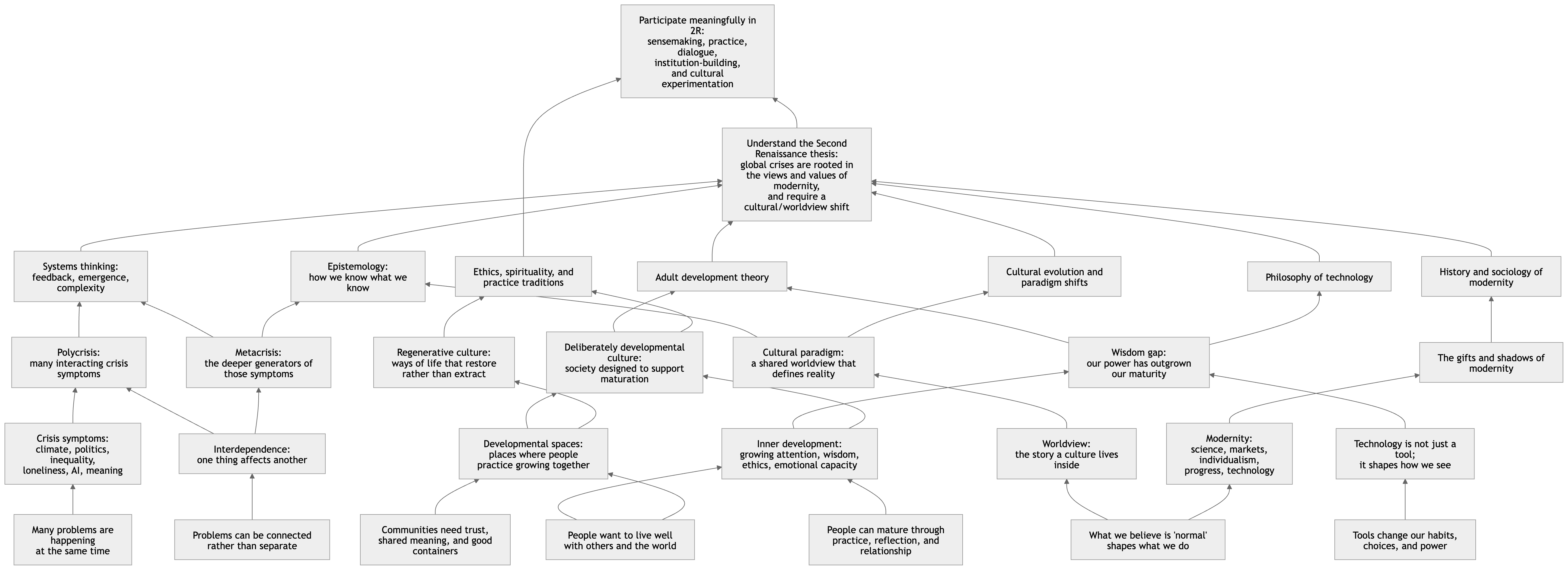
2R fluency
└── Participate meaningfully in Second Renaissance
├── Understand the core thesis
│ ├── Polycrisis: many visible crises interacting
│ │ ├── Many problems are happening at once
│ │ └── Problems can affect each other
│ ├── Metacrisis: deeper causes generating the symptoms
│ │ ├── Cultures have hidden assumptions
│ │ └── What feels “normal” may itself be part of the problem
│ ├── Modernity: the dominant cultural paradigm
│ │ ├── Science, markets, individualism, progress, technology
│ │ └── These have gifts and shadows
│ ├── Paradigm shift: changing the shared worldview
│ │ ├── Societies live inside stories
│ │ └── Stories shape what people see as possible
│ ├── Inner development: growing the human capacities needed
│ │ ├── People can mature through practice and relationship
│ │ └── Wisdom, ethics, attention, and emotional capacity matter
│ └── Technology critique: technology shapes the world, not just tools
│ ├── Tools change habits, power, and imagination
│ └── More power requires more wisdom
└── Practice 2R in real life
├── Developmental spaces
│ ├── Communities need trust and good containers
│ └── Growth needs repeated practice, not just ideas
├── Regenerative culture
│ ├── A good society restores life rather than extracting from it
│ └── Culture is built through habits, institutions, and examples
└── Educational hospitality
├── Concepts should be explainable at several depths
└── Nobody should need elite academic language to enter the conversation

It would be useful to think about what this proposed school is trying to accomplish.

Public schooling often amounts to indoctrination, and more often than not teaches students not how to think, but what to think. But if we take an honest look at the history of public schools, this seems like a feature rather than a bug from the POV of the state.

A 2R school would primarily aim to teach how rather than what, imho. And I think this ought to be reflected in the structure of a syllabus. For example, what if we did the following:

  • Organize the syllabus around a series of questions, where the goal of the step/module is to find a way of answering the question, and the means of doing it are not prescribed but assistance and collaboration are available. William James’ definition of intelligence was something like “being able to find variable means of achieving a fixed goal”.

  • Make the syllabus itself transparently revisable. Not in a naive sense, like opening a Google doc to edits from anywhere, but in the sense that it would be versioned and periodically improved.

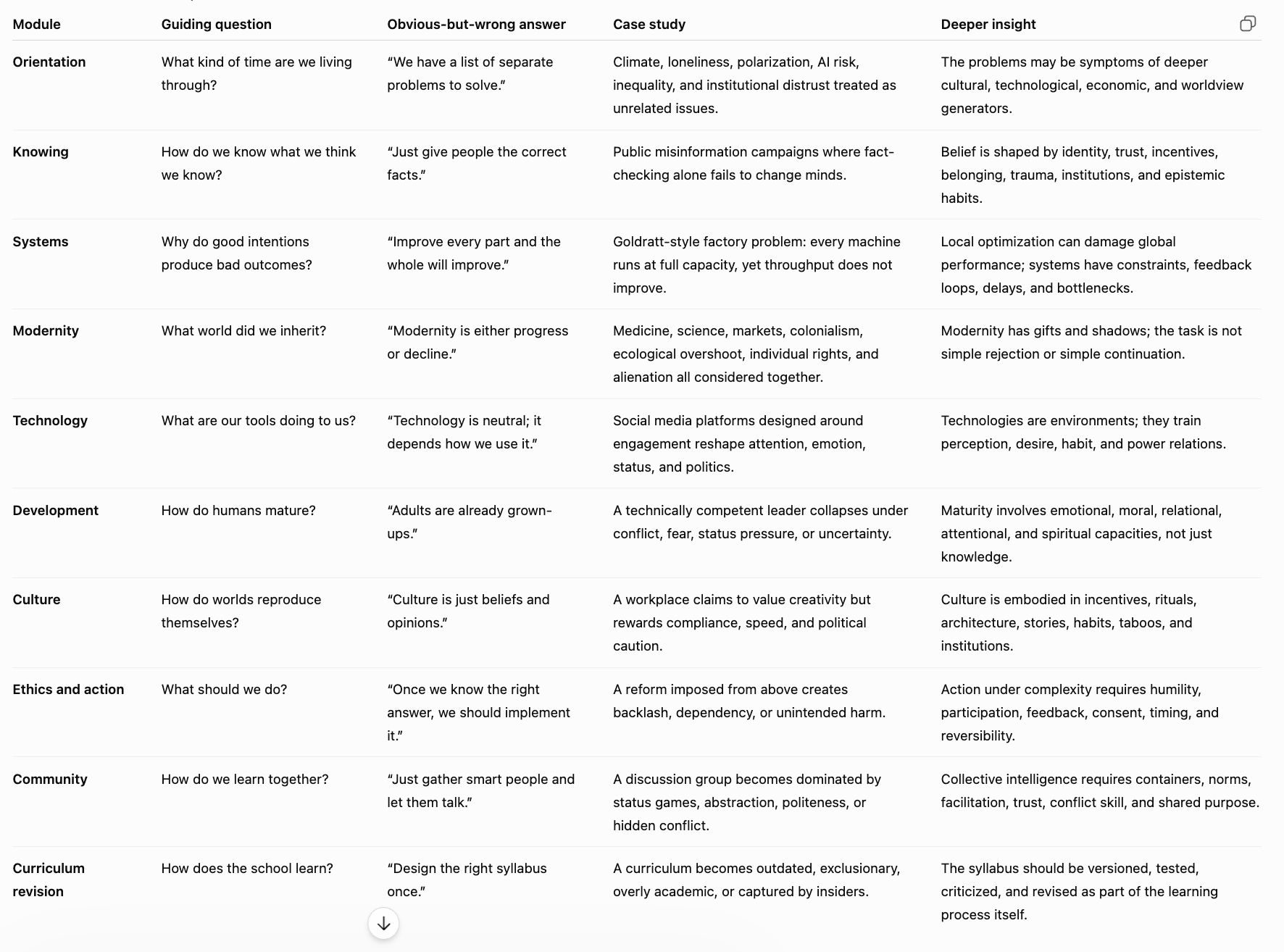
Here’s a first stab at the questions:

1. Orientation: why are we here?

What kind of time are we living through?
This opens the door to crisis, polycrisis, metacrisis, civilizational transition, collapse, renewal, and the possibility of renaissance.

What is worth saving, repairing, grieving, and outgrowing?
This keeps the school from becoming either naive progressivism or reactionary nostalgia.

What would it mean to become more alive, more truthful, and more capable together?
This points toward education as formation, not mere information transfer.

2. Knowing: how do we think clearly?

How do I know what I think I know?
Epistemology, bias, ideology, sensemaking, uncertainty, propaganda, scientific method, lived experience.

When should I trust experts, institutions, tradition, intuition, peers, or myself?
This is crucial because “do your own research” and “trust the science” are both inadequate by themselves.

How do groups become smarter or stupider together?
Dialogue, groupthink, collective intelligence, polarization, status games, deliberation.

How do I change my mind without losing myself?
This makes intellectual humility practical rather than decorative.

3. Systems: how do things affect each other?

Why do good intentions so often produce bad outcomes?
Systems thinking, feedback loops, unintended consequences, complexity.

What is a symptom, and what is a generator?
This leads naturally into the distinction between crisis and metacrisis.

Where are the leverage points in a situation?
Instead of merely describing problems, students learn to ask where meaningful change is possible.

How do ecological, technological, economic, psychological, and cultural systems interact?
This prevents the syllabus from isolating climate, AI, politics, mental health, economics, and meaning as separate “subjects.”

4. Modernity: what world did we inherit?

What are the gifts of modernity?
Science, rights, medicine, literacy, individual freedom, material abundance, pluralism.

What are the shadows of modernity?
Extraction, alienation, disenchantment, instrumental reason, coloniality, commodification, ecological overshoot.

What does modern society train us to notice, desire, ignore, and become?
This makes “worldview” concrete.

Which parts of modernity need to be preserved, which need to be transformed, and which need to be composted?
A good 2R school should not be anti-modern in a simplistic way.

5. Technology: what are our tools doing to us?

When is a tool just a tool, and when does it become an environment?
Language, writing, money, social media, AI, institutions, markets.

How does technology reshape attention, power, desire, memory, and relationship?

What kinds of wisdom are needed when human power increases?

Can we build technologies that support maturity rather than addiction, domination, or fragmentation?

6. Development: how do humans mature?

What does it mean to grow up, not just grow older?
Adult development, emotional maturity, moral development, spiritual practice.

What capacities does this historical moment require of us?
Attention, grief, courage, discernment, cooperation, patience, responsibility, imagination.

What practices actually develop those capacities?
Dialogue, contemplation, embodiment, service, conflict work, artistic practice, apprenticeship.

How do we distinguish genuine development from status performance?
Very important for avoiding “higher consciousness” as a new hierarchy.

7. Culture: how do worlds reproduce themselves?

What is culture, and how does it shape what feels normal?

How are values transmitted through families, schools, media, rituals, institutions, and built environments?

What kinds of culture produce wise, capable, trustworthy people?

How does cultural change actually happen?
Through stories, exemplars, institutions, crises, practices, technologies, economics, and intergenerational transmission.

8. Ethics and action: what should we do?

How should we act when we cannot know enough?

What responsibilities come with seeing systemic problems?

How do we avoid purity, despair, cynicism, and savior complexes?

What is mine to do, what is ours to do, and what is not yet possible?

9. Community: how do we learn together?

What makes a group trustworthy enough to learn in?

How do we handle disagreement without collapsing into politeness, domination, or fragmentation?

What kinds of authority are legitimate in a developmental school?

How can a school teach “how to think” without secretly smuggling in “what to think”?

This question should probably be explicit and recurring.

10. Curriculum self-revision: how does the school learn?

What evidence would show that this syllabus is failing?

Who is excluded or misunderstood by the current version?

Which concepts are over-compressed, over-academic, or insufficiently grounded?

What should be added, removed, renamed, simplified, or split into levels?

How do we preserve continuity while allowing real revision?

1 Like

Here is an article I wrote for Global Bildung a couple years ago:

https://medium.com/bildung/what-it-means-to-be-human-why-we-need-this-conversation-now-e6e146a4f05d

I like how commonsensical the outline sounds. That’s one of my goals: to redefine “common sense”. I want the Ward and June Cleavers of the future to be teaching this content to their kids as conventional wisdom.

My more discursive approach to this, and to the original AI summary, runs roughly so …

Start with brainstorming all the complex challenges in the world today. Shift to the question of how we all might find a way to live in such a world. Focus on the situation of each person. Draw that out from each student - there will be differences. Establish a process for sharing and dialog, so that different perspectives can be presented, while respectful and constructive relationships are maintained. Let larger themes and concepts crystalize, maintaining experiential grounding for any thematic abstraction. As the group begins to converge toward consensus views, stress test these views against other perspectives available through wider research. Iterate the process above multiple times till the group feels its got a defensible approach for whatever its effective environment is. (That will probably come out as “local, connected to the global”). Then devise action experiments and stress test the views that way also. Repeat, revise, repeat.

1 Like

Here’s an additional feature of a module/lesson in that vain, inspired by the Mencken quote: “There is always a well-known solution to every human problem — neat, plausible, and wrong.”

For each module:

  1. Guiding question
    What are we trying to understand?

  2. Tempting answer
    What is the simple, obvious, plausible answer?

  3. Case study
    A real-world situation where the tempting answer fails.

  4. Breakdown
    Why does the obvious answer fail?

  5. Deeper model
    What concept, practice, or framework helps us see more clearly?

  6. Transfer
    Where else does this pattern appear?

On the “technologies are environments” point, a couple days ago I read an interesting article criticizing the common view that language emerged first, and big brains, tools, cultures, etc. came along later. The article suggested that was backwards.

Digging into the “why” of it (according to the language-later view), got me thinking of Jason Storm’s “hylosemiotics”, the language of things. Likewise, it brought to mind how Habermas (summarizing all sorts of social science), in his later works grounds both culture and language in ritual. There’s more … but this gist of it is that I am sniffing around the “ground truth” or the irreducible “base case” for the origin of language. In a world in which talk is cheap (and mostly slop), how do we rectify names, so to speak, and align speech with something deeper than just signs pointing to each other?

Rather that retrieving the article from a couple days ago, I just now ran a quick AI summary to test if the article’s view was more mainstream or more of an outlier. Here is that result:

Anthropologists generally agree that language and culture co-evolved in a feedback loop, making it impossible to separate the two. A Perspectives: An Open Invitation to Cultural Anthropology textbook explains that complex culture could not exist without language to share knowledge, and language depends on culture to encode its meaning and pass it down. [1, 2]

While they grew together, one usually catalyzed the other:

  • Basic Culture Came First: Rudimentary cultural behaviors—like making fire, using basic stone tools, and passing these rudimentary skills to offspring—existed before complex, abstract language.
  • Modern Language Accelerated Culture: To move beyond simple observation into complex traditions, myth, and abstract thought, early Homo sapiens developed advanced language capacity roughly 100,000 to 135,000 years ago. [4, 5]

Once language was established, it allowed humans to rapidly build, store, and transmit abstract cultural ideas across generations. [1, 3]

AI responses may include mistakes.

[1] https://courses.lumenlearning.com/suny-culturalanthropology/chapter/language/

[2] https://dspace.univ-ouargla.dz/jspui/bitstream/123456789/26304/1/9%20Language%2C%20Culture%20and%20Related%20Disciplines.pdf

[3] https://michaeltfassbender.com/nonfiction/other-nonfiction/which-came-first-language-or-culture-language/

[4] https://www.youtube.com/watch?v=JERf1Rf2eZg

[5] https://neurosciencenews.com/genetics-language-origin-28489/

The way I am parsing all this, is I imagine a troop of tool using apes (pretty simple tools), mimetically copying each other in their tool use. They grunt and howl and gesture in the process. Over time, the sounds and gestures take on symbolic meanings beyond the initial situations. Brains expand to improve performance in all of that, because there is a payoff in food, security, mating opportunities, etc. In a nutshell - tool using was a critical component of the “environment” that selected for the most distinctively human traits. No faber, no sapiens.