I’m just wondering what kind of victory is there to be won? If someone doesn’t want to engage (as frustrating as it is), it is within their agency not to. Can one not be only loosely attached to their belief system, rather than willing to defend it with their life? Finally, why is this so central to the 2R?
1 Like
Sure, that is possible. If Jonah is not too attached to his belief system then presumably he won’t be particularly distressed if I treat that belief system disrespectfully. I cannot do anything other than treat it disrespectfully, because I am actively trying to consign it to history.
Finally, why is this so central to the 2R?
I answered why in that long opening post: The Hard Problem of Consciousness and 2R - General - Second Renaissance Forum, but I will summarise again now.
The conclusion of that post is that materialism and physicalism are incoherent – that they do not make sense internally unless you deny the existence of consciousness, which is absurd (although some materialists do actually do so because they feel compelled by logic – the logic says either materialism or consciousness has to go, and they choose consciousness).
Now, if it was merely incoherent then that wouldn’t matter much, but in fact an enormous amount rests on it. Materialism necessarily implies naturalism – there are no supernaturalist (or praeternaturalist) materialists, because materialism lacks the conceptual space to account for anything other than a material world that follows laws that are either fully deterministic or deterministic with objective randomness (though in Jonah’s case it is completely deterministic because he subscribes to the MWI).
Not only does this rule out the praeternatural, it also rules out all higher forms of spirituality and all meaning. It condemns people to a sort of nihilism – although some materialists deny this. In this very thread Jonah has said (for example) that science can show us how I know I know about the praeternatural – by which he means science can show us how I’ve deluded myself into thinking I know such things. In his world, he’s arrived at this conclusion via empirical evidence and rational thinking. In fact he’s arrived there by basing his entire worldview on an incoherent metaphysical belief. The moment you arrive at an understanding of why materialism cannot possibly be true then the impossibility of the existence of the praetenatural is (or at least should be, or can be) replaced with an open-ness or agnosticism towards such things. This change in belief is in turn absolutely critical for the spiritual development of individual humans – it allows Reality to start working on them – it offers them opportunities to grow which weren’t previously possible. (This is exactly how Jung described synchronicity).
Our belief systems regulate the praeternatural. We are sovereign over our own reality tunnels. That is why skeptics don’t experience praeternatural phenomena, and why the praeternatural phenomena people do experience are “tailored” to their own belief systems.
What has this got to do with 2R? It opens the door to two parallel revolutions – a scientific one and a spiritual one. I believe this is the key to one half of the ideological shift necessary for 2R. The other half is the acceptance that structural realism is true. Praeternatural phenomena are real, but they are part of this world. They are what gives it meaning, starting with free will. One of the strangest places on the internet is this subreddit: All discussions about the topic of free will. As a society we are deeply confused about this. From a subjective perspective it is completely obvious that we have free will, and we treat other people as if they do have free will (nobody gets away with “the laws of physics did it, it’s not my fault”). And yet it is beyond most people’s imagination to figure out how free will can be possible, so they assume it must be some sort of illusion. Even Nagel admits to being deeply conflicted about it – he has written that he changes his mind every time he thinks about it.
Understanding what is wrong with materialism – not just that it is false but exactly how it is false – is key to clearing up all of this confusion. Or at least some of it.
But it’s not easy to “force” coherence onto people who are metaphysically incoherent. They might not be ready to be challenged and converted, or simply disinterested. When the topic is psychological and consciousness development, it doesn’t necessarily entail a scientific revolution. I’m still not satisfied that you proved that this thorough epistemic revision is essential to the 2nd Renaissance.
Indeed. It would require work from that person. Serious work. That’s why I want Jonah to engage with my argument. He hasn’t, and I suspect the “I’m too busy” line is cover for the fact that he hasn’t got a sensible response (because there isn’t one).
They might not be ready to be challenged and converted, or simply disinterested. When the topic is psychological and consciousness development, it doesn’t necessarily entail a scientific revolution. I’m still not satisfied that you proved that this thorough epistemic revision is essential to the 2nd Renaissance.
I can only make a case. Each person has to make their own mind up about the strength of that case.
BTW - I’m in full agreement about a lot of the stuff you’re proposing - it’ s just that I don’t find it fundamentally different to what I already believe in (or consider feasible) . You really drive some specificities in and insist they make all the difference - but to me they still don’t. I am happy with phenomenalism, panpsychism, transcendental idealism… and I don’t feel “the urge” to tie it up with quantum theory. I do find QM fascinating, but it doesn’t bother me that I’m not weaving this grand theory of everything… I suspect a lot of people to some extent sympathise with my position.
I’ll keep on trying to see what’s so special about your NED…
1 Like
That should be a good thing.
You really drive some specificities in and insist they make all the difference - but to me they still don’t. I am happy with phenomenalism, panpsychism, transcendental idealism… and I don’t feel “the urge” to tie it up with quantum theory.
It is not about “urges”. It is about coherence. The more that is tied up, the more oomph it has to drive a paradigm shift through.
I’ll keep on trying to see what’s so special about your NED…
So you aren’t reading that other thread?
We have work to do - General - Second Renaissance Forum
You haven’t seen the post where ChatGPT rebuts its rebuttal? You can’t see anything special there? I think maybe you aren’t looking very hard. Either that, or you don’t understand what is being proposed.
I have provided an integrated theory which elegantly and efficiently solves a handful of the biggest mysteries in modern science, all in one go, and you think there’s nothing special about it?
Do you think there are loads of theories like this, that can solve all these mysteries together? There are none. Nobody has come up with anything like this before.
as with David, the main problem here seems to be incredulity.
Somebody was eventually going to figure out the solution to this conundrum – the key to the paradigm shift. Why not me?
@GeoffDann As a moderator, I am declaring that this is not acceptable behavior for this forum. Please note that I am not debating the content of your opinions in any way. I think you are crossing way over the net of collaborative dialog by framing your opinion in language that claims to be objective exterior truth with complete certainty, while at the same time asserting the absolute falseness of someone else’s epistemological standing in a way which completely closes you off to any further productive engagement.
And yet you continue to fixate on this particular person, seeking that they (in my story) engage with you in a way that satisfies and validates you. I also see you falling into the trap of thinking and claiming “they won’t engage with me, they must know their ideas are bad” when I believe instead that you’ve driven them away from you with your aggression. If someone accused me of “abuse of power” and then appealed to their chain-of-authority stating that I am “not a neutral”… gosh I wouldn’t want anything to do with you after that.
I am asking you to cease and desist writing about this person lest you cross the line into harassment.
Ideas do not feel disrespect. People do. You are not talking to ideas, but to people.
If you have a goal of changing other people’s beliefs, then I think you’ll find that adopting language of disrespect and conflict as a strategy will backfire on your goal almost anywhere you go, not just here. Even if you are a perfect decoupler of ideas and persons, other people are not. We are humans and need to give each other margins of tolerance and respect that allow us to process difference without getting locked in conflict-feelings and drama.
I see you recognizing that you match some of the signs of the crackpot archetype: theory of everything, working twenty years on your own, giant claims… you see that “the main problem here seems to be incredulity” is your obstacle. I think you would be wise to approach that kind of situation with humility and charm as you seek allies, knowing the uphill landscape facing anyone in such a position.
And yet, let’s look at the “you statements” in just your last post here:
- “So you aren’t reading…?”
- “You haven’t seen…?”
- “You can’t see…”
- The one “I think” is attached to an insult: “I think maybe you aren’t looking very hard”
- “you don’t understand…”
- “you think there’s nothing special…?”
Does it give you pause to see those strung together? I perceive you to be frustrated, and writing from that frustration. If I were you right now, I think I’d feel very frustrated. But venting at people from inside that frustration is, by all my experience, just going to keep burning up the fuse of tolerance. If you want to continue participating here, please take this seriously. Thank you.
Hello James
From my perspective, your post above completely fails to take into account the current discussion in this thread: We have work to do - General - Second Renaissance Forum
I will ask you to reconsider what you have written, because right now you are putting me in an impossible position. You have identified the wrong problem. You believe my interpersonal skills are at fault, when in fact I am offering you the path to the solution, and you are trying to block it in order to protect the person who is the real root cause of the problem.
Or to be more accurate, the problem is with the whole group. David Joseph has clearly articulated it. You cannot manifest 2R unless the group has the basic required level of cohesion, which means getting the underlying meta-ideology right. At the moment you have a serious problem to deal with, and you have chosen to attack the messenger instead of listening to the message. You are repeating exactly the mistake which has caused so many previous attempts at this sort of movement to fail.
Please can we try to sort it out.
. If I were you right now, I think I’d feel very frustrated.
Well, I am not. I am trying to help you. I am saying what I am saying because I am absolutely convinced it needs to be said, even though I’m being threatened with expulsion from this group if I don’t stop saying it. Please consider your actions and your motives.
It even says on your main page, very clearly, that materialism is part of the problem. And yet when I go to great effort to explain exactly what the problem is, and why having an unreformed materialist (somebody who wants to bring Dennett into the new paradigm(!?)) as part of the admin team is likely to cause a serious problem with group cohesion, you identify me as the problem?? Would you also think it is OK to have somebody in this group trying to bring capitalism into the new paradigm? Because that’s the level of absurdity we’re talking about here. Dennett is a textbook example of what the new paradigm cannot look like.
This “Second Renaissance” cannot happen if people prioritise personal politics over the actual ideas themselves, and that doesn’t just apply to Jonah either. I am the only person around here who is offering the sort of ideas that you need, but those ideas are disruptive. They involve the definition of lines, which also implies some people finding themselves on the wrong side of those lines. I am talking about the psychology of materialistic belief because the psychology of materialistic belief is a central part of the complex of problems we are dealing with. This new paradigm needs to be disruptive. It needs to disrupt the comfortable, decrepit existing ideological order (where everybody is allowed to believe whatever they like, because there’s no actual truth) to the extent that it can be replaced with something else. Do you think that can happen without people going through extremely uncomfortable transitions and groups being broken apart and remade?
Jonah’s materialistic metaphysics are a perfect example of the old paradigm which cannot be accommodated in the new. I have explained very clearly why, and nobody has responded with any criticism (at all) of that explanation. What I am saying is completely in line with the views of Iain McGilchrist, who is the number one person on your list of “new paradigm” people. And yet when I try to force this issue - just as it is going to have be forced in order to make the paradigm shift happen - you have decided to step in to prevent me from being able to to do so, on the grounds that it is too disruptive to the group and too disrespectful of people’s opinions.
Please can I ask you to leave this discussion open. Let me continue to speak openly even if it causes discomfort within the group. This discussion is desperately needed. This is the work that needs to be done. As a group, you need to come to terms with the real problems which are preventing 2R from happening. This cannot happen “nicely”. It will necessarily involve certain people having to change their views or accept that they can’t be part of the new paradigm.
You appear to believe it is more important to keep this place comfortable, with nice friendly vibes, without serious ideological rifts, than you think it is to actually hammer out the meta-ideology you need to make this happen.
We cannot birth the new paradigm unless we are prepared to systematically defeat the old one. That’s how paradigm shifts work, and this is The Big One.
I am the only person offering this group the epistemological meta-ideology it desperately needs. And all I am doing is saying what needs to be said in order for people to understand how that epistemology works, what the underlying cosmology is, and why this idea is revolutionary enough to carry the paradigm shift. This is extremely difficult stuff to explain. I cannot do so if also being put under pressure to not say anything that other people do not want to hear. I need to be able to speak completely honestly and openly, or it will not be possible for me to adequately answer people’s questions.
EDIT: I have a suggestion as to how this can be resolved. The problem here is that, just as with Jonah, I am facing an individual disagreement with a moderator about ideas which are extremely important to the goals of this group – and they are the most important goals imaginable. I fully understand how my presence here, and what I am saying, is disruptive and difficult for people in many different ways. But I am also getting a lot of positive feedback, and I see that people are understanding me. Could we please have a thread, in which everybody who has been paying attention recently takes part, where there is a discussion about how we proceed from here as a proto-movement. Specifically we need to talk about how the group can be kept together, which is a fore-runner of the question of how the meta-movement can be kept together and what is to be the framework for our theory of change. That is going to have to involve a frank discussion of two specific categories of belief – metaphysical materialism and postmodern anti-realism (especially its presence in some forms of metamodernism). It will not work if I am the only person willing to speak uncomfortable truths – if other people leave it to me to articulate all of the difficult stuff while they remain in their comfort zones because they don’t want to take the sort of risks I am being forced to take. Don’t you think it would be easier for me if I compromised on my principles and prioritised personal politics over the truth? I will be happy to abide by the conclusions of such a discussion. If the conclusion is that materialism and anti-realism are to be considered acceptable in some forms, then I will abide by it. I would also be happy to leave this place for a while to give the group some specified period of time to discuss what I’ve said without me taking part in the discussions. But I cannot just back down on what I consider to be essential components of the paradigm shift because I’ve been told by a moderator that I’m causing too much personal discomfort and making too many “you…” statements. I have spent my whole life speaking truth to power. I have no intention of stopping now.
I am NOT any sort of messiah figure. I already flunked that. It was much too hard to walk that walk, so I do not talk that talk (I also do not want to repeat what I see as mistakes made by Wilber in this regard). Now I see myself as somebody who can bridge ideological divides, but the process itself could not be better described than in Luke 12:49-52:
“I have come to set the world on fire, and I wish it were already burning! I have a terrible baptism of suffering ahead of me, and I am under a heavy burden until it is accomplished. Do you think I have come to bring peace to the earth? No, I have come to divide people against each other! From now on families will be split apart, three in favor of me, and two against—or two in favor and three against.
Please let me know if you want me to start such a thread, although it will be very much more effective if somebody else initiates it and sets the questions. Alternatively just tell me I am not wanted here and I will disappear. However, please bear in mind that if that is what happens then I’m going to end up on a collision course with this group anyway, precisely because this group will have demonstrated that it is not capable of hosting the conversations needed.
From the intro of my book:
The attempts to suppress Bendell’s work bear striking similarities to the broader pattern of resistance to challenging dominant worldviews—whether in academia, politics, or media. His story illustrates the precarious position of radical thinkers who poke at the comfortable narratives of progress and control, and reflects the reality that institutions built on the old order – those of economic growth, material consumption and technological optimism – are incapable of hosting the conversations necessary for the transformation required. At the heart of this struggle is a recognition that the future we imagine must be liberated from the intellectual and cultural forces that resist it.
You are resisting it.
Please note that if you do choose to exclude me from this group, I must insist that all long quotes from my book are deleted from the forum, as well as this thread. It is not OK to just leave this stuff here if I am not free to respond to future comments about it. This group can then just return to its materialistic/pomo comfort zone and I will get on with the job of actually making 2R happen without you.
Geoff
Just a quick interjection … I wonder if this piece from the P2P Foundation wiki is of relevance or interest? It’s nearly all the (curation) work of Michel Bauwens—I just enjoyed helping to create the table in wikitext, which is not exactly straightforward  Theory of Thought-Shapers - P2P Foundation
1 Like
Here are my observations, as another person who has contributed to the stewarding of the research aspect of Life Itself and the 2R field.
As you already know, @GeoffDann, and along with @Martin I actually am in quite a lot of agreement with the essence of your views. I won’t claim to “understand you” completely, just that I can imagine in my own mind what it’s like to have worked out an intellectual position over a long period of time, and to believe with passion and fervour that it is vital, nay essential, that people come to see the truth in that, for their own good and for the good of the wider world.
I have also had a few similar initial senses. I have worked out for myself ideas which I see as at minimum self-consistent, and which I see as potentially contributing massively to the world’s future, if only people would understand them and put them into practice.
Where I see myself as taking a different approach to the one I see you apparently taking, Geoff, is how I take that forward.
I have learned, from sometimes bitter personal experience, that not everyone shares my perspective, my belief system, my values. And for certain others don’t share my experience — and experience colours so much in the way that we look at the world. I see this meta-perspective as something that tends to grow over time with many perceptive people. I’ve noticed how older members of our community treat you, as I see it, charitably. And I see this as one of the characteristics of adult development which folks associated with Life Itself take as positively reflecting the ideas of Deliberate Development. I do think we all take positive positions with regard to adult development, and speaking personally, the people I have most respect for are not those who have claimed to arrive at the ultimate truth, but those whose increasing awareness leads to increasing humility. This doesn’t mean a loss of passion — a bit like this passage in Eliot’s Four Quartets. But it does, to me, mean an increasing understanding of how other people differ, and (hopefully) an increasing understanding of how to deal constructively with others, to help them with their personal development, if that’s what they want.
My observation, Geoff, is not that you are upsetting everyone — you aren’t. But your words and tone are upsetting some other valued members of our community. As I see it, you are absolutely not alone in this, and as you point out, some great thinkers in the past have also upset others of their contemporaries. You have helpfully stated explicitly that you don’t want to be seen as a Messiah figure. But right now I’m having some difficulty reconciling this with the rest of what you say, and I’d like to explore that.
If we have a separate thread coming out of this, and I support this idea by the way, I wouldn’t see it as confronting the substance of your ideas, but rather the challenge of conveying good ideas to other people. How to do that? Being clear consistent and visionary is a good start; so (to my mind) is a willingness to accept that one may be mistaken not only in substance, but also in approach. I see it as a basic position of respecting others, as others have been putting quite some effort into respecting you. Of course I’m not including those who have felt hurt by your words, as I know how hard it is to respect the views of someone who you feel is hurting you.
We could start by looking closely at what has previously been written about the culture that we wish to see on this forum, and generally around 2R. We may not all agree in detail, but I expect there is a lot of general agreement nevertheless.
Personally, I’d love to see your ideas being taken seriously, and gently influencing the way people see things; and I’d also love to see you taking other views seriously and allowing the way you see things to be influenced, expanded, enlarged, deepened. However, at this point, as others have been pointing out, there is already hurt to be healed; there is reconciliation to be done. Maybe we can do this through the Restorative Circles practice? Or how? This could also be something to take up in the suggested other thread. If you can suggest some other methodology to address these issues, that would be of interest. My sense is, only when these are resolved can we return to evaluating your ideas as such with equanimity and openness.
1 Like
After reading the Mind and Cosmos… thread I’d like to offer more nuance here. I do see @GeoffDann as being open to insights delivered via ChatGPT, but not so open to insights that come via other participants here. I see this as rather problematic, as I have noticed in other (second-hand) contexts the way that LLMs adapt themselves (in a way that could appear very astute, on an anthropomorphic view) to the views of those prompting them. To anthropomorphise further, I could even see LLMs as having a tendency to be somewhat sycophantic.
While I do see a lot of value in using the insights coming through the use of LLMs, I would really prefer this forum to be more centred on the ontological commoning between real people here. This is, to me, a much more promising way to develop both our culture and our commons of knowledge / wisdom.
p.s. I see this forum as part of a learning journey for all of us. It is not only a learning journey in terms of the subject matter discussed (somewhat left-hemisphere), but also a learning journey in terms of how we interact (including a lot more right hemisphere). Being left-hemisphere heavy seems to me to invite less of the archetypally feminine energy; focusing more on relationship between us I would hope would bring in more of that energy, and I hope more contributions from those more identified with that energy. (And I am being deliberate in not equating feminine energy with being biologically female)
2 Likes
Hi Simon
Thankyou for that post. I am indeed listening, and I do not want to create conflict for the sake of it. However, the truth was that Jonah’s unwillingness to either engage or admit there is any problem with his position left me in an extremely difficult position. I hope we can get beyond this stage very soon.
I am not actually claiming to arrive at ultimate truth. I am claiming to have the bare bones framework of the next big paradigm, which is also exactly what 2R needs. It raises far more questions than it answers. It might seem like “ultimate truth” to people still thinking in the old paradigm, but in fact it is radically open ontologically and opens the door to all sorts of new possibilities in terms of research of various kinds. It is also politically and religiously neutral.
All I am really doing is fitting a bunch of what currently appear to be major scientific impasses/paradoxes together in a single structure which relates them to each other in a completely new way (a way that “dissolves” all of them at the same time). At the moment none of them are considered to be related to any of the others. It is heresy to link the hard problem and the measurement problem, let alone link both of those up to the other things. But in terms of “absolute truth” all it does is confirm that the mystical isn’t nonsense after all. Apart from that, it is wide open.
It provides just enough to hold a meta-movement for 2R together, but no more than it needs to. Its purpose is to make sure we are asking the right questions, not provide all the answers (although it does have implications).
Here it is again, 8 times in 2 paragraphs. I asked if it gave you pause… and I saw you write three words “From my perspective” and then appear to ignore everything I said and dive right back into the exact same behavioral/communication pattern in service of your object-level crusade against materialism or whatever.
I reject your claim; I have a different story. I will repeat again, I am not disagreeing about your ideas. I am also not engaging with your object-level disagreement with others. I absolutely do not care, as a moderator, what your metaphysics or epistemology or your opinions are. (I imagine you may be tempted to try to protest here that I am missing what matters so much to you, if so please try to set that aside temporarily.) My concern is whether you can demonstrate enough self-awareness to distinguish between your opinions/ideas and your interpersonal behavior.
I reject your claim about my motivations. I disagree that I am reacting to your “it”, your “issue”, your “paradigm shift”. Instead I am pointing, again and again, at the way you apply “force” as you attempt to, in your own words “force this issue”. I keep pointing at your “you statements” as the most concrete and clear symptom of inappropriate interaction force, and I haven’t heard you demonstrate any signs that you’re hearing me or seeing what I’m pointing at.
I reject your framing; no I have not called you a problem - I am carefully and repeatedly trying to point at your behavior. Demonstrating an inability to distinguish between people and behavior and ideas seems to be the primary enabler of your behavior failing to adhere to the ground rules of this forum. If, when you decide in your head that someone is an “unreformed materialist”, your behavior is to, instead of asking them if your interpretation/story about them is correct, instead start advocating for them to be removed from being “part of the admin team”… gosh can you see how big of a leap that is, how much unwarranted confidence you’re placing on your story of someone else, and how you’ve started attacking the existence of a person as a problem when you perceive yourself to disagree with what you perceive their ideas to be?
I’m out of time at the moment, consider this post unfinished.
1 Like
I’ve already asked you to cease and desist in pursing and blaming this one person, and this seems like a violation of that request. I will also generalize this to ask that you stop blaming other people for your behavior, full stop, ever. You are responsible for your behavior and no one can force you to behave poorly.
(Edit: discourse ate my angle brackets the first time, on my elision of “<story that blames other person>”)
1 Like
And so I have pointed back at yours.
What has actually happened here was an attempted closing of ranks to protect Jonah, and instead of capitulating I stood my ground. Since then, Jonah has finally responded.
I stand by my actions.
EDIT: Outro Post - Geoff Dann - Welcome - Second Renaissance Forum
You recently mentioned your “New Epistemic Deal” so I decided to give it an honest read (I’m far too busy to read more than two chapters of your book but this post seems to cut to the chase about what you think we ought to actually do about the situation we are all in, so I thought it’s the best leverage point for engagement). I agree with much of it, but more in terms of the underlying facts rather than the strategic direction of what one ought to do, given these facts. These are different concerns. Let me explain.
The New Epistemic Deal is at its strongest when it says that serious moral and political reasoning must begin from reality. That seems exactly right. If ecological overshoot, limits to growth, civilisational fragility, and the inadequacy of growth-based economics are real, then they cannot be treated as optional ideological preferences. Any serious discussion about the future has to begin by facing the world as it is, not as our inherited political or economic models would prefer it to be.
I also think the proposal is strong in refusing both crude scientism and postmodern anti-realism. Science should have epistemic privilege where publicly testable claims are concerned. At the same time, science should not be used as a weapon to rule out questions it has not settled, especially around consciousness, subjectivity, spiritual experience, value, meaning, and metaphysics.
That balance matters.
Where I think the proposal may run into difficulty is that it currently combines two different tasks.
The first task is to create a shared basis for serious conversation.
The second task is to advance a particular metaphysical interpretation of consciousness, free will, synchronicity, the praeternatural, and the directionality of reality.
Both tasks may be important. But they may need to be kept distinct.
A shared epistemic agreement needs to be something that people with different metaphysical views can enter without feeling that they have already been asked to accept the conclusion of the deeper debate. Otherwise, people who might agree with the basic need for reality-facing discussion may reject the whole proposal because they think they are being asked to sign up to too much at once.
For example, I think many people could agree to something like this:
- There is an objective reality.
- Science gives us uniquely reliable knowledge about publicly testable aspects of that reality.
- Consciousness is real and cannot be dismissed as an illusion.
- Subjective experience matters, but it cannot automatically oblige other people to believe the same thing.
- Moral and political reasoning must be constrained by ecological and material reality.
- The realities of limits to growth, ecological overshoot, and civilisational fragility must be faced honestly.
- Scientism should not be allowed to rule out possibilities merely because they do not fit a reductive worldview.
- But spiritual or praeternatural claims should not be treated as publicly binding unless they can be publicly justified.
That seems to me like a very powerful foundation.
Then, within that foundation, there can be a second conversation about whether synchronicity, praeternatural causality, teleology, and metaphysical freedom are real in the stronger sense you describe.
The advantage of separating those two levels is that it makes the New Epistemic Deal easier to enter. A scientific realist, a non-reductive naturalist, a spiritual practitioner, a Christian, a Buddhist, a Jungian, a process philosopher, a panpsychist, a skeptic, or someone influenced by Nagel or McGilchrist could all potentially accept the basic deal, while still disagreeing about the deeper metaphysics.
That would not weaken your position. It might actually protect it.
Because then the deal would not require people to believe your lived experience. It would only require them not to dismiss it illegitimately.
That seems like the crucial move.
A skeptic has the right to say:
“I do not share your experience, and I do not yet see enough reason to believe your metaphysical interpretation.”
But the skeptic should not have the right to say:
“Because this is not currently scientific, it is automatically nonsense.”
Likewise, someone with powerful lived experience has the right to say:
“This is real to me, and I need a worldview that can make sense of it.”
But they probably should not ask others to treat that experience as public knowledge before the necessary shared justification exists.
This distinction could make the New Epistemic Deal much more robust.
It would allow the proposal to say:
We are not demanding agreement on ultimate metaphysics. We are demanding disciplined honesty about what kind of claim is being made.
That would mean distinguishing between:
- scientific claims;
- philosophical claims;
- moral claims;
- ecological constraints;
- subjective reports;
- spiritual interpretations;
- metaphysical hypotheses;
- practical commitments.
This may sound procedural, but I think it is actually radical. It would change the quality of the conversation. Instead of arguing over whether something is “real” in one flat sense, people would have to ask: real in what sense, knowable how, binding on whom, and relevant to which decision?
Applied to the New Epistemic Deal itself, I would say:
Your ecological and anti-growth claims are intended as public reality claims. They need to be argued publicly, scientifically, historically, and economically.
Your claims about consciousness are philosophical and experiential claims. They are not optional, but they need careful formulation.
Your claims about the praeternatural are metaphysical and experiential claims. They may be true, but they should probably be protected as live possibilities rather than made into entry requirements.
Your moral claim is that refusing reality is ethically corrupting. I think that is basically right, but it should be phrased carefully enough to distinguish bad faith denial from honest uncertainty, transitional disagreement, or different interpretations of the evidence.
So my suggested refinement would be:
The New Epistemic Deal should not ask everyone to agree on spirituality, metaphysics, or the praeternatural. It should ask everyone to agree on the rules by which such things can be discussed without scientistic dismissal, subjective coercion, or reality-denying relativism.
That, to me, is the strongest version.
It keeps the door open to what you are trying to say, while making the door wide enough for others to walk through.
It also makes the proposal less vulnerable to being dismissed as “Geoff’s metaphysics” and more capable of becoming a shared compact for people who know the current paradigm is broken but do not yet agree about what replaces it.
The practical next step might be to rewrite the NED in two sections:
A. Shared epistemic commitments
These are the ground rules for serious conversation.
B. Open metaphysical questions
These are questions the deal protects from premature dismissal but does not force anyone to settle in advance.
That would let the proposal do what I think it most wants to do: create a serious space where science, ecology, morality, consciousness, and spirituality can all be discussed without collapsing into either reductionism or fantasy.
I think that is a genuinely important aim.
2 Likes
The New Epistemic Deal is at its strongest when it says that serious moral and political reasoning must begin from reality.
You might think this is obviously true, but there is a problem: I can’t just say “it must begin from reality” without defining what “reality” actually means. Postmodernists deny there is any such thing, and physicalists try to define it in terms of either obsolete classical physics or deeply contested interpretations of QM. It is this problem which forced me to spend much of the last 20 years trying to find a bulletproof way to define realism. That’s why I ended up defending a new model of metaphysics and cosmology. It was required to support that one claim about “reality” without immediately getting dragged into the stalemate of contemporary mainstream philosophy.
Science should have epistemic privilege where publicly testable claims are concerned. At the same time, science should not be used as a weapon to rule out questions it has not settled… That balance matters.
Yes, but that means I have to defend a combined claim which almost nobody likes: that brains are both necessary for consciousness (neuroscience proves this) and insufficient (the hard problem proves this). Loads of people are happy to accept one of these claims, but only a tiny number are willing to accept both, regardless of the fact that there is no reason why both can’t be true. The physicalists don’t want to relinquish their “dismiss woo for free” card, and the idealists don’t want to give up on disembodied consciousness and life after death. So everybody prefers the status quo. That is the old paradigm.
Both tasks may be important. But they may need to be kept distinct.
They cannot be kept distinct. Either on its own just takes us back to the stalemate.
A shared epistemic agreement needs to be something that people with different metaphysical views can enter without feeling that they have already been asked to accept the conclusion of the deeper debate.
There cannot be a shared epistemic agreement if there is no agreement about the basic structure of reality. Physicalists, panpsychists, idealists and postmodernists cannot agree on epistemology precisely because they do not agree about basic ontology. The only way to end this stand-off is to explain why none of these positions are correct, and the only way to do that is to provide a new one - one which solves so many problems that the arguments are finished forever. This is what Kant originally did to the arguments between rationalists and empiricists, but his solution to that problem led to where we are now. Without an understanding of what went wrong, and a correction of it, we will remain in the stalemate.
Otherwise, people who might agree with the basic need for reality-facing discussion may reject the whole proposal because they think they are being asked to sign up to too much at once.
Everybody wants an excuse to reject the whole proposal, because everybody has got something to lose. It’s multi-dimensional trench warfare, and each side will settle for nothing less than a win. I am trying to put a white flag with “the truth” written on it, right in the no-man’s land in the middle. This is my problem, and this is why I need your help.
Then, within that foundation, there can be a second conversation about whether synchronicity, praeternatural causality, teleology, and metaphysical freedom are real in the stronger sense you describe.
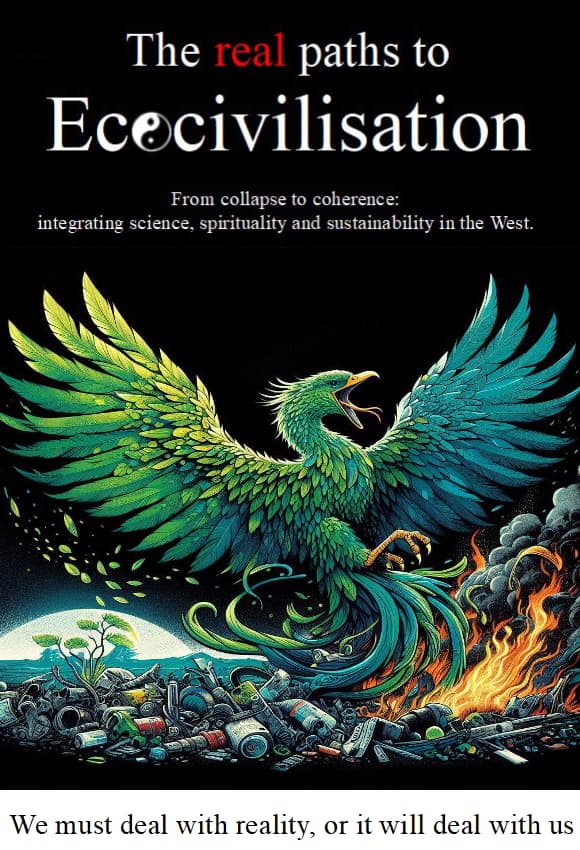
The foundation you’ve posted is very close the NED, but I the differences break it. The problem is that as things stand, science and philosophy are both stalemated around the key issues. The moment you accept consciousness exists and has causal power, we are thrown straight into the deep end of the biggest arguments in analytical philosophy. Unless I can show that I have a radical new way of resolving those arguments, then the NED just dumps us in the middle of those unresolved arguments…and there is no escape from them apart from 2PC. That is why The Real Paths to Ecocivilisation took me 20 years to get right: I had to write about both the metacrisis and ecological collapse and the science/spirituality conflict in modern Western history. It was no use writing about one of those things and not the other, because the two issues critically intersect if we’re talking about re-constructing the foundations of Western civilisation in a radically new way.
This is only possible if the physicalists are willing to accept that the hard problem of consciousness is real and the anti-physicalists are willing to accept that brains are necessary for consciousness. But the moment you accept those two things then, according to the current state of philosophy of mind and evolutionary biology, you got a massive problem, and it is the exact problem Nagel wrote about in Mind and Cosmos: the only way to save naturalism (or avoid theological supernaturalism) is to accept that consciousness evolved teleologically. But HOW?? Nagel’s version is fundamentally incomplete, because he did not integrate with quantum mechanics. And the moment you actually do try to integrate with QM, you are forced towards Henry Stapp’s re-interpretation of “consciousness causes collapse”. Leaving the question: how can you integrate Nagel and Stapp? And the answer is the Two-phase Cosmology. No other answer will work, and without that answer nobody in the scientific community will take any of this seriously: they will just contine to dismiss Nagel, dismiss Stapp and refuse to accept that their work could possibly be connected. Nothing will change.
Then, within that foundation, there can be a second conversation about whether synchronicity, praeternatural causality, teleology, and metaphysical freedom are real in the stronger sense you describe.
The teleological evolution of consciousness and free will cannot be negotiable, because they are essential parts of the basic structure of 2PC. Everything else (except the hypernatural) is left open by Principle 6 of the NED. 2PC does not close that at all. The part about meaning and synchronicity is (Extended Competition-resolved Collapse) is optional. The skeptics can reject it.
The New Epistemic Deal should not ask everyone to agree on spirituality, metaphysics, or the praeternatural.
It must ask agreement to sufficient extent to ensure 2PC is taken seriously. We need the new interpretation of QM, which opens the door to the resolution of all 30 problems, including the scientific explanation of consciousness, quantum gravity and the entire crisis in cosmology. Without that there is no viable path forwards, because the whole project will just get sucked backwards into the existing philosophical-scientific stalemate which is the old paradigm.
Bottom line: without 2PC, the NED is impossible to defend, because everybody will just go back to their entrenched old-paradigm positions. The purpose of 2PC is to conclusively and irreversibly end the philosophical stalemate we are currently trapped in.
I provided a short list of postulates that constitute a minimal starting point for agreeing about reality to such a degree that we can agree on what needs to be done. It seems your contention is that we must agree on ALL of the points of a metaphysics framework - specifically, yours - before this can be effectively done. That’s a nonstarter, and a strategic error, in my opinion.
The key question you should consider: Suppose someone else suggested another sort of “Epistemic New Deal”, and also stipulated that following it would require agreement on what constitutes reality? This would be a nonstarter for you, no? Then what you propose is a nonstarter for anyone else.
You are saying it is a strategic error because you are thinking “nobody will agree to this”. I am trying to get you to understand that the very fact that nobody will agree to it even though it resolves the 30 biggest problems in science and philosophy IS the problem.
I hope I can just be direct here. The strongly suspect that real problem is that you, personally, aren’t willing to accept 2PC, because it is inconsistent with your own existing metaphysics. If so, then this is just a perfect demonstration of why my task is so difficult. Very few people are interested in the truth, and that includes you. Why am I saying that? Because you really aren’t interested in understanding 2PC – you aren’t interested in understanding why I keep claiming it must be true. Every time I say that, you think “How arrogant. He thinks he knows the truth. Why is his truth (2PC) any better than my truth? [idealism? panpsychism? I am only guessing…]”.
This is exactly why it is necessary for people to understand 2PC (its basic structure), and why it is necessary for them to accept it as actually the correct answer. Without it, you will continue to believe idealism is true, the physicalists will keep defending physicalism, and we will remain trapped in the old paradigm stalemate.
You intepret this as me being arrogant, stubborn, overestimating my own capabilities, and generally not willing to accept I might be wrong. None of these things are actually happening. The truth is I am defending the only position which can actually unlock the path to the new paradigm. I cannot back down without ruining the only solution which actually works.
The key question you should consider: Suppose someone else suggested another sort of “Epistemic New Deal”, and also stipulated that following it would require agreement on what constitutes reality? This would be a nonstarter for you, no? Then what you propose is a nonstarter for anyone else.
And with that statement all becomes clear. You do not understand my justification for claiming 2PC is the one correct answer, having made no serious effort to understand that justification. You therefore still think in terms of my truth vs your truth vs Christian truth vs physicalist truth. You aren’t remotely interested in the actual truth itself. If you were, you would have made the effort to understand my justification for claiming 2PC is true. It would take you 15 minutes to load the entire text into an AI and interrogate it about this, but you have chosen not to do so.
EDIT: I did not answer your question. Would I accept it? Answer: if their system could solve the same 30 problems as cleanly as 2PC does then I would. However, that is impossible, because there cannot be two solutions which both solve the same 30 problems.
THAT is the old paradigm.
I can see no way forwards for this discussion without you engaging properly with the metaphysics and cosmology I am proposing, and understanding why they have such enormous explanatory power: why my position is both original and revolutionary. You just flinch when I say that, because it sounds so arrogant. But you haven’t tried to find out why I am saying it.