2R Goal Tree: What is Expected?

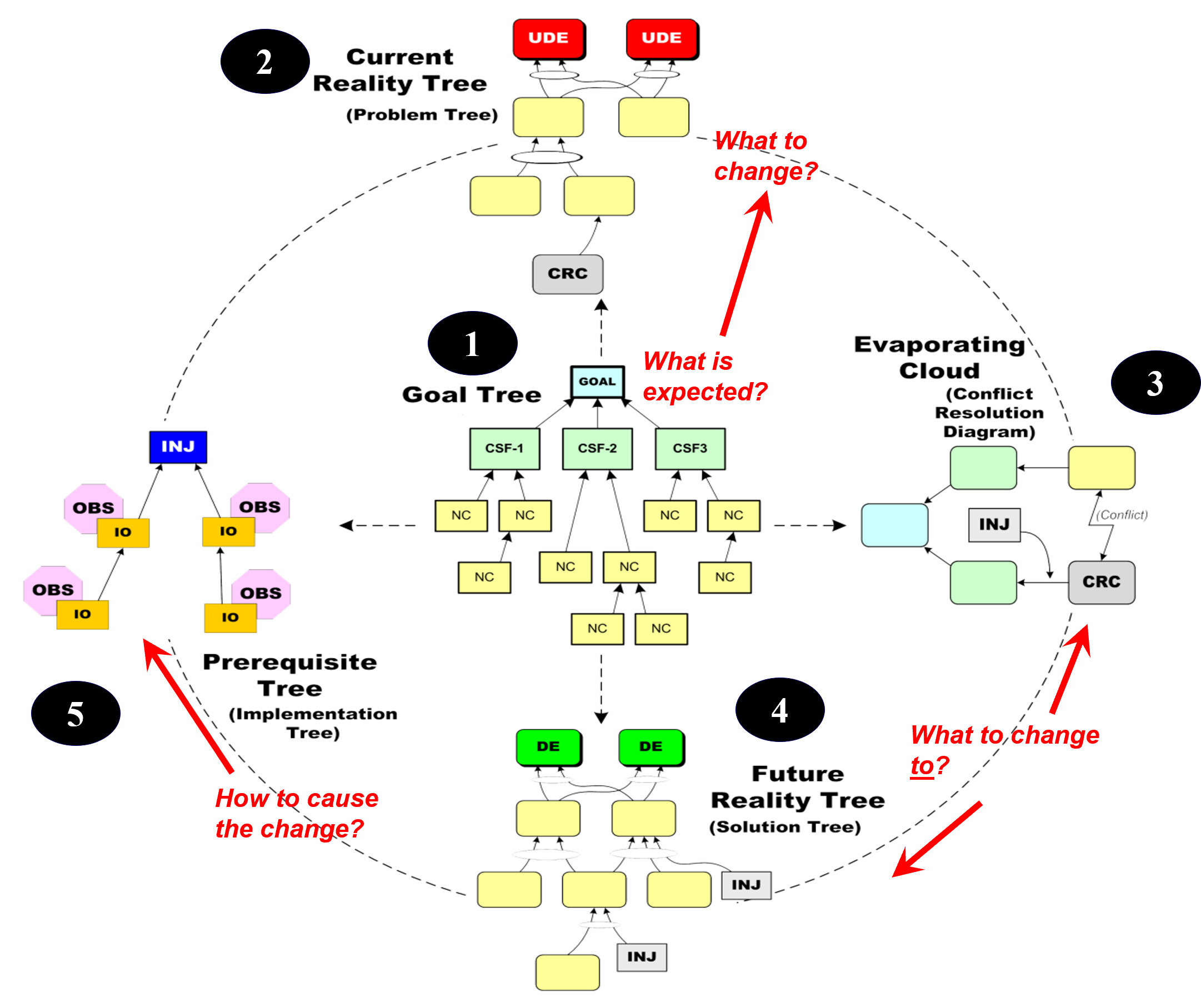
This will be the first in a series of posts concerning the Logical Thinking Process and how it can help us organize our research efforts towards a goal:

Co-initiate a Second Renaissance: a conscious transformation of foundational views, values, practices, and institutions toward a wiser, weller, regenerative civilization.

Just to keep on the same page, let’s agree that everything in the document is provisional and up for discussion/debate. If you would like to see specific changes, please comment in the document itself. If you would like to discuss details, please comment in this thread.

More LTP Threads:

The LTP is based on the Theory of Constraints, which is a framework for figuring out how to make progress towards non-straightforward goals.

Here’s something I wrote in the WA Group a few weeks back that explains the purpose of this sort of analysis:

As I see it, we can assume we have a common goal, whether or not it has been explicated well.
Then we can asssume there is some form of throughput - measurable progress towards this goal. Evidence that somehow, what we are doing will result in what we desire.
Then there is operating expense - what our efforts are costing us. This includes things like time, money, and anything else we’ve invested in interacting as we have been.
And then there’s inventory - accumulated residues of operating that tend to get in the way of throughput. For example, theories that remain theory and are not put into practice. Ideas demanding attention that do not contribute to throughput.

A bottleneck is a constraint where throughput is falling behind demand. Bottlenecks should be the focus of attention. So, if we focused our attention on producing a learning curriculum, we would effectively be saying, this particular endeavor is where supply is falling short of demand.

The danger is, choosing the wrong constraint to focus on contributes to more inventory, which decreases throughput. This is quite evident in many forum posts (e.g. the one that gave rise to the curriculum question in the first place). Suppose we try to get together a curriculum and end up debating definitions of modernity, the correct way to apply systems theory, and so on and so forth? This would be the likeliest outcomce, in my estimation, and it’s a perfect example of how a lack of goal awareness contributes to a collective endeavor missing the mark.

Be that as it may, this is all relative to the stated goal. If our goal is to talk a lot, and debate theories, then we have a lot of throughput, and we should be proud of ourselves.
2 Likes

Really excited to see this :clap:

If this is the overview post can you link to the relevant related posts?

1 Like

This reply is on the Goal Tree document, specifically. (I already posted replies on other documents in other threads.)

I’m fine with section CSF 1 — Shared Diagnosis of the Civilizational Crisis. It’s kind of a word cloud, not a tightly argued web of mutually reinforcing concepts, but good enough for now.

On the next section, CSF 2, I like this introductory statement: “The Second Renaissance must offer an attractive “pull factor”: a desirable future strong enough to motivate commitment, imagination, and experimentation.”

Now I shall wax metaphysical! I don’t think it’s the job of 2R to create the “pull”. It’s the job of 2R to align with the “pull” that was cosmically established in ancient days and draws the universe itself forward towards its mysterious denouement. My self-understanding is that I got “pulled” in such a manner a few years ago into the whole liminal web business (of which I had no prior knowledge at all) and as a condition of entry to that world (a condition in some sense “given” to me, not rationally constructed at all), is that I am to stay far, far away from exploitative marketing strategies to “sell” dubious content for purely profit-driven purposes. So to me, the needed 2R “pull” is not a marketing strategy. It’s more like spiritual alignment.

Which leads us to CSF 3.

CSF 4 is skillful means for CSF 3. CSF 5 is taking all that to scale. CSF 6 is why I waxed metaphysical a moment ago.

CSF 7 is where my personal motor really starts running! This is basically the professional/technical wing of 2R, or its integrated theory/practice program. Anyone want to go there right this minute? Let’s go there!

CSF 8 is the geopolitical and species-level context for CSF 7. This ain’t the Ivy League, and we ain’t training people for dinner parties and fancy board rooms. I see us more like doing what Gandalf did for the Hobbits to get them ready to march on Mordor. Go ahead and tremble for the future! But steel yourself to slog through chaos anyway!

Very much agreed, and this is one of those points that is often overlooked by theoreticians and would-be entrepreneurs everywhere. Long story short, no one cares about your theory of everything or your world changing idea (speaking from experience). The real test is: does your idea align with pull forces? What pulls it into existence? As I’ve commented before, Bitcoin’s success in becoming mainstream can be thought of as a push phenomenon–i.e. the properties of the tech itself made its rise inevitable–or as a pull phenomenon–i.e. the needs of the world, post global financial crash, gave rise to enhanced awareness around the problems of centralization and so on. The pull view is simply more correct, and we ought to first care about aligning ourselves with real needs–not advocating for beautiful solutions that need to convince.

Last summer I drafted a lengthy essay to create a framework for balanced treatment of cultural materialism and cultural idealism in macrohistory. To get all that down out of the academic clouds, the structure I went with was the material “push” in tension with the spiritual “pull”.

For the material “push” I basically went with UTOK’s summary of the energy-emergence-complexity story that is getting told by many authors nowadays. In a nutshell, everything complex is the result of anti-entropic systems emerging from energy gradients and efficiently managing entropic dissipation. To give a down-to-earth example - waking up hungry in the morning is a material “push”. It’s your bio-body telling you “get me some calories!”. In the paleolithic, that would have involved gathering or feeding off of leftover hunting kill. Nowadays, there are complex international supply chains involved with putting boxed product into local stores who hand over the goods for plastic and internet codes. Same “push”, different complexity due to systemic cultural evolution on the technical-material plane. On that level, yes Bitcoin got “pushed”. There is a heavy hunter-gatherer vibe in that world.

Brendan Graham Dempsey (very UTOK-affiliated) leans into the “push” so hard he wants to make God Himself one of those energetic emergences. In that view, the universe is rolling its own Telos - making up destiny as it goes along, so to speak. I’ll accept his analysis with one extremely important refactoring. For Dempsey, “God” is emerging. For me, “God talk” is emerging. My sense of the divine is where this all comes from in the first place, what keeps feeding it in every moment, and where it is headed as its ultimate goal. That view comes to me from spiritual traditions the world over. The diversity of those spiritual traditions is a function of the “push” that pushed paleolithic indigenous all over the planet (for breakfast finding), separated them, and diversified their cultural framings. The unity of those spiritual traditions comes from navigating the same metaphysical ambient with common alpha-omega existential questions for all humans of any era or any station. Why did evolution want intelligent apes with tools, of all things? To do the work it wants done, I would argue.

So I came to 2R because I was restless - feeling a lot of “push” to get away from annoying cultural factors that were screwing with my sense of well-being in the world. Possibly even threatening breakfast access, in the extreme. But what drew me to 2R specifically was the spiritual “pull” to go where I am meant to do the work the universe made me to do. Among other things, that involves setting up shop on a platform substantial enough to correct what I see missing in UTOK, Integral, and Brendan Graham Dempsey.

As explained in this post, I’m making an update to the Goal Tree:

6.7. Shared strategic artifacts are governed as living, revisable commons, with clear processes for challenge, update, stewardship, and provisional adoption.

Hello @dvdjsph Thank you for directing me here.

As I mentioned I think your pattern and the one I was trying to describe are pointing in a similar direction I think there are many words and concepts labels for this.

This zettel from my zettelkasten comes to my mind for example:

# The Ancients Decoded Reality

- #tags: #rumi #everything_is_connected #history #perception

- https://www.youtube.com/watch?v=ADYdypHZb2A

- 1. you are not separate; you never were, never could be

- 2. fear is illusion; love is truth

- 3. the mind is not a camera; it is a projector

- 4. the enemy is not the world; the enemy is the ego

- 5. everything is connected

@rufuspollock probably remembers this:

Inner Change - Cultural Change - System Change

In a funny twist this loop is of course also related to @Mars - upgrade post.
It is very difficult to talk about these things in text but I will try. In mars post, I mention the “peaceful world change prompt”

Let me quote Marvin Minsky: you dont’ understand something if you understand it only in one way. So I will try to explain these things using multiple examples.

So this loop IS also the peaceful world change prompt in that it represents an attempt for improving the situation in a peaceful way but for many perspectives. Youval Noha Harari speaks in his book spapiens, the last few sentences/paragraphs: What do we want - to want.

It is a kind of Meta(computer science) thinking that is very difficult to do individually and gets even more complicated when you expand this principle to larger groups of people. Also because it touches on things like identity.

Daniel Schmachten berger had a time where he used the term: omni consideration. I tried to find sources for that for now I can only point to an example like this:

https://shows.pippa.io/futurefossils/episodes/51

or this:

If you find better sources please share!

Good so we have now created a loop in which still fits to the model: individual → groups of people (small , < dunbars number?) → largest groups of people( countries, continents?)

There are also multiple effects working here. For example we might say:

What if all the AI resources in the world tried to ask that question:

How to do a peaceful world change prompt?

There can of course not be a single answer, we still would need to start from change points of the individual. One of the Questions that then arrises:

How can we go from individual to group?

Many communities on earth still can do this, but “atomized” individuals in urban centers largely have lost this abilities for reasons.

In my [Social Media - Digital Developmental Spaces] and The Story of Predictive History 1(Social Media - Digital Developmental Spaces - #2 by curious_reader)

Post I hint to interesting examples of how people tried to apply - the loop -
Predictive History failed, maybe , but also there are interesting ways to infer from it.

Chat as minimum viable - anything- is a interesting resource to read here( see Social media post)

I also think that the Atproto Community tries - more or less unconsciously - to create such a positive loop. As I described I see semble as one of the very important projects.

And this gives us hints to another property of the loop pattern:

Doing it openly and digital can help create resonance and cohesion.

I also mentioned the akasha weco video. in that Video laurence just described what I here but into my words, with weco they tried to create a space in which people could create their own online spaces from which they eventually would go to offlince spaces and experiments in governance models.

Governance and Technology , its a tricky thing but resources like this could help: https://plurality.net/

roomy and semble for now just work on data and access,

weco already had the idea that with resonnace people could experiment with governance. Maybe there are already projects like this in the AtProto space.

The Glassbead game an DreamTalk play an important role here for creating resonance.

I hope this makes some sense to you.

BTW this article goes into similar directions We May Be Entering A Second Axial Age - NOEMA