Just to keep on the same page, let’s agree that everything in the document is provisional and up for discussion/debate. If you would like to see specific changes, please comment in the document itself. If you would like to discuss details, please comment in this thread.
This is another big one, so I’ll go with that old grad school trick of quoting the introduction and the conclusion. Depending on how the discussion goes, we can later circle back to details in the middle!
Objective
OBJECTIVE:
A functioning Second Renaissance operating system exists.
Meaning:
The group can reliably convert interest into practice,
practice into contribution,
contribution into facilitation,
facilitation into pockets/sangha,
and pockets/sangha into replication and wider movement influence.
…
The key dependency chain
The most important sequence is probably this:
Define throughput ↓
Create consent-based entry pathway ↓
Offer recurring practice ↓
Move practitioners into contribution ↓
Train contributors into facilitators ↓
Use facilitators to host dense containers ↓
Stabilize pockets and sangha ↓
Document what works ↓
Replicate mature patterns ↓
Build movement and institutional influence
On the “Objective” section above, I like idea of a 2R operating system. That has both literal and metaphorical resonance for me!
This funnel looks right to me:
- The group can reliably convert interest into practice,
- practice into contribution,
- contribution into facilitation,
- facilitation into pockets/sangha,
- and pockets/sangha into replication and wider movement influence.
What a lot of people are going to find glitchy or problematic is the idea of “practice”. We have not exactly laid down a 2R 8-fold path or anything like that, really! “Practice” at this point feels very plural - very “practices”. One “practice” I would like to encourage is personal perspective sharing - give a snippet of autobiography or “how this worked in my case” for any idea that is being put forward. Prefer the embodied personal to the disembodied abstract. That process, by its nature, will catalyze a practice POV. As for the rest - contribution to facilitation to pockets to replication - it’s basically a well known technology adoption lifecycle model with a heavy trainer of trainers vibe. I don’t see any need for widely creative innovations here - just a lot of grunt level execution, and very critically, the passion and desire to push through all that execution.
Moving to the “key dependency chain” section, the very first point - “define throughput” is likely going to have a lot of people all tied up in knots! We’re not exactly Adam Smith’s pin factory, after all! My take is, we’re basically in the education business, with a special focus on R&D and training for cultural transformation. The “throughput” is raw information to workable ideas, along with a parallel throughput of people unfamiliar with any of it to advanced theorists and practitioners of all of it. We’re a school. Without the stupid stuff like grades and tuition. If you buy what I selling about 2R being a “school”, then the rest of the key dependency chain is literally educational administration, a vertical in which I have both formal credentials and years of experience. Again, there is no wheel to reinvent here. Just wheels to put our collective shoulders to!
1 Like
I agree, and I see this as a good thing. It’s akin to the tension one feels when asked “well, what does this positive change you’d like to see actually look like practically? How would you know it when it happens?”
The fact that this dependency chain exists means it puts some burden on us (or at least those of us who find value in this methodology) to address this as the primary bottleneck. And yet, ruminating on this very point has led me to reconsider whether this dependency chain is well-conceived.
If we were to start defining throughput and jumping into this set of tasks, we’d be implicitly affirming this tree’s validity, and all of those that led up to it. However, we don’t really have a way of testing the trees’ validity and updating them if we find flaws in them.
This was apparent from the very first meeting; @rufuspollock offered some revision suggestions, and Margaret also questioned some points. Now what? Since I’m the trees’ creator, should I get to decide whether or not to make those changes? Should Rufus decide? If these trees organize our R&D in the future they will be very consequential, so one or two points of failure wouldn’t be in line with what we profess to believe in.
This got be to thinking: perhaps the very first point in the dependency chain should be, decide on how these trees get updated.
So I made some changes to the Prerequisite Tree (redundantly I might add that I don’t anticipate making any more updates unilaterally!)
Decide how the trees get updated
** ↓**
Validate and revise the trees enough for provisional use
** ↓**
Define throughput
** ↓**
I will make more updates to the other affected trees and post within their threads.
Sounds like a good agenda for the June 19 session!
1 Like
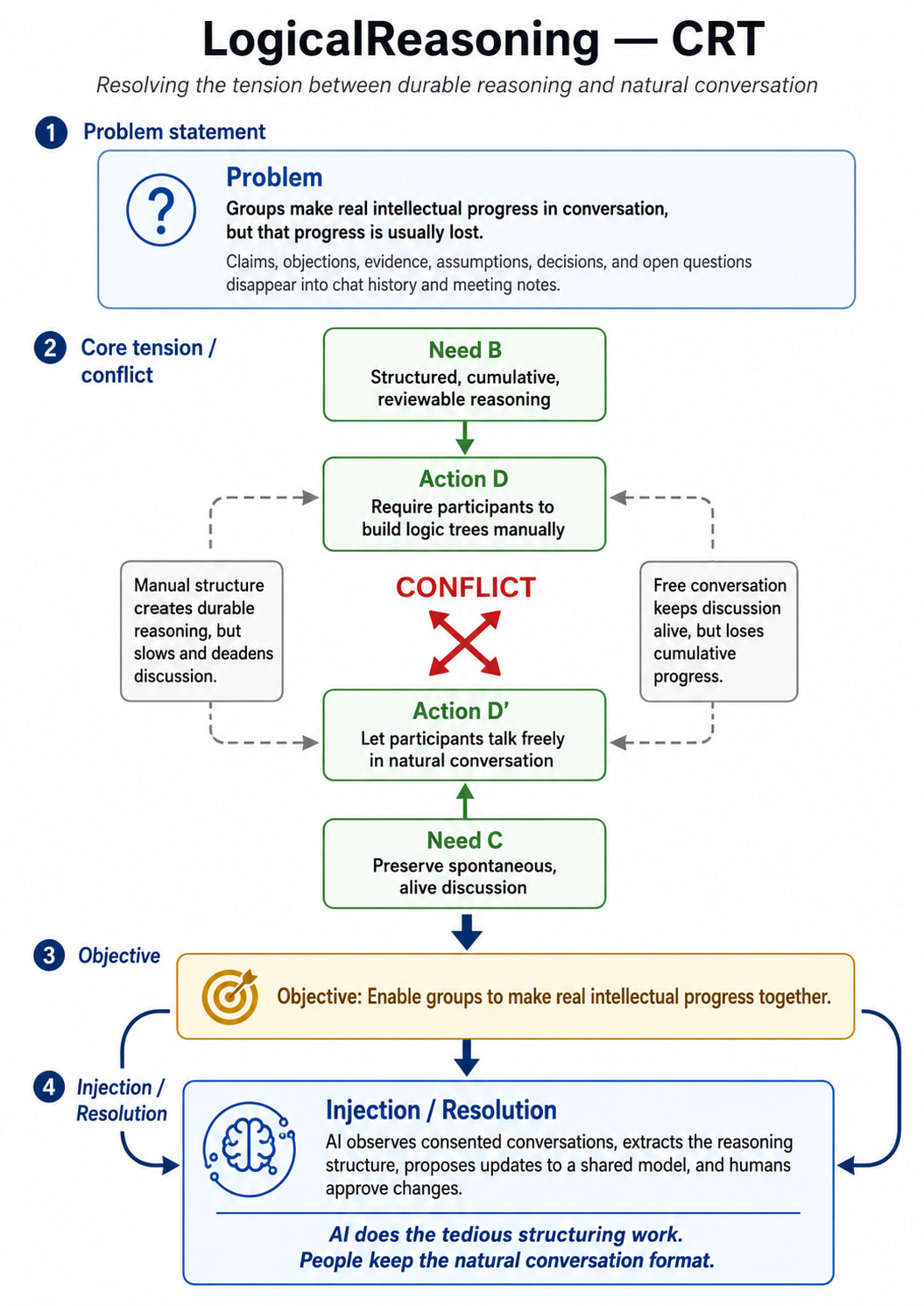
From the problem statement, “Groups make real intellectual progress in conversation, but that progress is usually lost”, I have a rather different take.
The missing link here is the relationship between group conversation and personal development. To me, the educational value gleaned from the group conversational encounter persists in the participants, even if everyone goes separate ways after the session and the group as such creates no artifacts. Most of the college classes I ever taught where like that. Yet, following my students from as far back as 20 years ago, many have grown into very responsible positions, and they give their work in school with me back in the day some credit for that.
If we can form groups that persist for extended duration, so much the better! But there can also be things to be gained from less formal encounters.
I think the key question is, progress on what? Saying that the progress is lost isn’t saying that the individuals don’t develop, it’s saying that the conversation itself often doesn’t develop.
For example, members of a certain discussion group may rightly feel they’ve “learned something” from having taken part in certain discussions - but often it isn’t about the subject itself, it’s about the group dynamic, themselves, or something meta to the discussion.
Suppose a group of researchers has a passionate discussion about a topic that seems important, and minds/stances are changes for several participants. For example, “our group needs to be politically active” is a new group charter that is adopted. But two weeks later, nothing has really changed for a variety of reasons (e.g. inertia, the cost of change, etc). Several months later, the same discussion gets taken up again, because it was important after all and the conditions that gave rise to it haven’t changed - and this is what is meant by intellectual progress for a group. It’s about the coherence of the group’s shared vision, not about the individual members’ development.
My sense is that time’s river meanders, quite a bit, with many eddies and whirlpools that look very much like all the other eddies and whirlpools. A fair number of fetid swamps to drift into as well! My main concern is to keep paddling and not get stuck in either the reeds or the rocks.
Growing a research group that persists over time is a fine objective. Sometimes it works, sometimes not. Sometimes such groups find their moment. Sometimes they fade and wither. My larger sense of “progress” makes room for all of that. Yesterday I was reading Taleb’s advice about 1/N startup investing - place similar tiny bets on N different ideas and see which ones come in big. (This only works if all the little N have some plausible nonlinear upside). So rather than investing big energy trying to make this or that research group “happen”, I prefer to knock on a lot of doors until wandering into something that really is “happening” for its own mysterious reasons. (Basically, the story of how I got involved in 2R in the first place!)
Let’s say a particular research scene is throwing off sparks. Then the question of bottling the lightening becomes very relevant. I think Weber called this the routinization of charisma. Scaling charisma is sort of my stock in trade. (If the word “charisma” attaches to me at all, it’s in that scaling arena). In your example above, I’m not really feeling the “spark”. “We need to be politically active” suggests to me the famous Star Wars phrase - “There is no try, only do!”. Energy tends to kick people in the hinter portions till they find themselves up and moving in spite of themselves. At some point they may realize they are getting pulled in political directions. But feeling the pull itself is where it all really begins. A group that keeps cycling back to aspirational ideas with no action attached is not really feeling it, IMO. If instead they were breaking bottles over each other’s heads in a rage-filled argument about which of several actions they ought to take next - now that would be lightening!